TL;DR: AI translation can turn a foreign-language product listing into an English draft in minutes, but the quality that protects your rankings and conversions comes from the workflow around the model: US keyword re-research, claim and compliance checks, unit and sizing fixes, and a native review gate on your highest-value ASINs. This guide gives you a tiered speed-vs-quality framework, a scoring rubric, and a pre-publish checklist you can run on your next batch.
Key Takeaways
- AI translation earns its keep on first drafts and catalog scale. The quality risk sits in search terms, product claims, units, and brand voice — not in grammar.
- Treat speed and quality as two separate dials, not one. Tier your catalog so hero ASINs get native review while long-tail SKUs pass through automated gates.
- Localization is not translation. Re-research US search volume and shopper intent instead of translating your source-market keywords word for word.
- Quality can be measured: score search-term coverage, claim compliance, specification match, readability, and post-launch conversion on a weekly cadence.
- Every publish needs one human checkpoint with the authority to say no. Sampled native review is far cheaper than a suppressed listing or a wave of avoidable returns.
- Speed comes from batching, glossaries, and templates. Quality comes from checklists, sampling, and a feedback loop that updates the glossary after every batch.
Table of Contents
- Why AI Listing Translation Is Really a Quality-vs-Speed Trade-off
- What Quality Actually Means in Ecommerce Product Listing Localization
- Where AI Translation Wins on Speed — and Where It Stalls
- The Real Risks of AI-Translated Marketplace Listings
- Four Workflows: Choosing Your Speed-vs-Quality Tier
- A Step-by-Step Workflow: Fast AI Translation With Quality Gates
- How to Evaluate AI Translation Quality: A Weekly Scorecard
- Localize Keywords, Don't Translate Them
- Mini Case Study: 40 ASINs Into English in Three Weeks
- How to Go Faster Without Losing Quality
- Pre-Publish QA Checklist for AI-Translated Listings
- Conclusion: Quality Is a System, Not a Model
- FAQ
- Next Steps
- References
Note on marketplaces: This guide is specifically optimized for the US market. Where we mention character limits, category style guides, or policy pages, confirm the current requirement inside Seller Central before publishing — requirements vary by category and change over time.
Why AI Listing Translation Is Really a Quality-vs-Speed Trade-off
Most sellers frame AI listing translation as a two-way choice: use AI and publish fast, or hire a translator and publish well. That framing hides where the trade-off actually sits. The variable that decides whether an AI-translated listing sells is rarely the model's grammar — it is whether anyone checked the search terms, the product claims, the units of measure, and the cultural fit before the listing went live. Speed and quality are not opposite ends of one dial. They are two separate dials that you set per ASIN, per category, and per revenue tier.
That distinction matters more in the US marketplace than almost anywhere else. The US store is usually the largest revenue pool for a cross-border seller, and it is also one of the most competitive search environments in ecommerce. The same product can be described in five perfectly correct ways, but only one or two of them match what shoppers actually type into the search bar. An AI draft that reads beautifully and indexes for the wrong phrases will look like a translation problem when it is really a keyword-research problem — and no amount of rewriting the prose will fix it.
This guide is written for sellers at every stage: a first-time seller translating ten SKUs before launch, a growing seller expanding a proven catalog, an operations or marketing manager who owns the localization budget, and a brand team coordinating hundreds of ASINs across categories. We will define what quality actually means, compare four AI translation workflows by speed and risk, walk through a step-by-step process with quality gates, and hand you a scoring rubric plus a pre-publish checklist you can reuse on every batch. Where we quote timelines or cost ranges, treat them as planning assumptions to validate against your own team's throughput — not as guarantees.

What Quality Actually Means in Ecommerce Product Listing Localization
Quality in marketplace listing translation is not a single score. It is at least five separate tests, and AI performs very differently on each one. Before you decide how much human review to budget, decide which of these five dimensions carries the most risk for the product in front of you. A silicone phone case and a children's sleep aid do not deserve the same workflow.
1. Accuracy and completeness
Accuracy covers whether the translated text says the same thing as the source: specifications, materials, included accessories, warranty terms, and dimensions. Modern AI models are strong here for straightforward product copy, but they have a known weakness — they quietly drop or soften information they judge redundant. A bullet that read "includes 2 spare filters" can survive a translation round as "includes spare filters": technically fluent, commercially wrong, and a likely cause of negative reviews. Accuracy checks are therefore about completeness as much as correctness.
2. Search-term relevance
This is the dimension AI misses most often, because it is not a translation task at all. Translating a German or Japanese keyword literally gives you a correct conversion of a phrase that US shoppers may never search. Quality here means the listing uses the terms with demonstrable US demand in your category, placed where Amazon's index actually reads them: the title first, then bullets and the product description, then the backend search-term field. You can publish a flawless English translation and still be invisible — and the fix belongs to keyword research, not to the language model.
3. Compliance and claim safety
Amazon's listing policies, restricted-product rules, and advertising claim standards apply to the English text you publish, not to the language you started from. AI will faithfully translate an aggressive claim — "cures", "clinically proven", "best in the world", "FDA approved" — into equally aggressive English. Compliance quality means every claim in the final listing is substantiated, permitted in the category, and phrased in a way that survives review. In regulated categories, this single dimension should determine your entire workflow.
4. Cultural fit, units, and sizing
English is not one market. US shoppers expect inches and pounds alongside or instead of metric units, US-style apparel and shoe sizing, familiar date formats, and category-specific vocabulary — "flashlight" rather than "torch", "crib" rather than "cot", "stroller" rather than "pushchair". Cultural fit also covers imagery conventions and seasonal references. AI will usually convert units when you explicitly ask, but it does not reliably know which conventions your specific category depends on, so this belongs on a checklist rather than in a prompt.
5. Conversion readability
A listing can be accurate, compliant, relevant, and still unreadable. Conversion quality is about structure: a title that front-loads the value proposition, bullets that lead with the benefit, and description paragraphs that scan well on a phone. AI tends to produce uniform, encyclopedic sentences, and uniformity is what makes listings forgettable. Strong listings are uneven on purpose — short line, specific detail, benefit, proof.
| Quality dimension | What good looks like | Where AI typically fails |
|---|---|---|
| Accuracy & completeness | Every spec, accessory, and warranty term survives the round trip | Drops "redundant" details; smooths over ambiguity |
| Search relevance | Uses high-demand US terms in indexable positions | Literal keyword translation with no demand data |
| Compliance | Claims are permitted, substantiated, and category-safe | Translates an unsupported claim into perfect English |
| Cultural fit & units | US units, sizing, and vocabulary conventions respected | Keeps metric-only specs or foreign category terms |
| Conversion readability | Scannable structure, benefit-led bullets, mobile-friendly length | Uniform, dense, feature-first paragraphs |
Where AI Translation Wins on Speed — and Where It Stalls
AI's genuine advantage is not that it translates better than a professional translator. It is that it removes the blank page. A single model call can produce a title, five bullets, a description, and a set of backend search terms in the time it takes to open a spreadsheet. For a seller with 60 SKUs and one quarter to establish a US presence, that is the difference between a project and a possibility.
Concretely, AI is fast and dependable at first-draft translation of factual copy, shortening long source bullets into scannable English, converting units when explicitly instructed, generating tone variants of the same product, translating attribute values at catalog scale, and enforcing a consistent structure across hundreds of SKUs. It is also excellent at the work nobody wants to do: rewriting the same 30-word specification block 200 times without losing patience.
Where AI stalls is at judgment. It cannot tell you which US search term deserves a place in the title. It cannot decide whether a claim is permissible in a supplements or children's product category. It cannot hear that a sentence sounds machine-written, and it cannot tell you that your source listing is out of date — it will faithfully translate a 2019 spec sheet into fluent 2026 English. Those four gaps are exactly where your review budget should go.
| Task | AI-only | AI + QA gates + sampled native review | Fully human |
|---|---|---|---|
| 10 SKUs, first English draft | Hours | 1–2 days | 1–2 weeks |
| 100 SKUs, first English draft | 1–2 days | 1–2 weeks | Weeks to months |
| US keyword localization | Not reliable | 1–2 days per batch with research tools | Days per batch, higher cost |
| Claim and compliance review | Not reliable | Same day with a checklist | 1–3 days |
| Native polish of hero SKUs | Not reliable | 2–5 days for a focused set | 1–2 weeks |
Time ranges above are illustrative planning estimates for a small team, not benchmark data. Measure your own throughput on a pilot batch of five SKUs before you commit to a launch date.
The Real Risks of AI-Translated Marketplace Listings
The risks of AI-translated listings are less dramatic than the horror stories suggest, but they are often more expensive than sellers expect, because they fail quietly. Nobody files a complaint about a listing that is simply invisible. Below are the failure modes worth designing against, roughly in order of how much money they cost.
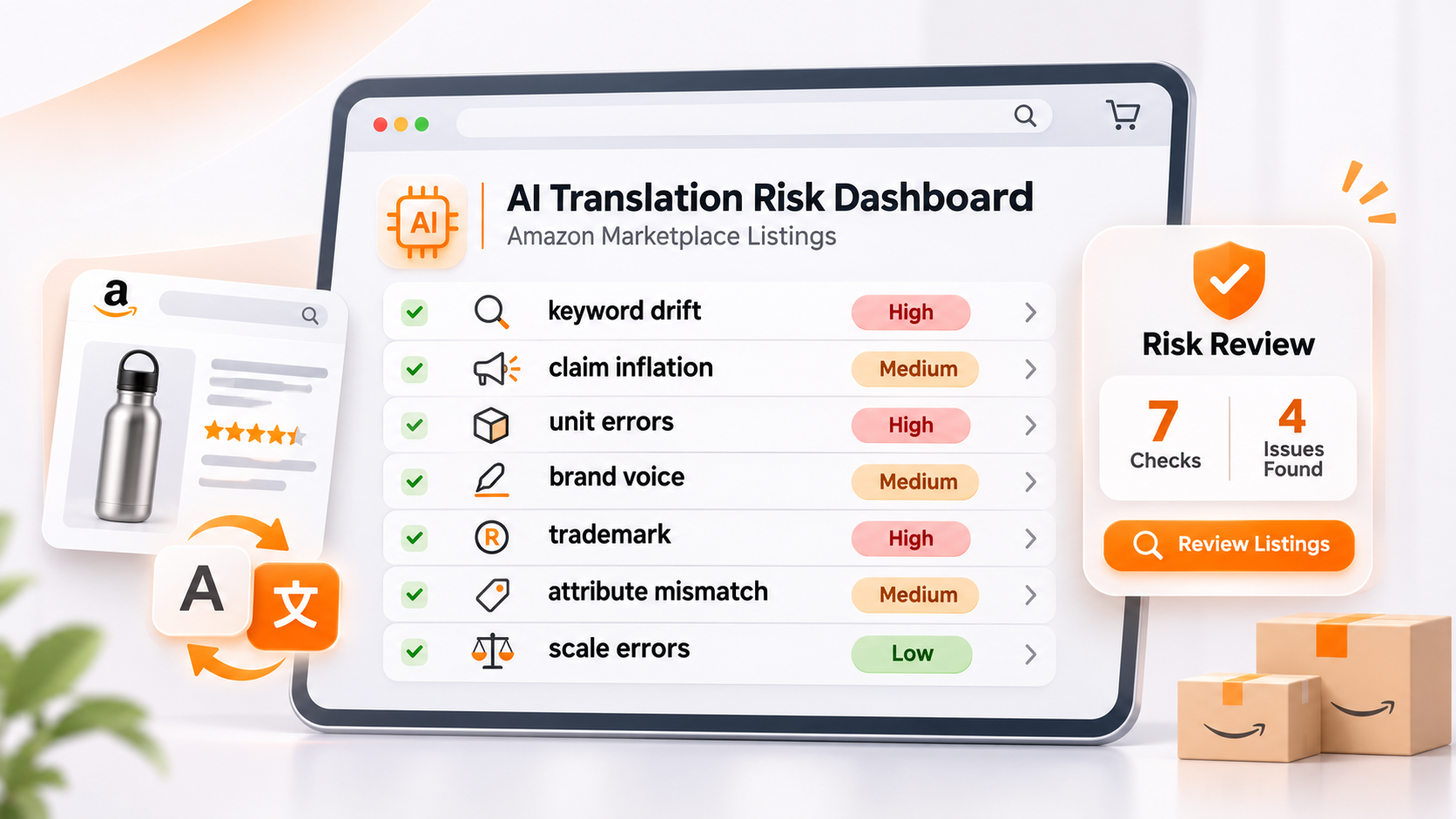
1. Keyword drift and invisibility. The most common failure is also the least visible. The English reads well, the bullets are clean, and the listing still does not surface for the phrases that convert in your category. Because there is no error message, sellers conclude that "AI translation doesn't work" when the real gap is the absence of a US keyword research step. If you fix only one thing after reading this guide, fix this one.
2. Claim inflation and policy exposure. Models preserve emphasis. If your source listing leaned on superlatives or implied health outcomes, the English version will lean on them just as hard — and now they sit under US advertising standards and Amazon's claims policies. This is where a fast workflow can turn into a suppressed listing or a legal review. Any listing in supplements, medical devices, children's products, pesticides, or batteries deserves a dedicated compliance read.
3. Specification and unit errors that become returns. A decimal point moved, a centimetre value left unconverted, an "includes 4 pieces" rendered as "includes pieces" — these are small text errors with a direct line to return rates and one-star reviews. In categories like furniture, cookware, apparel, and tools, unit errors are not cosmetic; they are the difference between a shopper buying and a shopper returning.
4. Brand-voice flattening. AI produces a recognisable register: evenly paced, cautious, and slightly generic. A brand that spent years building a distinct tone will sound like everyone else after a raw AI pass. For a private-label brand with premium positioning, that is a margin problem, not a style preference. This is one of the strongest arguments for human review of at least your hero SKUs and your A+ content.
5. Trademark and brand-name mishandling. Brand names, model numbers, and trademarked terms should never be translated, and competitor brand names should never be introduced for keyword purposes. AI does not know which of those words are legally sensitive. Maintain an explicit do-not-translate list and review it whenever the catalog changes.
6. Attribute and variation mismatches. Amazon listings are structured data as well as prose. Category-specific attributes, variation themes, and field limits differ by marketplace and category. AI can write a beautiful description while leaving a required attribute blank or a variation name inconsistent, which can affect how the listing displays and filters. Always re-check the catalog fields, not just the copy.
7. Errors at scale with no feedback loop. The single-SKU error is annoying; the same error repeated across 200 SKUs is a systemic problem. Without a glossary, a checklist, and a review sample, a mistranslated term or an over-claim multiplies silently. Build the feedback loop before you scale the batch size, not after.
Four Workflows: Choosing Your Speed-vs-Quality Tier
The practical answer to "AI translation quality vs speed" is that you do not pick one setting for your whole catalog. You assign a tier to each ASIN based on its revenue contribution, its regulatory exposure, and how much of your brand promise it carries. Here are the four tiers most sellers end up using.
Tier 1 — Raw AI draft, publish as-is
Fastest and cheapest. Best reserved for low-risk, low-traffic SKUs with factual, spec-driven copy: replacement parts, basic accessories, non-regulated home goods. Even here, run a keyword relevance pass, because speed without search terms produces traffic-free listings. Accept that this tier is a volume play, not a brand play.
Tier 2 — AI draft plus automated checks
The sensible default for most of a long-tail catalog. Add a machine-checkable layer on top of the draft: banned-word and restricted-claim scanning, unit and dimension verification against the source spec table, character-limit and formatting checks, and a spelling pass with a US-English dictionary. This tier catches the mechanical errors and leaves judgment calls to the next tier up.
Tier 3 — AI draft plus structured QA plus sampled native review
Our recommended default for growing sellers and brands. The full QA checklist runs on every SKU, and a native-level US English reviewer reads 100% of hero SKUs plus a random sample of the rest. The sample is the key: it keeps cost predictable while giving you an early-warning system for glossary problems. Editing an AI draft — sometimes called machine translation post-editing — is typically faster and cheaper than translating from scratch, because the reviewer corrects rather than composes.
Tier 4 — Full human transcreation
Slowest and most expensive, and the right call for a small number of situations: regulated categories, premium brand launches, products with legal warranty language, and any listing where a single wrong claim could trigger a suspension. A useful rule of thumb is to spend this budget on the 10–20% of ASINs that generate the majority of revenue and risk.
| Tier | Best for | Relative speed | Relative cost | Main residual risk |
|---|---|---|---|---|
| 1 — Raw AI | Long-tail, non-regulated, spec-driven SKUs | Fastest | Lowest | Keyword drift, tone mismatch |
| 2 — AI + automated checks | Bulk catalog expansion, mid-tier SKUs | Very fast | Low | Subtle claim or nuance errors |
| 3 — AI + QA + sampled native review | Growing sellers, hero SKUs, brand catalogs | Fast | Moderate | Sampling misses a one-off error |
| 4 — Full transcreation | Regulated, premium, or high-liability products | Slowest | Highest | Cost and calendar time |
A Step-by-Step Workflow: Fast AI Translation With Quality Gates
This is the process we recommend for most sellers entering or expanding in the US marketplace. It is designed so that speed comes from batching and standardisation, while quality comes from a small number of non-negotiable checkpoints. If you are still building your broader AI stack, the AI for Amazon FBA guide covers the surrounding automation decisions in more depth.
Step 1 — Freeze the source of truth. Before translating anything, confirm that the source listing is current. Update the spec sheet, remove discontinued variants, and reconcile the copy with the actual product. AI will translate whatever you give it, including mistakes you have been meaning to fix for two years. One hour of source cleanup saves ten hours of downstream review.
Step 2 — Build a glossary and a do-not-translate list. Include product-specific terms, materials, proprietary feature names, brand names, model numbers, and the approved US spelling of anything contested. Include forbidden terms too: claims you cannot make, competitor brands, and words that trigger category restrictions. A living glossary is the single highest-leverage artifact in the entire workflow, because it converts repeated human judgment into a reusable rule.
Step 3 — Tier the catalog before you translate. Sort SKUs into Tier 1–4 using revenue share, regulatory exposure, and brand importance as described above. This one decision determines your budget, your timeline, and how much review capacity you need to hire for. Translating everything at the same standard is how localization projects double in cost and slip a quarter.
Step 4 — Prompt with constraints, not requests. Weak prompts produce generic listings. Give the model the target audience, the US marketplace context, the category conventions, the character limits (commonly cited as up to 200 characters for titles and around 500 per bullet in many categories — confirm your own category's style guide), the glossary, and an explicit instruction to preserve all numeric specifications exactly. Ask for structured output: title, five bullets, description, and backend search terms as separate fields so you can drop them into the listing tool without manual parsing.
Step 5 — Run automated gates. Before any human reads the draft, let a script catch the mechanical failures: restricted and prohibited claim phrases, missing or changed numbers compared with the source spec table, metric-only measurements that were not converted, character-limit overflows, unapproved brand names, and misspellings flagged by a US-English dictionary. Each gate you automate is a review hour you get back.
Step 6 — Native review, sampled on purpose. A native-level US English reviewer should read every hero SKU in full and a random sample of the rest — commonly 20% of new listings or ten SKUs per batch, whichever is larger. Ask them to flag issues by category (keyword, claim, unit, tone, clarity) rather than simply fixing them, so that patterns surface and get pushed back into the glossary.
Step 7 — Publish in waves and watch. Do not upload 200 listings on a Friday. Release in batches of 10–25, monitor impressions, click-through, conversion, and returns for two to four weeks, and hold the next batch until the first one looks healthy. Wave publishing turns a potential catalog-wide error into a controllable experiment.
Step 8 — Close the loop. Every batch produces lessons: a term that should have been in the title, a claim that slipped through, a unit conversion the checker missed. Route those back into the glossary, the prompt template, and the gate scripts. Sellers who do this see review time fall batch over batch. Sellers who skip it pay the same review cost forever.
How to Evaluate AI Translation Quality: A Weekly Scorecard
You cannot manage translation quality if your only metric is "it looks fine to me". Build a simple scorecard and run it weekly for the first month after a launch, then monthly. Score each metric on a 1–5 scale, weight it according to your business model, and track the trend rather than the absolute number — the trend tells you whether your glossary and gates are working.
| Metric | How to measure it | Suggested weight |
|---|---|---|
| Search-term coverage | Share of your priority US keywords present in the title, bullets, and backend field | High |
| Claim compliance | Number of flagged claims per listing, with a target of zero unresolved | Critical |
| Specification match | Percentage of numeric values and units matching the source spec sheet | High |
| Readability | Average sentence length, bullet length, and mobile preview check | Medium |
| Native-review flags | Issues found per 1,000 words reviewed, by category | Medium |
| Post-launch performance | Conversion rate, return rate, and search-term ranking versus the pre-launch baseline | High |
Two practical tests sit underneath the scorecard. First, an indexation check: search your priority keywords in the marketplace and confirm the listing appears for the terms you deliberately targeted. Second, a controlled comparison: on a few comparable ASINs, publish one AI-only version and one reviewed version, then compare click-through and conversion over a four-week window. Keep the comparison fair by holding price, images, and advertising constant — otherwise you will attribute an ad-spend change to translation quality. For a related look at how automated writing compares with human editing, see our breakdown of AI writers vs. SEO editors for Amazon listing optimization.
Localize Keywords, Don't Translate Them
Translating keywords is the most common and most expensive mistake in marketplace listing translation. Translation moves meaning; localization moves demand. A literal English rendering of your source-market keyword may be perfectly accurate and completely unused by US shoppers, because search behaviour is shaped by category vocabulary, regional habits, and the terms competitors have trained the market to use.
The reliable process has five moves. First, use AI to generate candidate English concepts from your source keywords — not as final keywords, but as a starting vocabulary. Second, run those candidates through US keyword research to see actual search volume, competition, and related terms. Third, filter ruthlessly for relevance: a high-volume term that describes a different product will bring traffic that never converts. Fourth, map each selected term to a placement — the title for your primary phrase, bullets for secondary and long-tail phrases, and the backend search-term field for synonyms, spellings, and translations shoppers might type. Fifth, verify with an indexation check a week or two after publishing.
This is where a research tool earns its place in the workflow. SellerSprite's keyword research and reverse-ASIN data let you start from real US demand rather than from a guess, and compare your draft against what already ranks in your category. If you are building the surrounding process, the AI for Amazon FBA guide explains how keyword data connects to sourcing, advertising, and listing decisions. The same discipline applies to print-on-demand and licensed merchandise, where title conventions and trademark rules are unusually strict — see our notes on promoting Amazon Merch on Demand listings.
Mini Case Study: 40 ASINs Into English in Three Weeks
Illustrative composite. The scenario below combines common seller workflows to show how the tiers work in practice. The figures are planning assumptions, not measured results, and should not be treated as a performance guarantee.
Imagine a European home-goods seller with 40 ASINs, a two-person marketing team, and a three-week window before a US launch. Their first instinct was to run all 40 listings through a translation model in one afternoon. Their second instinct — after realising that none of the drafts used the terms US shoppers search — was to build a process.
In week one, they tiered the catalog: 8 hero SKUs (roughly 70% of projected US revenue), 14 mid-tier SKUs, and 18 long-tail accessories. They built a 40-term glossary covering materials, care instructions, and measurement conversions, plus a do-not-translate list for brand and model names. They also pulled US keyword data for the hero SKUs and discovered that two of their literal translations had almost no search demand while an alternative term carried most of the category's volume.
In week two, they generated drafts in batches of ten using a constrained prompt template that specified US English, the character limits, the glossary, and an instruction to preserve all numeric specifications. Automated gates caught 31 unit inconsistencies, 12 character-limit overflows, and 6 claim phrases that were not permitted in the category. Each fix was made once in the glossary or template and applied across the batch.
In week three, a US-based reviewer worked through the 8 hero listings in full plus a random sample of 10 from the remaining 32. They flagged tone issues in the hero set — the drafts read like spec sheets rather than product stories — and rewrote the opening bullets. The team published in three waves of 10–15 listings, holding each wave for two weeks of performance data before releasing the next.
The lesson is not that AI was fast or slow. It is that the time saved on drafting was reinvested in the two things AI cannot do: deciding which US terms matter and deciding which claims are safe. That reallocation is the whole strategy.
How to Go Faster Without Losing Quality
Most speed gains in listing translation come from removing repeated decisions, not from removing review. If you want to shorten the calendar without raising risk, work on these levers: standardise a prompt template per category so nobody rewrites instructions each time; maintain a glossary that grows with every batch; batch SKUs by category rather than by launch date, so one review session covers similar vocabulary; automate mechanical checks so human time goes to judgment; reuse approved structures across variants instead of translating each child ASIN from scratch; and keep a library of approved claim phrasings you can drop in rather than re-argue.
Conversely, some shortcuts reliably cost more than they save: skipping keyword research because the English "looks right"; publishing an entire catalog in one upload; letting the same reviewer silently fix errors without logging them; and treating translation as a one-time project rather than an ongoing operation. Listings decay. Specifications change. Competitors shift the vocabulary. A quarterly review cycle costs far less than a relaunch.
A practical target for most small teams is to keep the ratio of drafting time to review time at roughly one to two in the first batch, improving toward one to one by the fourth. If review never gets cheaper, your feedback loop is not working — the glossary and templates are not absorbing what the reviewers keep finding.
Pre-Publish QA Checklist for AI-Translated Listings
Run this checklist on every batch before upload. It is deliberately short enough that a small team will actually use it, and specific enough to catch the failures described earlier in this guide.
- ☐ Source listing confirmed current: specs, variants, and discontinued items removed
- ☐ Glossary applied, including brand names, model numbers, and do-not-translate terms
- ☐ US keyword research completed; primary term in the title, secondary terms in bullets, synonyms in the backend field
- ☐ All numeric specifications match the source spec sheet exactly
- ☐ Units converted or dual-listed in US conventions (inches, pounds, fluid ounces)
- ☐ Every claim is permitted in the category, substantiated, and free of prohibited health or superlative language
- ☐ No competitor brand names, trademarks, or restricted terms introduced
- ☐ Character limits respected for title, bullets, and description in your category
- ☐ Category attributes and variation fields completed and consistent
- ☐ Mobile preview checked for scannability; bullets lead with benefits
- ☐ Native reviewer sign-off recorded for hero SKUs and the random sample
- ☐ Publish wave size set at 10–25 listings with a two-week monitoring window
- ☐ Post-launch tracking configured: impressions, click-through, conversion, returns, and indexation for priority terms
Conclusion: Quality Is a System, Not a Model
The question "can AI translate my listings?" is the wrong question in 2026. It can, quickly and at catalog scale, and the output will often be more fluent than a rushed human translation. The question that actually determines your US results is narrower: where in my catalog do I need human judgment, and what is the cheapest way to put it there?
Answer that with tiers, gates, and a scorecard. Give your hero SKUs real review bandwidth. Let your long-tail SKUs pass through automated checks and sampled oversight. Re-research keywords instead of translating them. Treat compliance as a hard gate rather than a proofreading pass. And close the loop after every batch so the next one is faster, not just equal.
Speed and quality stop competing the moment you stop treating them as one decision. Speed is a property of your process. Quality is a property of your checkpoints. Build both deliberately and AI translation becomes what it should have been all along: a way to enter the US market in weeks instead of quarters, without gambling your brand on a machine's judgment.
FAQ
How does AI translation balance quality and speed for product listings?
It balances them by splitting the job. AI handles the parts that scale mechanically — first drafts, tone variants, attribute translation, and consistent structure across hundreds of SKUs — while humans handle the parts that require judgment: choosing US search terms, approving claims, checking units and specifications, and protecting brand voice. In practice, sellers get the best quality-to-speed ratio when they use AI to remove the blank page and then apply a small number of non-negotiable human checkpoints before publishing. The drafting time saved should be reinvested in review, not used to skip it.
What are the risks of using AI to translate marketplace listings?
The main risks are keyword drift, claim inflation, specification and unit errors, brand-voice flattening, trademark mishandling, attribute mismatches, and errors repeated at scale without a feedback loop. Most of these fail quietly: a listing that reads perfectly but indexes for terms nobody searches simply generates no traffic, and no error message appears. The highest-severity risk is claim language in regulated categories such as supplements, children's products, and medical devices, where a directly translated superlative can create policy or legal exposure. Any AI translation workflow should include automated claim scanning and a human compliance checkpoint.
How can sellers improve AI-translated listing quality without slowing down?
Improve quality by standardising rather than by adding review hours. Build a glossary and a do-not-translate list and update them after every batch. Use one constrained prompt template per category. Automate mechanical checks such as unit conversion, character limits, restricted claim phrases, and spec-table matching. Batch SKUs by category so one reviewer session covers similar vocabulary. Then review a sample rather than everything, and log every issue by type so the same problem does not reappear in the next batch. Teams that do this typically see review time fall batch over batch, which means quality rises while the calendar stays the same.
Is AI translation accurate enough for Amazon listings?
For factual product copy, modern AI translation is generally accurate enough to serve as a first draft in most categories. Accuracy is not the same as readiness. Fluent output can still miss US search demand, carry an unsupported claim into a new regulatory environment, or silently drop a specification detail. Treat AI output as a draft that requires a keyword pass, a compliance pass, and a numeric check. For regulated or premium products, add full human transcreation on the SKUs that carry the most revenue and risk.
Should I translate my existing keywords or research new ones for the US?
Research new ones, and use translated keywords only as raw material. Search demand is market-specific: a literal English version of your source-market keyword can be perfectly accurate and almost never searched by US shoppers. Use AI to generate candidate concepts, then validate them against US search volume and relevance data, filter out high-volume terms that describe a different product, and map the surviving terms to the title, bullets, and backend search-term field. Finish with an indexation check a week or two after publishing to confirm the listing actually surfaces for the terms you chose.
Next Steps
- Pilot the process on five SKUs: one hero, two mid-tier, two long-tail. Build the glossary, run the automated gates, and time each step so you know your real throughput.
- Pull US keyword data for your hero ASINs before you rewrite anything, then rebuild titles and bullets around terms with real demand rather than translated guesses.
- Set up the scorecard from this guide as a simple weekly tracker, and assign one owner who has the authority to delay a publish wave.
- Put the infrastructure in place: create your free SellerSprite account to run keyword research and reverse-ASIN comparisons on your US drafts, and pair it with the AI for Amazon FBA guide to connect translation to your wider operations.
References
- Amazon Seller Central — listing policies, category style guides, and product detail page rules View
- Amazon Brand Registry — protecting brand names and trademarks in listings View
- W3C Internationalization — guidance on localization, language tags, and cultural conventions View
- Google Search Central — managing multi-regional and multilingual sites View
- U.S. Federal Trade Commission — advertising and marketing on the internet: rules of the road View
- SellerSprite — AI writers vs. SEO editors for Amazon listing optimization View
Sourcing note: external links point to primary documentation for further reading. All time and cost figures in this article are labeled as illustrative planning ranges, not benchmarks, and should be validated against your own account data and current marketplace requirements before you act on them.
By SellerSprite Content Expert
Amazon seller tools and marketplace SEO specialist.
Editorial process: AI-assisted draft prepared for human fact-checking, source verification, and brand review before publication.