TL;DR: Amazon and AWS consulting services solve different problems. Amazon marketplace consultants help sellers improve listings, advertising, inventory processes, and day-to-day operations. AWS consultants design data infrastructure, integrations, cloud applications, and custom AI workflows. Some projects require both, but many sellers can accomplish their goals with existing tools and a narrowly defined implementation project. Before hiring, identify the decision you need to improve, confirm the available data and permissions, and agree on measurable deliverables. The best consultant may be the one who recommends a simpler solution instead of building new software.
Key Takeaways
- Amazon consulting and AWS consulting are not interchangeable. One primarily addresses marketplace operations; the other addresses the systems used to process data and run applications.
- Consulting should begin with a business decision. Define the reporting, research, inventory, or operational problem before choosing a cloud service or AI model.
- AWS infrastructure does not grant Amazon seller-data access. Account data and operational actions require appropriate authorisation, integration methods, and permissions.
- A successful prototype is not a finished implementation. Documentation, monitoring, access controls, error handling, and handover should form part of the project scope.
- Measure the complete economics. Consulting fees, implementation costs, cloud consumption, maintenance, and human review must be weighed against measurable business improvements.
Table of Contents
- The Word "Amazon" Hides Three Different Consulting Markets
- Write the Problem Before You Contact a Consultant
- Check What Existing Tools Can Already Do
- What an AWS Consultant May Actually Build
- Worked Example: A Weekly Inventory Exception Report
- Data Access Is a Permission Question, Not a Cloud Feature
- Evaluate the Proposed Work, Not Just the AWS Credentials
- The Consulting Invoice Is Not the Total Project Cost
- Make the Statement of Work Testable
- The First Month After Launch Matters More Than the Demo
- Hire for a Decision You Can Measure
- FAQs
- References
Scope: This article addresses US Amazon sellers and ecommerce businesses considering external consulting, cloud integration, or AI automation. It distinguishes official Amazon services from independent consultants and software providers. Project examples and cost models are hypothetical, while the platform descriptions and permission requirements draw on Amazon and AWS documentation available as of October 2026.
The Word "Amazon" Hides Three Different Consulting Markets
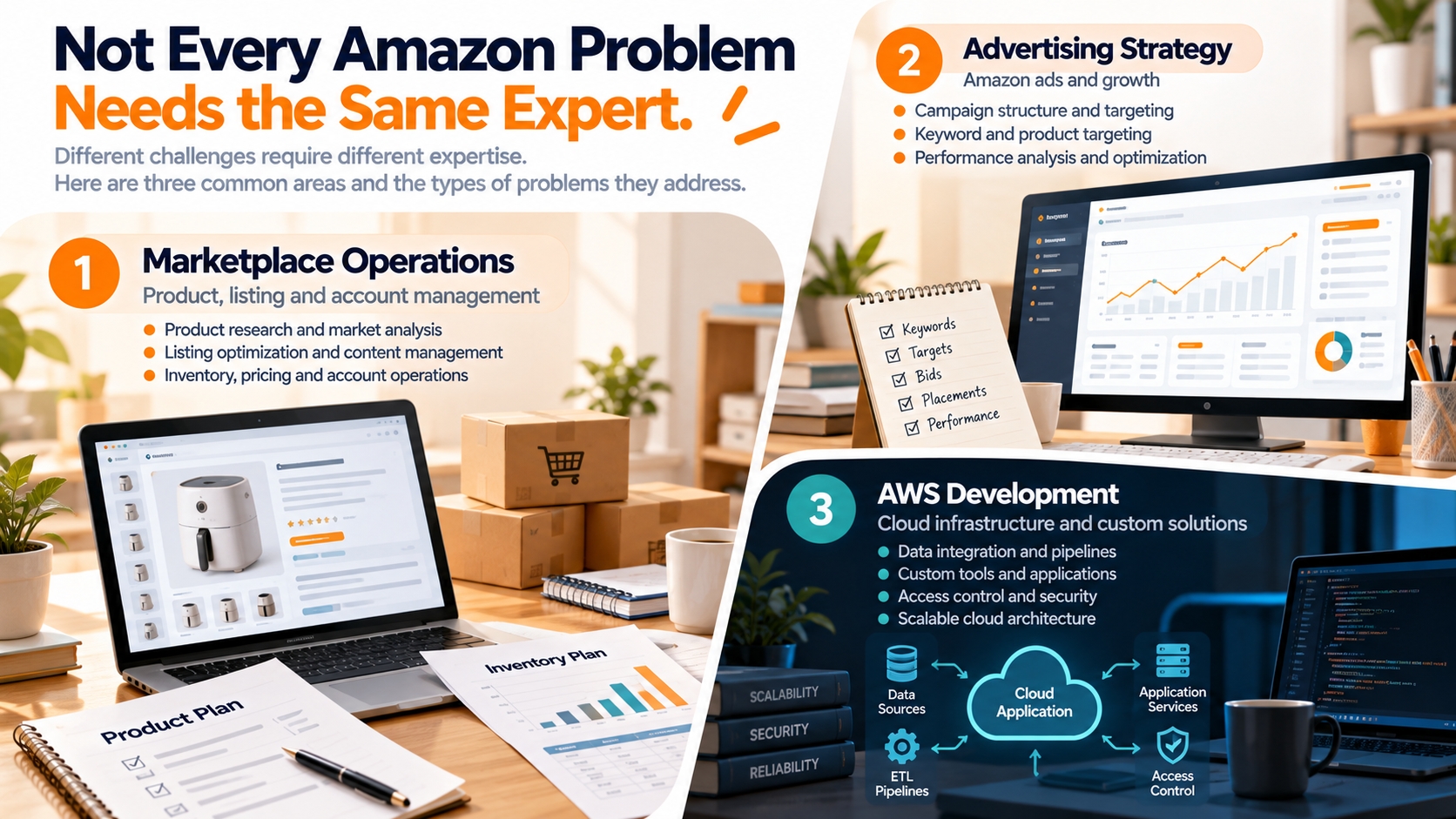
A seller searching for Amazon and AWS consulting services may encounter marketplace agencies, advertising specialists, cloud architects, and AI development companies. They can all claim Amazon-related expertise, but the work they deliver may have little overlap.
A consultant who can improve a Sponsored Products account is not automatically qualified to design a secure data pipeline. An AWS-certified engineer may be highly capable at cloud development without knowing how an Amazon seller manages parent-child ASINs, seasonal demand, or inventory replenishment.
Amazon Marketplace Consulting
Marketplace consultants work on the commercial and operational side of selling. Their services may include product research, listing improvements, advertising management, category analysis, account operations, and fulfillment-related planning.
Amazon's Service Provider Network helps sellers find third-party businesses offering marketplace-related services. Amazon vets providers and provides service information, but states that it does not endorse individual providers or their services.
Amazon Advertising Consulting
Advertising consultants are a more specialized category. They can support Sponsored Products, Sponsored Brands, campaign measurement, creative development, and other Amazon Ads services.
Amazon Ads maintains a separate Partner Network and directory for advertising-related partners. These providers may overlap with marketplace agencies, but an advertising engagement does not necessarily include software engineering or AWS architecture work.
AWS Cloud and AI Consulting
AWS consulting focuses on the technology environment: data integration, application development, cloud infrastructure, machine learning, security, monitoring, and ongoing technical operations.
Businesses can engage independent AWS Partners or investigate AWS Professional Services, which is offered by AWS itself. These are different arrangements, with different teams and commercial terms.
| Service type | Typical business problem | Deliverable to request |
|---|---|---|
| Marketplace consultant | Poor product positioning, listing quality, marketplace execution, or catalog decisions. | Product audit, competitive analysis, operating recommendations, and implementation priorities. |
| Advertising consultant | Inefficient campaign structure, targeting, creative, or advertising measurement. | Campaign audit, controlled testing plan, performance reporting, and optimization records. |
| AWS consultant | Data silos, manual integrations, unreliable applications, or specialized AI development needs. | Architecture, functioning integration, tested application, security controls, documentation, and handover. |
Larger projects may need both marketplace and AWS expertise. In those cases, establish who owns the business requirements and who owns technical implementation. An AWS developer should not have to invent Amazon operating rules, and a marketplace consultant should not approve cloud security decisions outside their expertise.
Write the Problem Before You Contact a Consultant
A request such as "We want AI for our Amazon business" gives a consulting firm considerable freedom to propose technology. It tells the firm very little about the decision that needs improvement.
The project becomes easier to evaluate when the business describes the existing process, the information it uses, its limitations, and the result it wants.
Replace the technology request with an operational question
VAGUE REQUEST
"Build an AI dashboard for our Amazon products."
BETTER PROJECT BRIEF
"Every Monday, identify products at risk of running out before replenishment, explain the inputs, and prepare a report for our inventory planner to approve."
This version identifies the user, frequency, decision, and expected output without dictating a particular cloud service.
Separate the decision from the technology
The workflow in the example could begin with a spreadsheet, an existing reporting tool, or a simple rules-based process. Only after testing those approaches should the business decide whether an AWS application or AI model is necessary.
This principle applies to several common Amazon seller tasks. Keyword clustering may need consistent labeling rather than custom model training. Review summarization may need a well-designed report and human verification. Advertising cleanup may require more reliable search-term reviews instead of unrestricted automated campaign changes.
Write down what failure looks like
A consultant should know whether an incorrect recommendation wastes an analyst's time or changes a customer-facing product listing. Those outcomes require different controls.
For each proposed workflow, define which source data it may use, how old that information can be, which outputs need review, and which actions are outside scope. An implementation that cannot explain its inputs is difficult to improve after deployment.
Check What Existing Tools Can Already Do
Custom development is not necessarily the natural next step after manual work. Before commissioning an application, check what Amazon, established marketplace software, and existing reporting tools can already provide.
The purpose of this review is not to avoid all external consulting. It is to avoid paying for a complex implementation when the real requirement is a better-designed operating process.
Start with Amazon's native seller capabilities
Amazon has expanded its AI-powered Seller Assistant to support business recommendations and selected operational workflows. Its September 2026 announcement described persistent business context, configurable recurring tasks, and integrations involving Amazon Quick and, in beta, Anthropic's Claude.
Sellers should check which capabilities are currently accessible to their accounts. An announcement about an integration does not mean that every account can use every feature or automate every Seller Central operation.
Use established research tools for marketplace intelligence
A business that needs competitor identification, category research, customer-feedback analysis, or keyword interpretation may not need to develop those capabilities from the beginning.
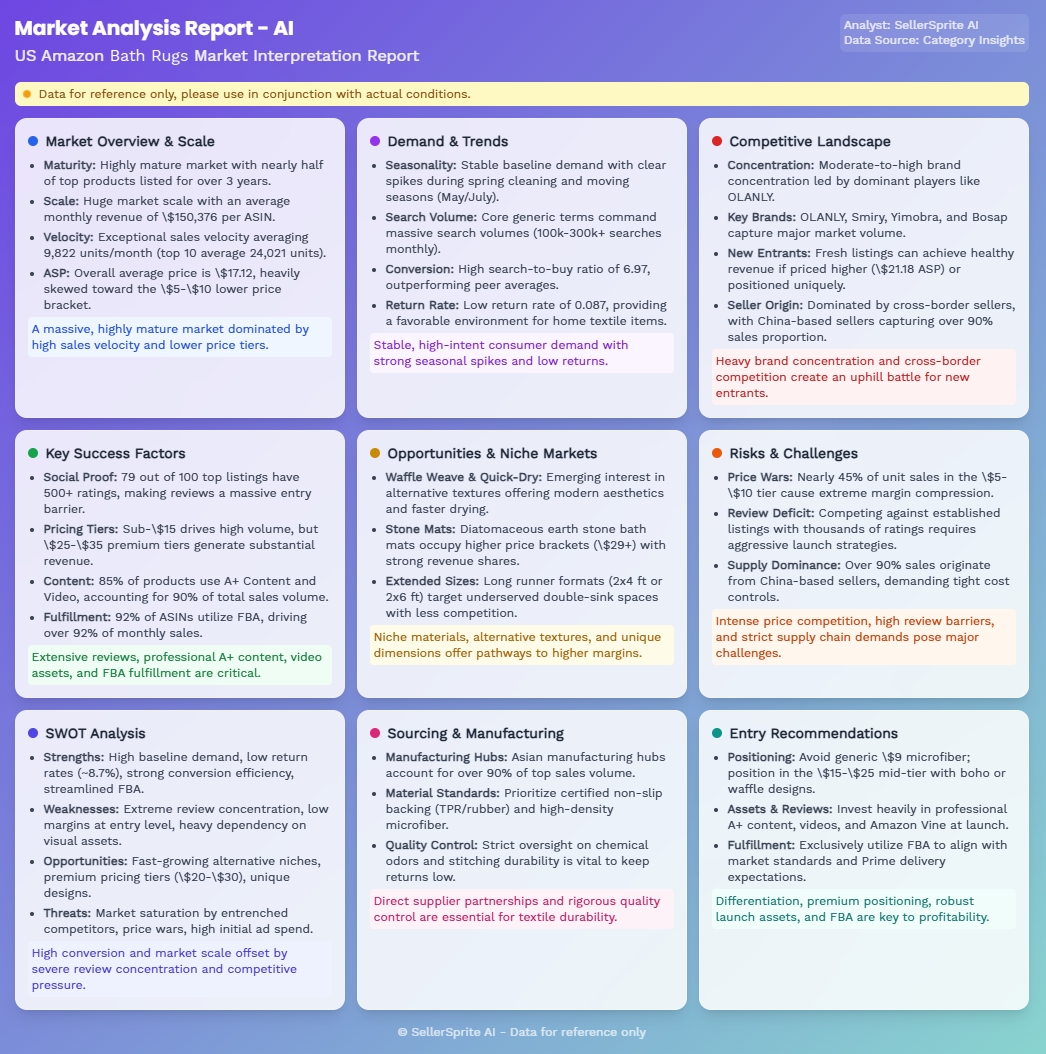
For example, SellerSprite's Category AI Insights interprets category-level market information, including demand patterns, competitive structure, and possible opportunities or risks. It provides an AI-generated research report that sellers can review without commissioning a separate cloud application for the same basic analytical task.
The report remains decision support, not proof that a category will produce a particular return. Marketplace estimates should be interpreted according to their definitions and update periods, and checked against the seller's own commercial constraints.
Build only where the existing workflow stops
A custom integration becomes more relevant when the business needs to combine authorized seller-account information, supplier records, internal financial data, and marketplace research into a repeatable process with its own business rules.
Even then, the custom component may only need to collect approved files, validate them, perform calculations, and prepare a report. A foundation model should be added because it improves a specific part of the workflow, not because the project has AI in its title.
The build-or-buy question: What important task cannot be completed adequately with existing authorised tools, and how much additional business value would a custom system create? If the answer is unclear, purchase a limited diagnostic engagement before committing to development.
What an AWS Consultant May Actually Build
AWS offers the infrastructure for developing applications, managing data, and operating AI systems. A consultant selects and configures the components needed for the agreed business outcome.
The services are not interchangeable. An AI-generated summary, a historical demand forecast, and an automated account update have different technical and security requirements.
Data Integration and Reporting
A consultant may design a system that collects authorized marketplace reports, normalizes SKU and ASIN identifiers, joins supplier lead times, and prepares consistent operational summaries.
Depending on requirements, the implementation could involve cloud storage, scheduled data processing, databases, and reporting services. The technology choice should follow the required data volume, update frequency, operational complexity, and available engineering support.
Generative AI Applications with Amazon Bedrock
Amazon Bedrock supports applications using foundation models, including model inference, knowledge-based retrieval, agent workflows, and configurable safeguards.
A business might use a Bedrock-based application to summarize internal reports, explain product-performance exceptions, or prepare documents from approved source material.
The consultant still needs to define how source data is retrieved, how unsupported claims are identified, and which outputs require human approval. A fluent summary does not make a source accurate or current.
Predictive Machine Learning with SageMaker AI
Amazon SageMaker AI supports building, training, evaluating, and deploying machine-learning models. It may be relevant when a company has enough reliable historical data to justify a custom predictive process.
Forecasting demand and generating an explanation of demand are different tasks. A language model can summarize a forecast, but that does not mean it has produced a statistically validated forecast.
Ask the consultant to compare a proposed machine-learning model against a simpler baseline. If the additional complexity does not improve performance enough to justify the cost, the simpler method may be preferable.
Operational Automation
Scheduled reports, exception notifications, data validation, and approved task routing can often be automated without allowing the system to make independent marketplace changes.
When a project proposes automated pricing, listing edits, or inventory actions, separate that capability into its own approval and permission requirements. The ability to generate a recommendation is not the same as authorization to execute it.
Worked Example: A Weekly Inventory Exception Report
Consider a hypothetical Amazon brand managing a catalog across several suppliers. Each week, an inventory analyst combines stock reports, recent sales, and supplier lead times to identify potential replenishment problems.
The team wants a faster process, but it does not want software to place purchase orders automatically. This makes a read-only report a suitable first consulting project.
Stage 1: Define the Decision and the Sources
The question is simple: which SKUs are likely to run out before replenishment arrives, based on the information currently available?
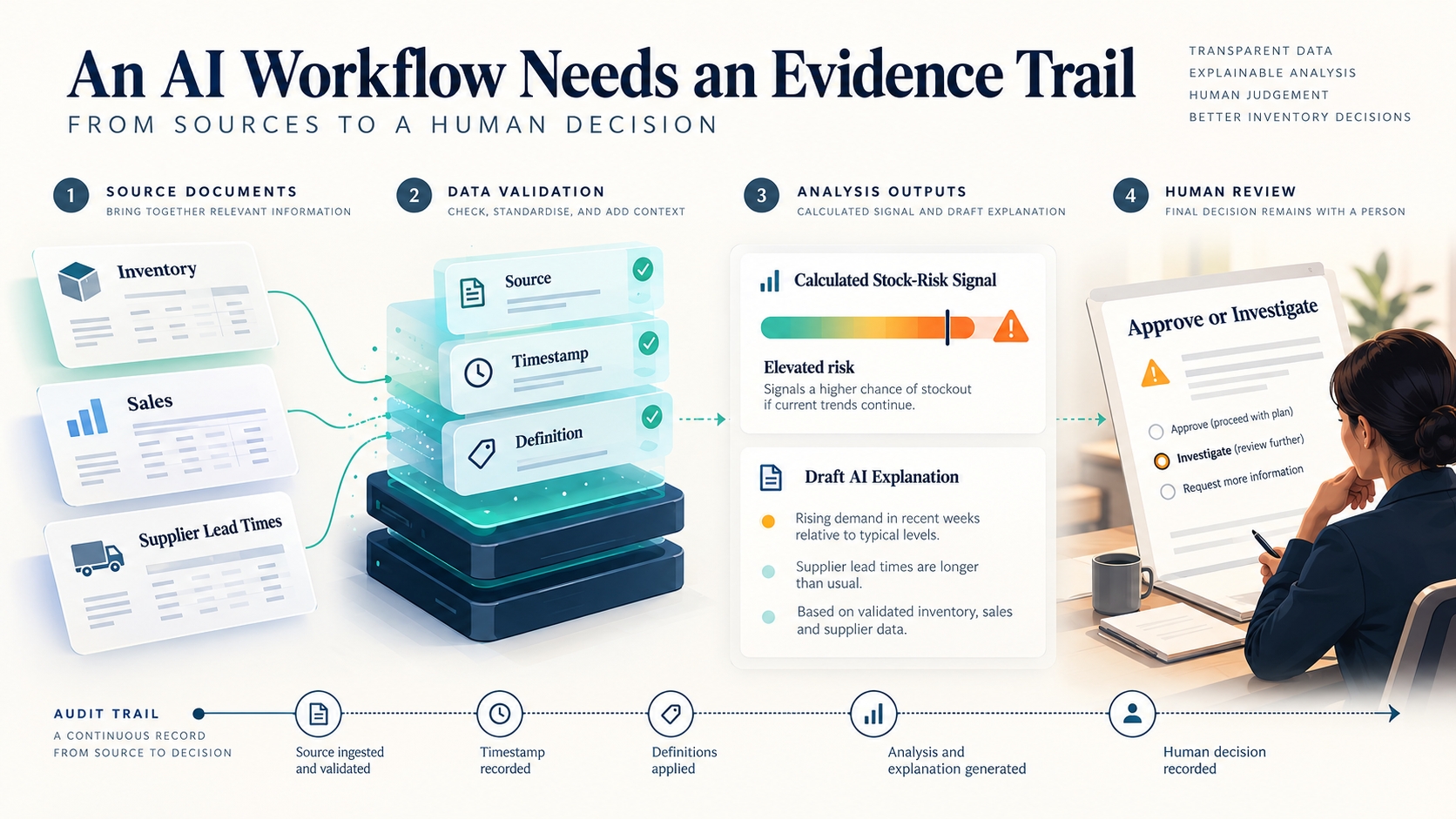
The initial inputs could include authorized inventory quantities, historical unit sales, supplier lead times, and confirmed inbound shipments. Each value needs a source, observation date, and business definition.
Stage 2: Use Deterministic Calculations First
An initial rule can estimate stock coverage as available units divided by a defined recent daily sales rate. The calculation must address zero sales, missing inventory, expected incoming units, and unusual changes in demand.
Products with coverage below the applicable lead-time and buffer requirement become review candidates. This is a screening calculation, not a sophisticated forecast.
Stage 3: Use AI to Explain the Exceptions
If generative AI adds value, it can prepare a short memo for each flagged product, citing the relevant source values and identifying questions the planner needs to resolve.
For example, it might highlight a supplier lead time that increased, a sales spike that may not represent normal demand, or a confirmed inbound shipment that changes the initial coverage estimate.
Where the evidence is incomplete, the report should say so. An AI explanation should not invent a supplier commitment or silently assume that an unavailable report contains zero sales.
Stage 4: Keep Purchase Decisions with the Planner
The planner reviews the exception, verifies the supplier information, and decides whether to revise a purchase order, expedite stock, or accept the estimated risk.
The system records the recommendation and the review decision. It does not change an Amazon listing, place a new purchase order, or adjust advertising merely because a stock-risk warning was generated.
Stage 5: Compare the Result with Actual Operations
The team evaluates whether the process identifies useful exceptions, how often analysts correct its calculations, and whether the complete review takes less time than the previous method.
As the process matures, the company can consider stronger forecasting methods or additional integrations. Those decisions should follow evidence of a remaining problem, not an assumption that more automation must always be better.
Data Access Is a Permission Question, Not a Cloud Feature
One of the most important consulting questions is also one of the easiest to overlook: where will the project's data come from, and who is authorised to use it?
Running an application on AWS does not give it automatic access to Seller Central, Amazon Ads, supplier systems, or licensed research databases.
Selling Partner API Access Has Its Own Requirements
Amazon's Selling Partner API, or SP-API, supports authorised integrations for functions such as product listings, order management, pricing, and inventory-related operations.
Developers must follow the relevant registration, application, role, and authorisation requirements. Public applications serving multiple selling partners have different registration and authorisation arrangements from private applications built for one organisation.
Some roles govern access to sensitive information and require additional controls. A consultant should confirm the required operations and permissions before promising automatic access to specific account data.
Distinguish Four Types of Data
| Information source | Appropriate use | Required distinction |
|---|---|---|
| Seller-account reports | Authorized first-party sales, inventory, orders, and operational performance. | Permissions, report periods, metric definitions, and available fields. |
| Marketplace research data | Competitor estimates, category trends, keyword indicators, and historical research. | Estimates are not private competitor account records; permitted reuse and data freshness must be checked. |
| Supplier records | Lead times, purchase costs, order quantities, and confirmed shipping commitments. | Forecasts, quotations, and confirmed commitments should not be treated as identical. |
| Policies and specifications | Marketplace requirements, technical definitions, and product compliance checks. | The applicable version and review date should be recorded. |
Security and Responsibility Must Be Designed Together
AWS recommends evaluating workloads through the Well-Architected Framework, which covers operational excellence, security, reliability, performance efficiency, cost optimization, and sustainability.
For a seller-data integration, require the consultant to explain how access is restricted, credentials are protected, failed operations are detected, and sensitive data is retained or deleted.
Read-only reporting should be separated from write permissions. Changes to prices, product listings, advertising, and other business-critical records need explicitly defined approval or execution boundaries.
A useful security question: "If the consultant leaves tomorrow, which accounts, credentials, data, and applications can our team still control, and which permissions must we revoke?"
Evaluate the Proposed Work, Not Just the AWS Credentials
Credentials help identify providers with relevant technical capabilities. They do not establish that a particular team understands Amazon seller operations or can deliver the proposed application within your budget.
AWS maintains an AWS Partner Solutions Finder that supports discovery by services, capabilities, industries, and other criteria. Use its information to shortlist candidates, then evaluate their experience with the exact workflow and data sources your business requires.
Ask to Meet the Delivery Team
The salesperson who presents the proposal may not be the architect, developer, or analyst who performs the work. Ask who will own the application design, integration development, testing, documentation, and technical support.
Relevant AWS qualifications are useful, but ask for examples of comparable data integration, permission management, and production support. Where Amazon marketplace logic is involved, verify that someone on the team understands those business requirements.
Ask the Consultant to Explain a Failure Case
A strong technical proposal should explain what happens when an upstream report is delayed, an API request is denied, a supplier changes a file format, or an AI-generated output contradicts the source information.
These are practical questions, not edge cases for a distant future. Data workflows depend on inputs and permissions that can change after implementation.
Confirm Whether the Provider Is Selling Advice, Development, or Ongoing Operations
A discovery engagement might produce architecture recommendations without building software. An implementation project should deliver working components. A managed-service arrangement may provide ongoing monitoring, maintenance, and support.
AWS Marketplace also supports negotiated professional-services offers. The description, scope, pricing, and payment terms should be reviewed as part of the specific offer rather than assumed from the marketplace listing.
The Consulting Invoice Is Not the Total Project Cost
An implementation fee pays for design and development work. It does not necessarily cover the cloud resources that the application consumes after launch or the people required to maintain it.
Separate one-time implementation expenses from recurring operation costs. Ask the consultant to identify every component that could continue generating charges after the initial delivery is accepted.
Keep the Cost Categories Separate
- Discovery and implementation: Requirements, architecture, integrations, testing, and deployment.
- Cloud consumption: Compute, storage, data movement, model usage, logging, and other applicable AWS services.
- Software or data subscriptions: Third-party tools, licensed datasets, and integration services not included in the consulting fee.
- Ongoing maintenance: Monitoring, bug fixes, API changes, security updates, and technical support.
- Internal review: The time employees continue spending on approvals, exception handling, and operational decisions.
Amazon Bedrock charges depend on the selected services, models, usage arrangements, and supporting capabilities. A deployment using AWS services needs an architecture-specific estimate rather than a generic monthly AI fee.
AWS Budgets can monitor cloud costs and provide alerts, but a budget alert is not automatically a hard spending cap. A consultant should propose suitable cost controls and explain which resources might continue operating if an alert is triggered.
Worked Cost Example: Does the Automation Pay for Itself?
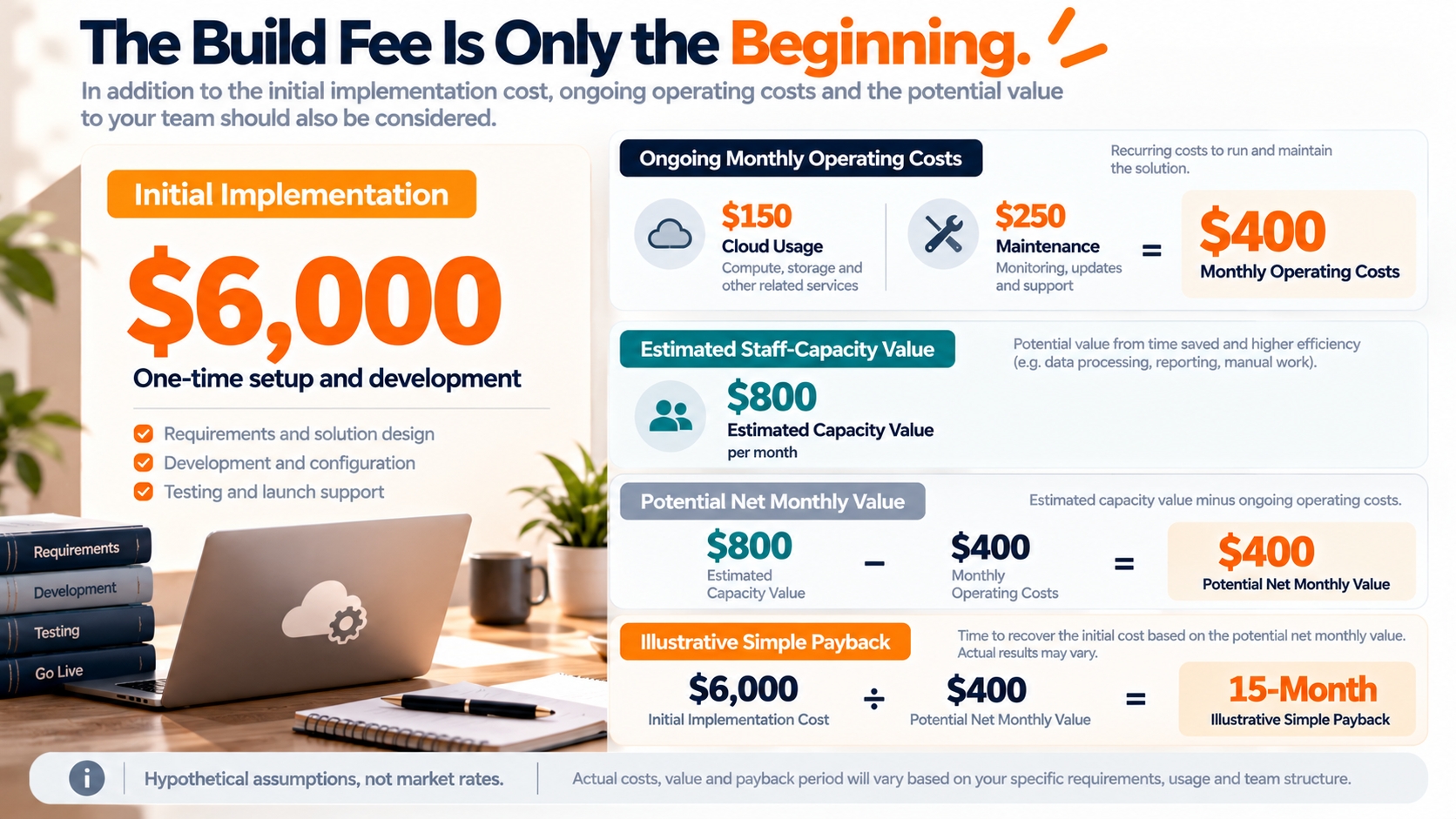
Return to the weekly inventory reporting project. Suppose the business receives a hypothetical proposal requiring a $6,000 implementation fee, with expected ongoing costs after deployment.
| Item | Assumption | Interpretation |
|---|---|---|
| One-time implementation | $6,000 | Paid for the agreed initial project, not a recurring monthly charge. |
| Cloud usage | $150 per month | Illustrative AWS consumption, subject to actual usage. |
| External maintenance | $250 per month | Technical support and routine maintenance allowance. |
| Potential time saved | 5 hours per week | Reduction from 8 to 3 hours of reporting and review per week. |
| Estimated capacity value | $800 per four-week period | 20 hours multiplied by an assumed $40 hourly value. |
For simplicity, treat the four-week period as one modeled month. The recurring cloud and maintenance allowances total $400. Subtracting them from the estimated $800 capacity value leaves a potential net benefit of $400 per modeled month.
Illustrative Simple Payback
$6,000 / $400 = 15 modeled months
This is a conditional simple-payback calculation, not a forecast of cash return. It assumes the time savings are sustained and economically useful. It excludes delays, implementation overruns, additional data subscriptions, and future changes in cloud usage.
Saving employee time does not automatically reduce payroll costs. The business only realizes an economic benefit if the released capacity is productively redeployed, reduces an actual expense, or supports additional valuable work.
Under these assumptions, the first twelve modeled months provide $4,800 of net capacity value against the $6,000 upfront investment. The project has not recovered its initial cost by that point. That distinction matters when evaluating an implementation proposal.
Make the Statement of Work Testable
A statement of work, or SOW, should describe what will be delivered and how the buyer will determine whether that delivery is complete.
Phrases such as "AI-powered marketplace intelligence" and "end-to-end automation" describe aspirations. They do not establish what data will be connected, which workflows will run, or how failed outputs will be handled.
Require Specific Deliverables
Suggested Acceptance Checklist
- Requirements: The business questions, intended users, inputs, outputs, and excluded activities are documented.
- Data inventory: Each source has an owner, permitted use, update schedule, and metric definition.
- Architecture: The technical design identifies major components, permissions, dependencies, and estimated operating costs.
- Working implementation: The agreed workflow runs against approved test data and produces the defined outputs.
- Validation: Test cases cover normal inputs, missing data, stale information, and important exception conditions.
- Controls: Access permissions, approvals, audit records, and response procedures are documented.
- Handover: The client receives the agreed documentation, operating instructions, ownership details, and support arrangements.
Evaluate Outcomes Without Hiding the Review Work
The right evaluation metrics depend on the workflow. A report generator should be judged on source accuracy, completeness, and the time needed to review it. A demand model needs predictive evaluation against later outcomes. An integration requires reliability, data consistency, and recoverable failure handling.
| Evaluation dimension | Evidence to request | Warning sign |
|---|---|---|
| Data reliability | Source reconciliation, timestamp checks, and handling of missing fields. | Unsupported data is silently filled in. |
| Repeatability | Repeated tests using the same inputs, documented assumptions, and accepted output variation. | Results cannot be reproduced or explained. |
| Human review | Approval records, correction frequency, and escalation rules. | Important changes occur without the agreed control. |
| Operational value | Complete task time before and after implementation, including corrections. | Generating outputs faster increases review workload. |
| Operating cost | Actual cloud usage, support expense, and cost per completed workflow. | Costs increase without a corresponding usable benefit. |
Set specific acceptance thresholds based on the product, data availability, and business risk. A universal accuracy percentage for every AI workflow would be meaningless because the consequences of errors vary.
The First Month After Launch Matters More Than the Demo
A demonstration is usually conducted with selected examples and prepared conditions. A production workflow must cope with ordinary business changes: missing reports, delayed source updates, unusual inputs, staff absence, and changing requirements.
Agree on who monitors the application after deployment, which problems require urgent intervention, and what happens if the workflow cannot complete its task.
Run a Parallel Review Before Expanding Authority
For high-impact workflows, compare the new system with the existing human process before relying on its output. Review differences rather than assuming the automated result is correct whenever it is faster.
If the system performs well as a read-only assistant, the business can consider additional capabilities through a separate approval and technical evaluation. There is no requirement to expand into autonomous execution.
Make the Client Capable of Operating Without the Consultant
The handover should include system access, architecture documentation, approved integration details, operating instructions, monitoring procedures, and a clear explanation of which responsibilities remain with the vendor.
The business should also know how to pause or disable the workflow, review usage charges, revoke authorizations, and retrieve its own data in the agreed format.
A system that only its original developer can understand may be technically functional but operationally difficult to own.
Hire for a Decision You Can Measure
The distinction between Amazon and AWS consulting services becomes straightforward when the business problem is clear. Marketplace consultants help improve selling decisions. AWS consultants help design and maintain the technology needed for specialized workflows. Some businesses need both; others need neither for the task at hand.
Begin with the information already available, the decisions employees currently make, and the cost of doing that work poorly. Check existing tools before commissioning an application. Where custom development is justified, ask for verified data access, explicit operating boundaries, and acceptance criteria that do not depend on a convincing demonstration alone.
Good consulting leaves the seller with a more dependable way of working. The number of cloud services in the architecture is not the measure of success.
FAQs
What are Amazon and AWS consulting services?
The phrase refers to different service categories. Amazon marketplace consultants support selling and advertising operations, while AWS consultants help businesses build and manage cloud infrastructure, data integrations, and applications. AWS also offers its own Professional Services. A project may involve one or more of these categories depending on the work required.
Is Amazon Web Services consulting the same as Amazon seller consulting?
No. AWS consulting primarily addresses technology architecture and systems. Seller consulting primarily addresses marketplace operations. An AWS consultant may help build an application for an Amazon seller, but cloud expertise does not automatically establish expertise in product research, listings, advertising, or inventory planning.
Do Amazon sellers need AWS consulting to use AI?
Usually not for standard AI-assisted research, listing drafting, or supported native seller workflows. Sellers can evaluate available Amazon capabilities and established software first. AWS consulting becomes relevant when the business requires a custom application, authorized data integration, or technical workflow that existing solutions cannot adequately provide.
How do I find an AWS consultant for an ecommerce project?
Start with AWS Partner discovery resources or AWS Professional Services. Shortlist providers with relevant data integration, AI, cloud security, and application experience. Then assess the actual delivery team against your business requirements and request a clear, testable scope of work.
Can an AWS consultant automatically access Seller Central data?
No. AWS infrastructure does not grant access to private seller data. Applications must use appropriate authorised integrations, such as supported SP-API operations, with the required registration and permissions. The seller must also follow the applicable authorisation process.
When should an Amazon seller consider Amazon Bedrock?
Bedrock may be suitable when a business needs to develop a custom generative AI application, work with approved internal knowledge sources, or add model-based explanations to a broader workflow. It is not required for every reporting or forecasting task. Data access, model evaluation, operational controls, and usage costs still need to be designed.
How much do AWS consulting services cost?
There is no universal project fee. Pricing depends on scope, integration complexity, security requirements, development work, and ongoing support. Cloud usage, software subscriptions, and maintenance may be charged separately. Ask for an itemized estimate and review the full operating cost. The financial examples in this article are hypothetical, not market rates.
What should an AWS consulting statement of work include?
Include business requirements, data sources, access permissions, architecture, development deliverables, testing, acceptance criteria, cost estimates, documentation, and ownership responsibilities. Specify which actions the application may perform and which require human approval. Handover and support terms should be agreed before implementation.
What metrics should sellers use to evaluate consulting results?
Use metrics relevant to the project: data reliability, task completion time, accepted recommendations, correction frequency, operational incidents, and ongoing cost. For predictive systems, measure forecast errors against actual outcomes. For marketplace improvements, assess the relevant business results while accounting for other changes that may have influenced performance.
Can SellerSprite replace an Amazon or AWS consultant?
SellerSprite provides marketplace research and AI-assisted analytical tools, not a replacement for every consulting or cloud development service. Its product, competitor, category, keyword, and customer-feedback capabilities can reduce the need to build common research workflows from scratch. Specialized data integration, application development, and ongoing technical operations may still require additional expertise.
References
- Amazon: Service Provider Network for Sellers View
- Amazon Ads: Find the Right Advertising Partner View
- AWS: Work with an AWS Partner View
- AWS: Professional Services View
- AWS Marketplace: Purchasing Professional Services View
- Amazon: Seller Assistant and Amazon Quick Integration, September 2026 View
- SellerSprite: Category AI Insights Guide View
- AWS: Amazon Bedrock Documentation View
- AWS: Amazon SageMaker AI View
- Amazon Developer Documentation: Onboarding as an SP-API Developer View
- Amazon Developer Documentation: Seller Authorization for Service Providers View
- AWS: Well-Architected Framework View
- AWS: Amazon Bedrock Pricing View
- AWS Documentation: Managing Costs with AWS Budgets View
- AWS: IAM Security Best Practices View
- Amazon Developer Documentation: SP-API Roles and Access View
By SellerSprite Content Team
The SellerSprite Content Team develops research-based educational content for Amazon marketplace operators and businesses evaluating ecommerce technology. Our work draws on marketplace data analysis, ASIN and keyword intelligence, technical documentation, and platform policy research.
Last reviewed: October 23, 2026