TL;DR: Amazon review management is the practice of monitoring genuine customer feedback, requesting reviews through permitted channels, resolving eligible customer issues, and using recurring complaints to improve products and listings. Sellers cannot edit star ratings, reward positive reviews, or pressure buyers to remove negative feedback. The useful work happens behind the rating: separating product problems from seller-service issues, checking review trends at the right ASIN level, and making changes that address what customers actually experienced.
Key Takeaways
- Product reviews and seller feedback are different. A complaint about a defective product calls for a different investigation from a complaint about shipping or customer service.
- Use Amazon's approved review-request process. Request a Review is available once per eligible order within its specified window. Do not filter customers by satisfaction or send repeated requests.
- Customer support is not review negotiation. Eligible brand representatives can contact customers through Amazon's Customer Reviews tool, but cannot ask them to change or delete their reviews.
- Review counts need context. Amazon's 2026 variation-review sharing changes mean a rating or review-count movement may reflect catalog structure rather than new customer experiences.
- The best review metric leads to a decision. A recurring complaint about product quality, packaging, instructions, or compatibility is useful when someone investigates it and records the outcome.
Table of Contents
- Amazon Review Management Starts with Two Different Queues
- Ask for a Review Without Asking for a Rating
- When a One-Star Review Arrives, Identify the Real Problem
- Why Your Review Count May Change Without a New Complaint
- Read Review Data Without Inventing a Defect Rate
- From Review Theme to a Change You Can Defend
- A Review-Management Routine That Produces Decisions
- A Better Rating Is Not the First Deliverable
- FAQs
- References
Scope: This guide focuses on Amazon.com in the United States and distinguishes product-review policies from seller-feedback procedures. Specific tool eligibility depends on selling-plan, brand-role and program requirements. Amazon's current rules, rather than third-party automation settings, determine which review-related actions sellers may take.
Amazon Review Management Starts with Two Different Queues
One unhappy buyer is not necessarily a product crisis. But when several customers report the same broken component, the business has something to investigate. The difficulty is knowing which kind of feedback you are looking at.
Amazon sellers often talk about reviews, seller ratings, returns, and customer complaints as if they were one system. They are not. These records answer different questions and require different responses.
Product Reviews Describe the Item
Amazon product reviews appear on product detail pages. They help shoppers evaluate quality, functionality, usefulness, and whether a product matches their needs. A customer might describe an appliance that stopped working, a storage container that leaks, or a shirt that fits differently from the size chart.
These comments concern the product, not necessarily the merchant who fulfilled the order. Multiple sellers offering the same ASIN may therefore encounter the same product-review history.
Seller Feedback Describes the Buying Experience
Seller feedback focuses on the buyer's experience with a particular seller, such as order handling, delivery, and customer service. It is managed through Amazon's Feedback Manager rather than the product-review system.
This distinction determines what the team should do next. An inaccurate product description may require a listing correction. A late shipment may require a fulfilment investigation. Treating both as a generic "negative review problem" sends the issue to the wrong place.
| Signal | What it tells you | Primary response |
|---|---|---|
| Product review | Customer experience with the product's quality, features, usability, or expectations. | Product, quality-control, and listing investigation. |
| Seller feedback | The buyer's experience with the merchant and order service. | Feedback Manager and seller-service review. |
| Return reason | Why a customer requested a return or refund. | Return-case handling and product inspection. |
| Customer support message | A specific service need, question, or unresolved order problem. | Resolve the issue through an authorised support channel. |
A buyer can leave a critical product review without requesting a refund. Another buyer can return a defective product without writing a review. These outcomes should be connected when evidence exists, but not counted as though they were identical events.
The first rule of review management: Route the issue to the team that can address its cause. Customer support can resolve an eligible customer problem; product teams investigate recurring defects; listing teams clarify expectations. None of them controls what star rating a buyer ultimately chooses.
Ask for a Review Without Asking for a Rating
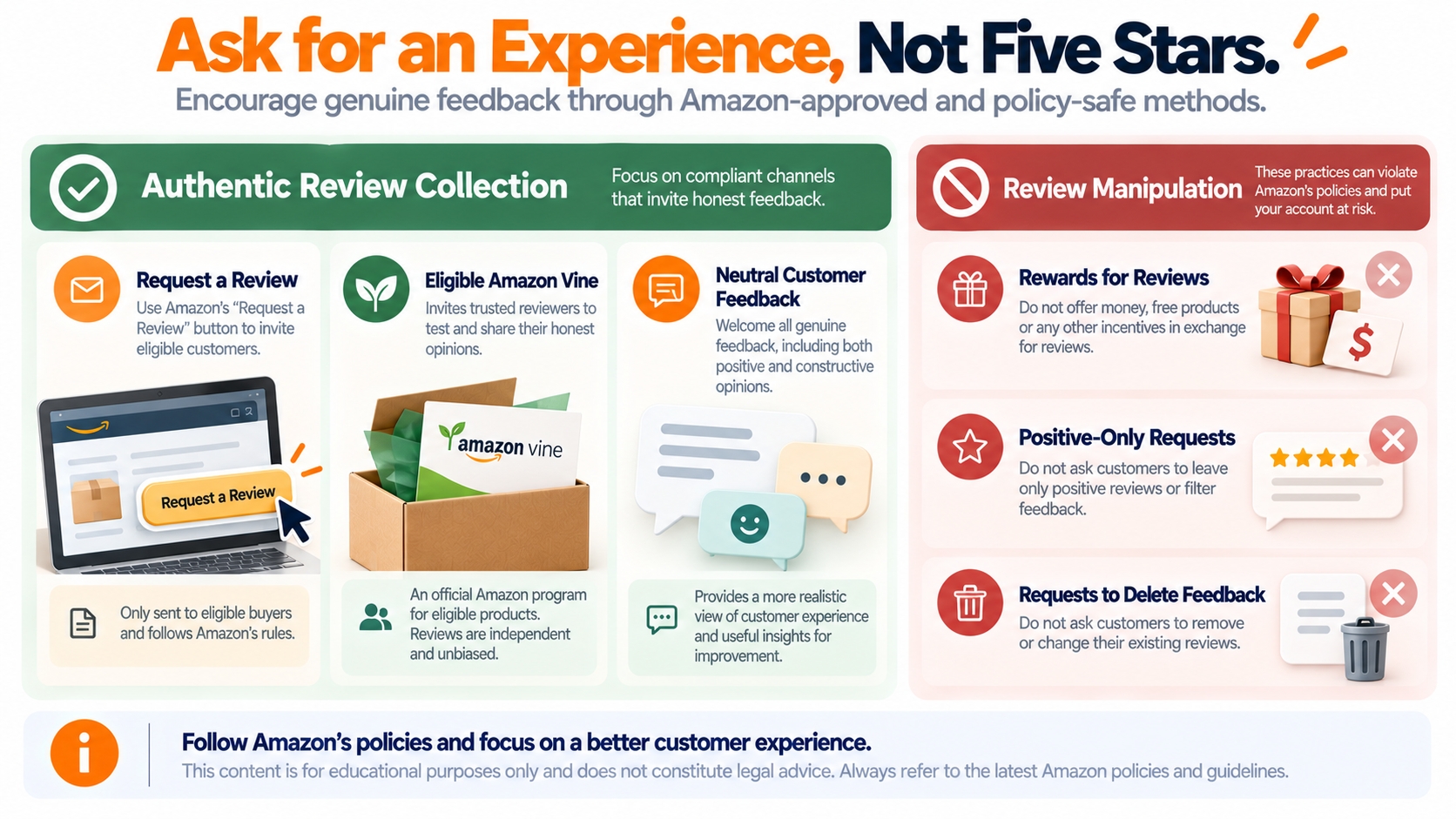
A new listing needs customer feedback, but a seller cannot manufacture its reputation by choosing who gets asked or what they are encouraged to say. Amazon expects reviews to reflect authentic customer experiences, including disappointing ones.
The practical choice is to use Amazon's permitted collection methods and make the actual product experience worth reviewing. That approach may build a slower review history than an aggressive campaign promises, but it avoids making the credibility of the listing dependent on prohibited tactics.
Request a Review: One Standardised Message per Eligible Order
Amazon's Request a Review feature is available on eligible orders through Seller Central. It sends a standardised message asking for both a product review and seller feedback.
Sellers can use this feature once per eligible order between 5 and 30 days after the order delivery date. Amazon supplies the message wording and translates it into the buyer's preferred language. Its systems also request reviews automatically, so the seller does not need to create a separate email campaign for every order.
The message is deliberately neutral. Sellers should not follow it with additional unsolicited review requests, write their own emotional appeals to selected customers, or contact only buyers believed to be satisfied.
Amazon Vine: Product Access in Exchange for an Independent Opinion
Amazon Vine is a separate, Amazon-operated programme that provides eligible products to invited reviewers known as Vine Voices. Those participants receive products to try and may publish their honest opinions.
For US participation, Amazon's current requirements include a Professional selling account and an eligible brand role for enrolled brands, or qualifying generic products, along with eligible FBA listings. Existing products generally need fewer than 30 reviews on the product detail page. Sellers can make up to 30 units available, depending on the enrolment tier and product eligibility.
Vine reviewers are not hired to deliver positive ratings. Products can receive critical reviews, and not every enrolled unit necessarily generates a review. Consider the programme's current fee tiers, inventory cost, product readiness, and eligibility before enrolling.
When Vine makes sense: The product is ready for genuine evaluation, its listing is accurate, its fulfilment requirements are met, and the business is prepared to receive unfiltered feedback. If important functionality or packaging problems are still unresolved, fix those before inviting more customers to experience them.
Packaging Inserts: The Line Between a Request and Review Steering
Product inserts can provide useful setup instructions, care guidance, or neutral information. Amazon has also clarified that neutral requests for honest reviews can be acceptable when they do not steer sentiment.
What sellers cannot do is use an insert to ask for positive reviews, offer compensation for a review, or direct dissatisfied buyers to private support while encouraging only happy buyers to review publicly.
ALLOWED APPROACH
- Use Amazon's eligible Request a Review function.
- Invite honest feedback without prescribing sentiment.
- Provide accurate instructions and helpful product support.
POLICY RISK
- Offer money, discounts, or free products outside an authorised programme in exchange for reviews.
- Request reviews only from customers expected to leave positive ratings.
- Ask buyers to revise or remove negative reviews after receiving support.
Amazon's product-review policies extend to employees, agencies, and third-party partners working for a seller. Outsourcing a campaign does not transfer the policy risk away from the seller account.
When a One-Star Review Arrives, Identify the Real Problem
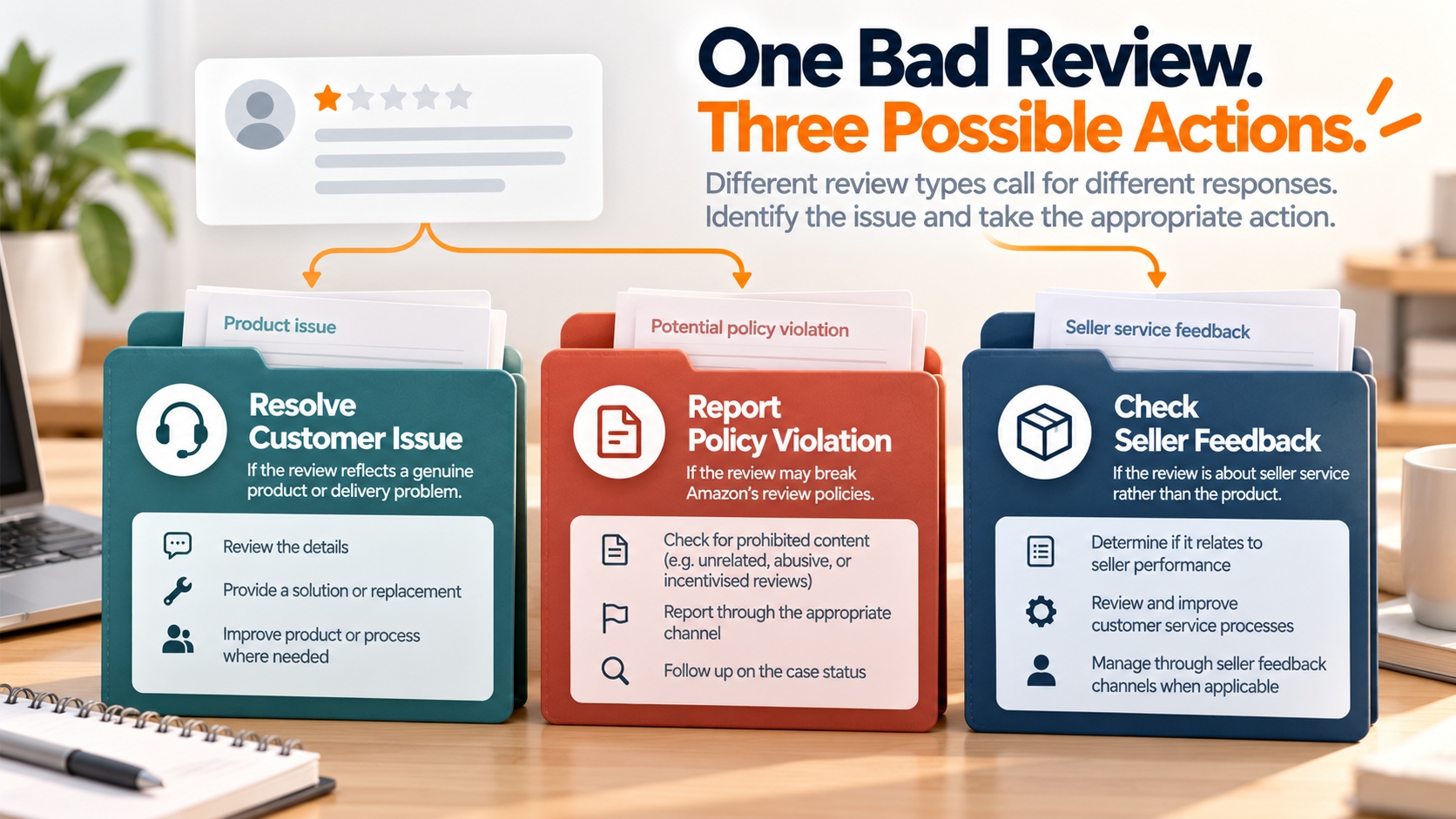
The temptation after a one-star review is to find a way to make it disappear. That is usually the wrong starting point. The first question should be whether the review describes a legitimate customer problem, violates Amazon's content rules, or belongs to a different feedback system.
These situations have different remedies. Customer support may be appropriate for an unresolved product experience. A prohibited review can be reported for moderation. Seller feedback should be handled through the seller-feedback process, not a product-review appeal.
What Brand-Registered Sellers Can Do
Amazon's Customer Reviews tool gives eligible brand representatives a way to monitor product reviews and contact buyers in specific circumstances. Access requires a Professional selling account and the Brand Representative role for a brand enrolled in Amazon Brand Registry.
Under Amazon's current US guidance, the Contact Customer option applies to reviews with ratings below three stars. Eligible sellers can offer a full courtesy refund or request additional information to help resolve the product issue through Amazon's available workflow.
In Seller Central, eligible brand representatives can open Brands > Customer Reviews, filter recent critical reviews, and select the available contact option. The tool supports approved customer-service communication. It is not a channel for negotiating a review revision.
Important distinction: Offering an eligible courtesy refund to resolve a real issue through Amazon's authorised process is different from offering money in exchange for a better rating. Do not ask the customer to update, remove, or reconsider their review as a condition of support.
Can Sellers Remove Negative Product Reviews?
Sellers cannot remove a genuine negative review simply because it hurts conversion or because they disagree with the buyer's assessment. Amazon controls review moderation and evaluates reports against its Community Guidelines.
If a review appears to violate those rules, use the available Report abuse or Report function and identify the relevant violation. Possible issues include prohibited content, manipulation, or material that does not meet Amazon's review standards. A low star rating by itself is not evidence of a policy violation.
Keep moderation requests factual. Repeated reports with no clear policy basis do not solve the customer problem, and Amazon does not guarantee that a review will be removed merely because it has been reported.
What About Negative Seller Feedback?
Seller feedback follows a different process. Sellers can review the order-specific feedback in Feedback Manager and use its available response or removal-request functions when the entry meets the relevant rules.
A product review does not automatically become seller feedback, and seller feedback is not automatically transferred into the product's star-rating history. The team should classify the record correctly before opening a support case.
A Practical Three-Way Triage
CUSTOMER ISSUE: The buyer describes a real product failure. Provide permitted support if eligible and investigate the underlying issue.
POTENTIAL POLICY VIOLATION: The content appears to breach Amazon's guidelines. Preserve the review reference and report the specific concern for moderation.
SELLER-SERVICE ISSUE: The complaint concerns the seller's order experience. Check Feedback Manager and the associated order records.
Why Your Review Count May Change Without a New Complaint
A review-management report usually begins with the visible star rating and review count. In 2026, those two numbers need an additional check: the product's variation structure.
Amazon changed how customer reviews are shared among product variations, with the rollout beginning February 12, 2026 and continuing through May 31, 2026. The aim was to make displayed feedback more relevant to the particular variation a customer is considering.
Similar Variations Can Still Share Relevant Feedback
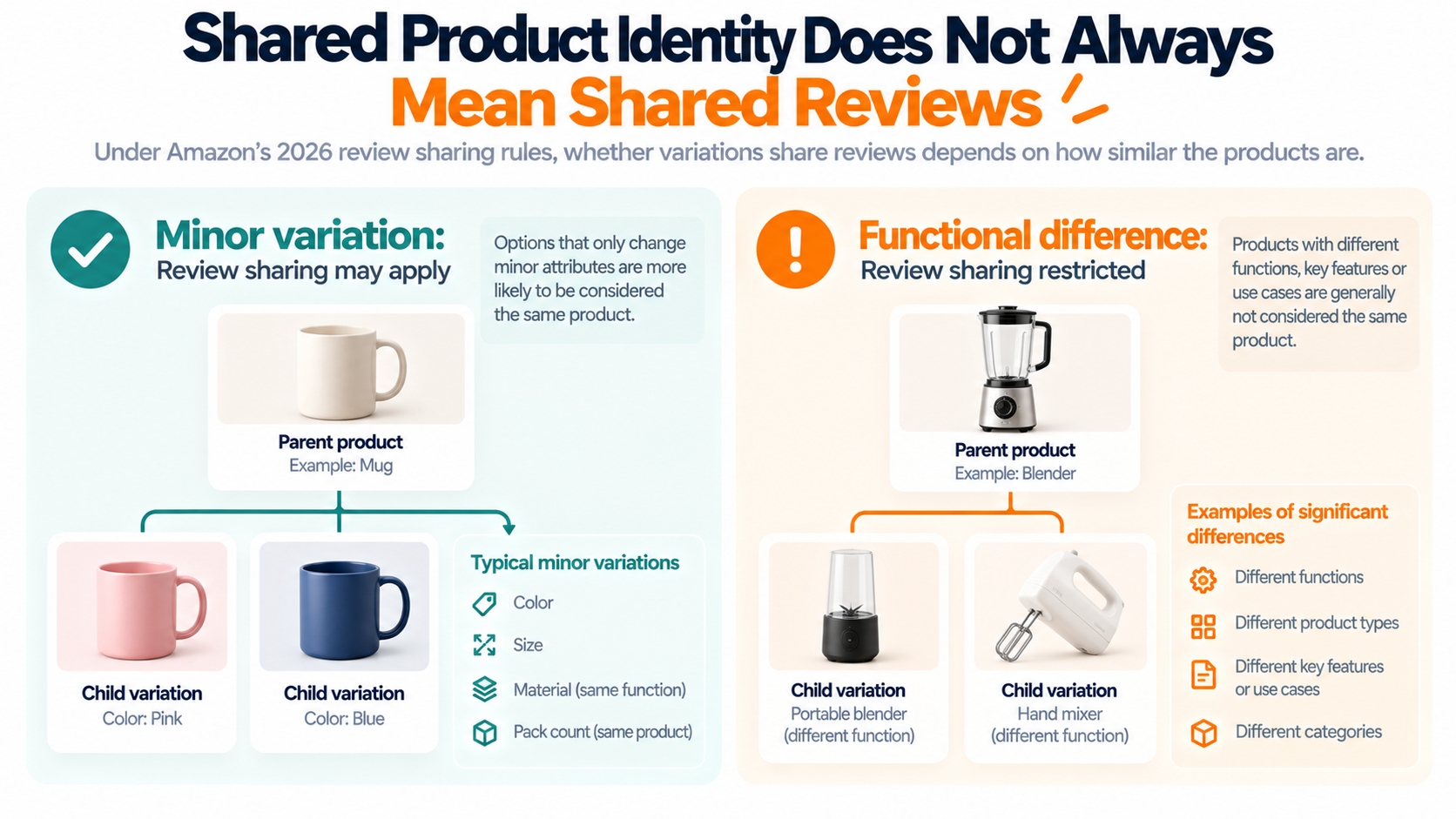
Amazon's updated approach allows review sharing between eligible variations with minor differences that do not affect functionality. Its published examples include colour or pattern differences, certain size variations with the same function, and pack-size variations.
Reviews are no longer shared in the same way across variations with significant functional differences. That may change visible star ratings and counts even when there has been no sudden increase in customer complaints.
Check the Variation Relationship Before Interpreting the Trend
If a product's review count changes sharply, examine the parent-child structure, variation themes, and recent catalog changes before attributing the movement to quality or customer sentiment.
Amazon's 2026 variation-review sharing announcement specifically recommends checking variation relationships in Manage All Inventory. A correct variation structure matters for both product identity and review relevance.
2026 review-trend checkpoint: When a rating or review-count movement appears unusual, check variation eligibility and catalog changes before treating the movement as a change in buyer satisfaction. Do not rearrange unrelated products into a variation family merely to combine review histories.
The same caution applies when comparing competitors. A parent listing with many historically shared reviews may not represent the buyer experience of the exact child ASIN or configuration you intend to compete against.
Read Review Data Without Inventing a Defect Rate
A review dashboard can tell you what customers are saying. It cannot, on its own, tell you how many units are defective or whether a particular rating movement caused sales to rise or fall.
The difference lies in the denominator. Buyers who leave written reviews are a selected group, not a complete or random sample of every customer. Star-only ratings, written reviews, fulfilled orders, and returned units should therefore be measured separately.
Five Metrics Worth Keeping Separate
| Metric | Useful interpretation | Important limitation |
|---|---|---|
| Displayed star rating | A visible summary of customer ratings for the displayed listing. | Not a direct defect rate or a simple average of the written reviews you sampled. |
| Review velocity | The number of newly observed reviews over a defined period. | Not equal to unit sales, customer acquisition, or a verified conversion rate. |
| Low-star review share | The proportion of a clearly defined reviewed sample carrying low ratings. | Not the proportion of all buyers who were dissatisfied. |
| Complaint-theme frequency | How often a specific issue appears in the coded review sample. | Multiple themes can appear in one review; a mention does not prove a defect. |
| Review changes alongside BSR | Whether review movement coincides with other market changes. | Correlation does not prove that reviews caused the BSR movement. |
The Difference Between a Complaint Share and a Product Defect Rate
Imagine that a seller examines 50 recent written reviews for one product. Twelve mention a lid that is difficult to close. Six mention damaged packaging, and three describe confusing dimensions. Some reviews may contain more than one theme.
In this hypothetical review sample, 12 of 50 reviews mention the lid issue, or 24%. That means 24% of the sampled review texts mention a lid problem. It does not mean 24% of units sold were defective.
To estimate an actual defect rate, the seller needs a clearly defined count of verified defective units and a relevant unit population. That evidence normally comes from product inspections, quality-control records, returns, and other operational sources, not review text alone.
Analysis rule: Always name the observation unit and time period. "Twelve of 50 sampled written reviews mention a lid problem" is useful and auditable. "The product has a 24% defect rate" is unsupported by that sample.
Keep an eye on the timing of review publication, promotion periods, product revisions, and variation changes. A review published this week may describe a product bought much earlier. A small batch of reviews may also create a dramatic-looking percentage change without representing a broad change in customer experience.
From Review Theme to a Change You Can Defend
Reading reviews only becomes useful when the team can decide what to investigate. A recurring phrase may point to a product defect, a misleading listing, a difficult setup experience, or an expectation that the product was never designed to meet.
Those are different problems. They should not all be solved by rewriting bullet points, nor should every negative comment trigger an immediate product redesign.
Sort Feedback by the Decision It Can Support
PRODUCT QUALITY
Repeated failures, wear, fit problems, or defective components may require supplier investigation, testing, or design changes.
LISTING ACCURACY
Confusion about size, included accessories, materials, or compatibility may justify clearer images and specifications.
PACKAGING AND DELIVERY
Damage complaints may call for a packaging review, handling checks, or analysis of affected shipments.
USER EXPERIENCE
Difficult setup, unclear instructions, or common misuse may require better guidance or product simplification.
Use AI Analysis to Find Patterns, Then Check the Evidence
Large review sets can be difficult to read consistently. SellerSprite's AI Review Analysis is relevant at this stage because it can help organise review content into product strengths, weaknesses, buyer expectations, use cases, and purchase motivations.
The tool can be used on your own listings and comparable competitor products. Its extension and web-based Review Analysis functions help sellers examine recurring customer concerns, ratings across variations, and review sentiment without working through every review individually.
The SellerSprite Review Analysis guide explains the extension workflow, AI-generated insights, variation-level information, and report-sharing options.
AI-generated themes should be treated as a research aid, not a verified statement about the entire customer base. Check the underlying reviews, sample coverage, product variation, and time period. A tool that identifies recurring concerns does not determine whether a specific review violates Amazon policy, nor does it confirm the physical cause of a defect.
Example: Customers Say the Lid Does Not Close Properly
Consider a hypothetical seller of food-storage containers. Recent reviews repeatedly mention difficulty closing the lids. At first glance, this looks like a product-quality problem.
The product team examines returned units and tests multiple production batches. Some lids are difficult to close because a component is misaligned. Others work correctly but require a motion that the product instructions never explain.
The evidence supports two different actions:
- Product action: Investigate component alignment and introduce appropriate quality checks for the affected batch.
- Listing and instruction action: Clarify the closing mechanism with an accurate product image or instruction step for correctly manufactured units.
Merely changing the listing would not fix the misaligned units. Merely changing the manufacturing process would not resolve confusion about correct use. The review theme identified a problem worth investigating; physical evidence determined the actual response.
After implementing the changes, the seller should compare later customer feedback with the earlier cohort and examine relevant return or inspection records. If the complaint becomes less common, that is encouraging evidence, but it is not automatic proof that the change caused a higher star rating or stronger sales.

A Review-Management Routine That Produces Decisions
Review management becomes difficult when every negative comment is treated as urgent but no one owns the underlying problem. A useful operating routine separates immediate customer needs from patterns that require longer investigation.
The following cadence is a suggested team workflow, not a set of Amazon-mandated response deadlines. Adapt it to order volume, product risk, programme eligibility, and the actual urgency of customer issues.
DAILY / CUSTOMER ISSUES
Check What Needs Action Now
Review eligible customer-contact opportunities, urgent quality concerns, and seller-service problems. Record which cases need permitted customer support, investigation, or a policy report. Do not treat every low rating as a request to contact the buyer.
WEEKLY / PRODUCT SIGNALS
Review Recurring Complaints by ASIN
Examine newly observed written reviews, recurring negative themes, product variations and relevant return evidence. Assign a clear owner to each issue worth investigating. Preserve enough source detail that another team member can understand the decision later.
MONTHLY / PRODUCT AND MARKET CONTEXT
Compare Trends Before Declaring Progress
Review rating and review-count movement alongside relevant BSR, price, inventory and promotional changes. Confirm whether catalog structure or variation-review sharing changed during the period. Track whether corrective actions were completed and whether the underlying complaint pattern changed.
Keep a Small, Auditable Issue Register
The review meeting needs a record of decisions rather than another presentation. A useful issue register can contain the ASIN or child variation, observed theme, source and sample period, evidence, assigned owner, corrective action, and follow-up date.
For example, an entry reading "customers report missing mounting hardware" should be linked to the relevant reviews, an inspection of actual packaged units, and the responsible supplier or warehouse process. The outcome should state what was found, not merely that someone updated the listing.
SellerSprite's Product & Keyword Tracker can provide supplementary historical context for product ratings, review-count changes, prices, and market performance. Use it to support competitive monitoring, not as a replacement for order-level customer-service records or Amazon's policy enforcement tools.
When Should the Team Stop Monitoring and Start Investigating?
There is no universal number of negative reviews that proves a product needs redesign. A single credible safety concern can demand urgent investigation, while a handful of subjective preferences may not justify changing the product.
Prioritise according to severity, supporting evidence, recurrence, and the ability to prevent further harm. For non-urgent problems, compare complaints across batches, variations, and time periods before deciding.
Three Questions to Close Each Review Meeting
- Which customer concern requires action, and who owns it?
- What evidence would confirm or reject our explanation of the issue?
- What will we check after the change to determine whether the underlying problem improved?
A Better Rating Is Not the First Deliverable
A strong Amazon review-management process does not begin with a target star rating. It begins with a product that meets its stated promise, a neutral way for customers to share their experiences, and a team prepared to act on the problems that emerge.
Use Amazon's permitted review-request tools. Handle critical reviews through the appropriate customer-service or moderation process. Compare ratings with their review sample, variation structure, and other marketplace changes before treating a trend as evidence of progress.
Some negative reviews will remain visible even after a legitimate problem has been resolved. That is part of an authentic review system. The business gains more by preventing the next avoidable complaint than by trying to erase the last one.
FAQs
What is Amazon review management?
Amazon review management involves monitoring genuine product feedback, requesting reviews through compliant methods, handling eligible customer issues, and using repeated complaints to guide product and listing improvements. Sellers cannot directly control the ratings customers give.
How can Amazon sellers request reviews legally?
Amazon recommends using the Request a Review feature for eligible orders. Sellers can use it once per order between 5 and 30 days after delivery. The standardised message requests both a product review and seller feedback without directing the customer toward a particular rating.
Is Amazon Vine the same as paying customers for reviews?
No. Amazon Vine is an Amazon-operated programme with specific eligibility and participation rules. Vine Voices receive products to try and provide independent opinions. Sellers cannot require positive reviews or determine their content.
Can sellers contact customers who leave one-star reviews?
Eligible Brand Representatives can use Amazon's Customer Reviews tool to contact customers who leave ratings below three stars. Available actions include an authorised courtesy refund or customer support. Sellers cannot request a change or removal of the review.
Can Amazon sellers delete negative product reviews?
Sellers cannot delete reviews themselves. They may report content that appears to violate Amazon's Community Guidelines. Amazon evaluates whether removal is appropriate, and an authentic negative opinion is not removable solely because the seller disagrees with it.
What is the difference between product reviews and seller feedback?
Product reviews describe customers' experiences with an item and appear on product detail pages. Seller feedback describes the buying experience with a specific merchant, including relevant order-service issues. Seller feedback is managed through Feedback Manager.
Why did my Amazon product review count change in 2026?
One possible reason is Amazon's updated variation-review sharing rules. Beginning February 12, 2026, Amazon rolled out changes that limit review sharing across variations with significant functional differences. Check the product's variation structure and relevant catalog changes before interpreting the movement as a change in customer satisfaction.
Does a high percentage of negative reviews mean the same percentage of products are defective?
No. Reviews represent a selected group of customer experiences. A percentage calculated from written reviews describes that review sample, not all sold units. Estimating a defect rate requires operational evidence such as inspected units, verified defects, and an appropriate sales or production denominator.
How can SellerSprite support Amazon review management?
SellerSprite Review Analysis can help identify recurring customer complaints, product strengths and weaknesses, use cases, and expectations across product reviews. Product & Keyword Tracker can provide additional historical context for review counts, ratings, and related market signals. These research functions do not replace Amazon's review-request, customer-contact, or moderation processes.
How often should Amazon sellers review customer feedback?
The appropriate cadence depends on product risk, order volume, and the availability of authorised customer-contact options. A practical routine checks time-sensitive issues frequently, reviews recurring themes weekly, and examines longer-term rating and product trends monthly. Those intervals are suggested operating practices, not Amazon policy deadlines.
References
- Amazon Seller Central: Customer Product Reviews Policies View
- Amazon Seller Central: Inappropriate Product Reviews View
- Amazon Seller Central: Request a Review from a Customer View
- Amazon: Amazon Vine Programme and Eligibility View
- Amazon: Customer Reviews Tool for Brand Representatives View
- Amazon Seller Central: Seller Feedback and Product Review Differences View
- Amazon Seller Forums: Changes to Review Sharing Across Product Variations in 2026 View
- Amazon Seller Forums: Product Inserts, Allowed and Prohibited Practices View
- SellerSprite: Review Analysis Guide View
- SellerSprite: Product & Keyword Tracker Guide View
By SellerSprite Content Team
The SellerSprite Content Team works across Amazon marketplace research, ecommerce data analysis, and seller operations. Its research examines how customer feedback, product quality, listing accuracy, and competitive conditions shape the buying experience. In the area of review and reputation analysis, the team focuses on interpreting rating trends, understanding recurring buyer concerns, and distinguishing marketplace signals from verified product-performance evidence. This approach supports practical, policy-conscious research for Amazon brands and marketplace operators.
Last reviewed: October 21, 2026