TL;DR: Amazon online arbitrage means buying products from online retailers at one price and reselling them through Amazon when the expected proceeds justify the costs and risks. The discount is only the starting point. Before ordering, confirm that you can sell the exact ASIN, that the product and its supply records meet the applicable requirements, and that the economics work at a realistic competitive selling price. Then verify historical demand, competing offers, inventory condition, and fulfillment costs. A small, documented purchase is a better first test than committing to a large clearance order based on today's price gap.
Key Takeaways
- Approval comes before the bargain. A low retail price is not useful if the seller cannot list the exact product or substantiate its sourcing.
- Match the entire product, not just its barcode. Brand, variation, quantity, packaging, condition, and market version must agree with the ASIN.
- BSR and estimated sales describe the market, not your guaranteed sales. Historical trends and competing offers provide better context than a single ranking or Featured Offer price.
- Stress-test the price before buying. Include acquisition, sourcing delivery, preparation, inbound shipping, Amazon fees, and an allowance for inventory problems.
- A successful batch must survive beyond one good sale. Record how many units actually sell, what they sell for, how long cash remains tied up, and whether the opportunity can be sourced again.
Table of Contents
- Amazon and Online Arbitrage: How the Model Works
- Check Selling Permission Before Sourcing
- A Matching ASIN Is More Than a Matching Image
- The Online Retailer's Receipt May Not Be Enough
- Look Beyond Today's BSR and Featured Offer
- Calculate the Margin That Survives a Price Drop
- One Unsold Unit Can Change the Whole Batch
- Run a Small Purchase Before Scaling
- A Repeatable Source Is Different from a One-Time Flip
- Know When to Walk Away
- FAQs
- References
Scope: This guide focuses on buying physical goods from online retailers and reselling them through Amazon.com in the United States. The examples primarily use FBA, although many sourcing checks also apply to seller-fulfilled inventory. Product eligibility, brand approvals, fees, and account requirements must be verified for the actual seller account and ASIN. This is operational guidance, not a guarantee of selling approval or legal advice about resale rights.
Amazon and Online Arbitrage: How the Model Works
An online retailer offers a storage accessory for $13. The same product appears on Amazon for $29.99. At first glance, the difference looks like an attractive resale opportunity.
But the Amazon price is not the seller's proceeds, and the retail listing does not prove that the product can be sold through that seller's account. The retailer may also cancel the order, send a different package version, or end the promotion before another batch is available.
Amazon online arbitrage is a retail resale model in which sellers locate products through ecommerce websites, buy inventory at an advantageous acquisition cost, and offer qualifying units for sale on Amazon. Profit depends on the actual selling price, costs, eligibility, competition, and condition of the inventory received.
Online arbitrage vs. retail arbitrage, wholesale, and dropshipping
The models are related because they all involve sourcing products, but the operational risks differ. In particular, buying from an online retailer for inventory is not the same as having that retailer ship an Amazon customer order on your behalf.
| Model | How inventory is obtained | Main additional risk |
|---|---|---|
| Online arbitrage | Buy through ecommerce retailers and receive or route inventory for inspection and fulfillment. | Retail order limits, substitutions, shipping delays, weak sourcing documentation, and temporary discounts. |
| Retail arbitrage | Purchase inventory from physical stores or local clearance sales. | Store-to-store supply variation, receipt documentation, packaging wear, and sourcing time. |
| Wholesale resale | Buy through a supplier or distributor relationship, often with negotiated quantities and terms. | Minimum orders, supplier qualification, cash commitment, and authorization requirements. |
| Dropshipping | An appropriate third-party supplier fulfills orders to customers under the seller's compliant arrangement. | Seller-of-record obligations, packaging identity, fulfillment control, and prohibited retail-to-retail fulfillment. |
Amazon's public reselling guidance distinguishes resale sourcing from direct-to-customer dropshipping. Its dropshipping policy requires the seller to be the seller of record and to meet specific supplier and packaging conditions. Buying from another retailer after receiving an Amazon order and sending that retailer's parcel directly to the customer is not a compliant shortcut.
The practical question for online arbitrage is whether the seller can purchase, document, inspect, and fulfill genuine inventory at a cost that remains profitable after the market changes.
Check Selling Permission Before Sourcing
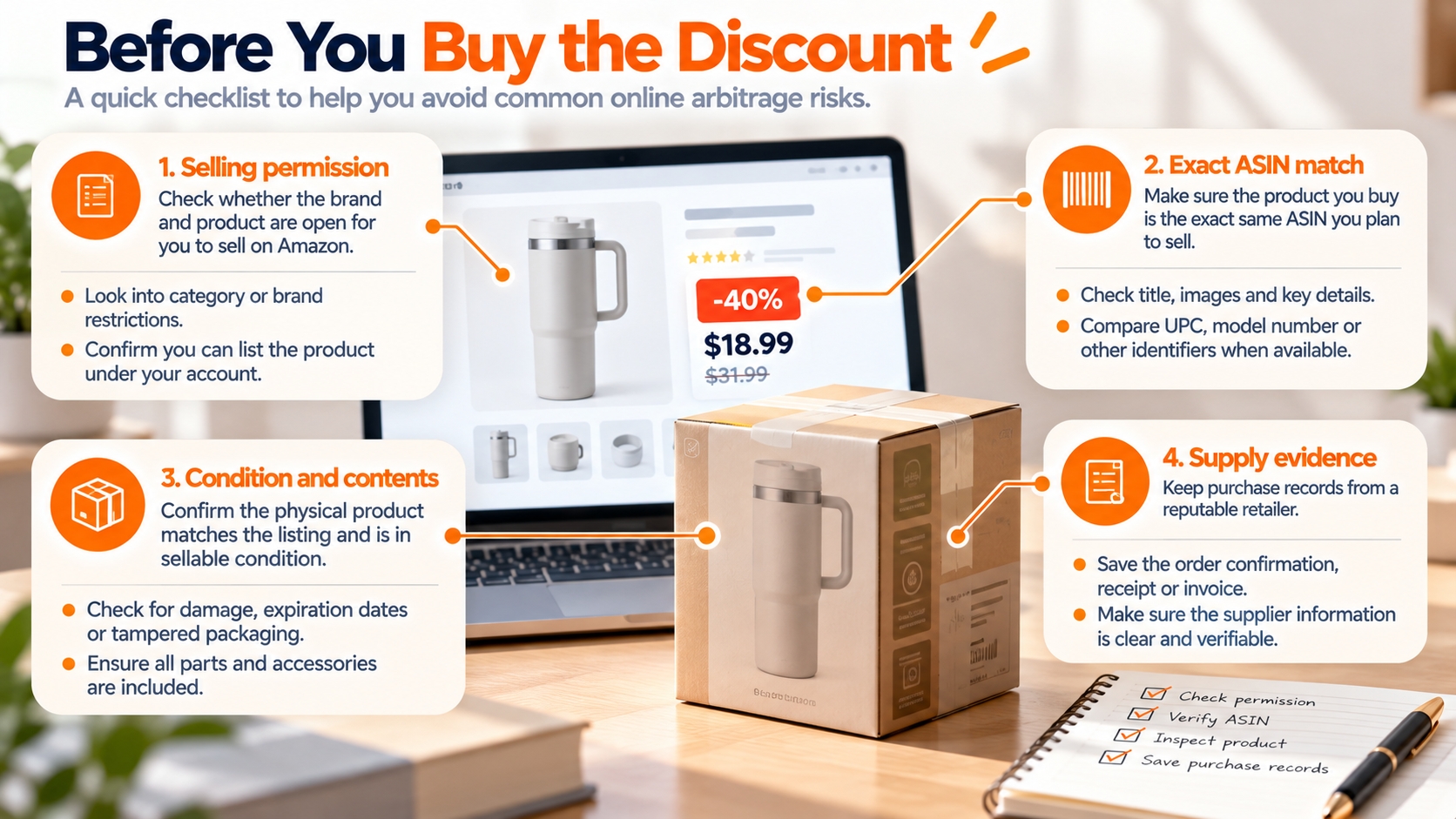
A common beginner mistake is to complete every profitability calculation before checking whether the product can be listed. That reverses the decision order. The seller should first establish that the exact product and condition are eligible for the intended account.
Selling privileges can depend on the brand, product category, ASIN, and condition. The presence of other sellers on the listing does not establish that a new seller has the same approval.
Check the exact ASIN in your seller account
Use Seller Central's Add Products process to locate the product, choose the intended condition, and check whether Amazon requires an application or other documentation. Confirm any approval using the actual selling account before committing funds.
Amazon's branded-product selling guide explains that certain brand applications require invoices from manufacturers or distributors, or a qualifying brand authorization letter. Approval to resell an existing offer is also different from permission to create a new detail page for a registered brand.
Check restrictions beyond the brand name
Some categories and items have special requirements covering safety, product compliance, condition, expiration dates, batteries, dangerous goods, or other restrictions. A unit that can be purchased from an online retailer is not necessarily eligible for Amazon FBA or resale in the same condition.
Check category and item-specific rules, product documentation, and fulfillment suitability. For beginners, it is often easier to evaluate a straightforward, non-expiring product than inventory requiring specialized compliance verification. This is a practical simplification, not a statement that all ordinary household products are unrestricted.
The first purchase gate: If you cannot confirm selling eligibility, supply authenticity, and the required evidence for the exact product, do not treat a price discount as a reason to proceed. A favorable margin does not resolve an approval problem.
A Matching ASIN Is More Than a Matching Image
Two shopping websites can display nearly identical product photography while offering different units. One might sell a single accessory; another might sell a two-pack. The manufacturer may also have changed the packaging, included parts, or model number without substantially changing the main photograph.
Online arbitrage depends on matching the physical inventory to the existing Amazon detail page. Research the product identifiers and the actual contents instead of matching only the title or image.
Compare the attributes that determine whether the offer is accurate
ASIN Matching Checklist
- Brand and manufacturer: Confirm that the names and product identifiers refer to the same genuine item.
- Model or part number: Check exact letters, revisions, and specification differences.
- Variation: Match size, color, capacity, scent, and other relevant options.
- Pack quantity: Determine whether the listing is for one unit, a multipack, or a manufacturer bundle.
- Region and compatibility: Confirm relevant language, power specifications, included plugs, warranty terms, and market-specific requirements.
- Packaging and condition: Inspect seals, labels, expiration information where relevant, and signs of previous use or damage.
- Program-specific requirements: Check for applicable product authentication, labeling, or other listing controls.
Clearance inventory is not automatically New inventory
Retail clearance may include untouched products, damaged boxes, open-box returns, or old versions. The seller needs to know what is actually being purchased and select a condition that accurately represents the item.
Amazon's public condition guidance distinguishes New, Used, and other permitted condition categories. Packaging and completeness matter, and some products cannot be listed in every condition. A discounted or returned product is not automatically eligible to be sold as New.
Inspect the received units before fulfillment
Online orders can arrive in split shipments, with substitutions or different product versions. Check every received unit before sending it to FBA or fulfilling an order yourself. Record discrepancies and initiate supplier returns where appropriate.
A third-party preparation center can perform defined checks, but the seller still needs a clear receiving standard and responsibility for resolving mismatches. Sending inventory straight into a fulfillment network without adequate verification can turn a small sourcing error into a customer complaint or stranded stock.
The Online Retailer's Receipt May Not Be Enough
Purchasing a genuine product and being able to satisfy Amazon's documentation requirements are related, but separate, questions. The item may have been sold by a legitimate retailer while the transaction record still lacks information required for a specific brand or authenticity review.
This is a central risk in online arbitrage because the seller often has an ordinary ecommerce order confirmation rather than a direct manufacturer or authorized distributor invoice.
Preserve the transaction trail
Keep the original retailer and supplier details, order confirmation, final receipt or invoice, payment record, quantity, product identifiers, shipment information, and receiving inspection notes. Where available, retain lot, serial, or other relevant traceability information.
These records help with reconciliation, tax administration, supplier disputes, and internal inventory control. However, retaining a record does not mean Amazon will accept that record for every approval or authenticity request.
Retail receipts and distributor invoices serve different purposes
Amazon's branded-product guidance describes applications that request purchase invoices issued by a manufacturer or distributor, or a qualifying brand authorization letter. A checkout confirmation from an ordinary online retailer should not be assumed to satisfy those requirements.
Check the actual application requirements before buying. An unrestricted offer at one moment also does not guarantee that the account will never be asked to provide authenticity evidence later.
Authenticity and resale rights are not identical to platform approval
General legal principles concerning the resale of genuine products do not override Amazon's own listing eligibility, product condition, intellectual property, or anti-counterfeiting requirements. Material product differences, warranty representations, and branded-product controls may create additional issues.
A supplier who cannot establish the authenticity or appropriate origin of inventory is a reason to reject the opportunity, regardless of the apparent savings. Amazon recommends researching suppliers, verifying products, and preserving transaction documentation.
A sourcing rule worth keeping: Save every legitimate purchase document, but never manufacture, alter, or misrepresent an invoice to qualify for an Amazon listing. If the available evidence cannot satisfy an applicable approval requirement, find a suitable supply relationship or choose a different product.
Look Beyond Today's BSR and Featured Offer
The next question is whether inventory can realistically sell. A product may have healthy category demand but already be served by several established merchants. The arbitrage seller must compete for orders while maintaining enough price room to cover the acquisition cost.
Read demand, historical prices, and competing offers together. A single snapshot can be unusually favorable because of a temporary stockout or promotion.
BSR describes product demand, not your share of sales
Amazon Best Sellers Rank is a relative sales-based position within a category. A lower numerical rank generally indicates stronger relative sales, but rankings differ by category and can change with recent sales activity.
A favorable BSR does not tell an additional reseller how many units it will sell. The product's activity is shared among the offers competing on the detail page, and the distribution of orders is not necessarily equal.
Study historical price and seller competition
Review the relevant ASIN over several periods. Did the offer price remain near today's level, or did it rise only after competing sellers ran out of stock? Did demand increase seasonally? Are new sellers entering the listing?
The Featured Offer, formerly commonly called the Buy Box, gives selected competitive offers prominent purchase placement. Price, fulfillment, availability, and seller performance can influence eligibility and selection. Matching the current Featured Offer price does not guarantee that a newly approved seller will receive the same visibility.
Check whether a price spike is a temporary opportunity
A listing can temporarily rise in price when a major seller goes out of stock. That price may be attractive on the day of research and unavailable by the time a new seller receives and prepares the product.
For short-lived arbitrage deals, examine a normal competitive price and a lower-price scenario instead of building the entire purchase decision around the highest recent offer.
Where SellerSprite fits into the research
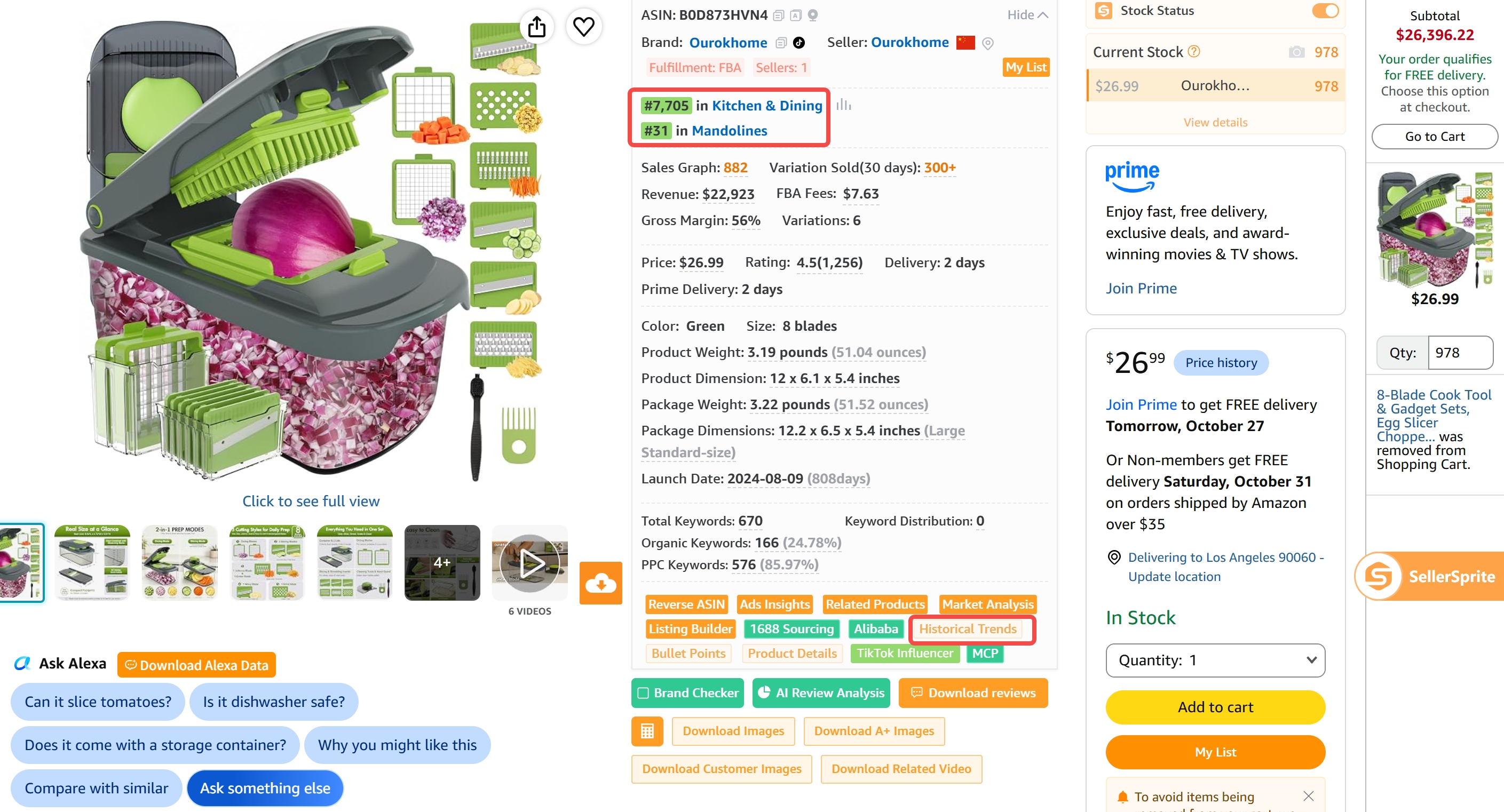
The SellerSprite browser extension guide explains how sellers can inspect product data on Amazon pages, including estimated sales, price, BSR, and historical trends. Product Research also supports broader comparisons and time-based analysis.
For online arbitrage, use these data as an initial research layer. Compare the candidate ASIN's historical behavior with the live offer list and the exact product being sourced. Estimated marketplace sales are not a record of an individual competitor's verified unit sales or a guarantee of future orders for your seller account.
Interpret the signals together: Historical demand tells you whether the product has a market. Offer competition helps assess access to that demand. Actual selling eligibility and a realistic competitive price determine whether your inventory can participate profitably.
Calculate the Margin That Survives a Price Drop
The largest source of false confidence in online arbitrage is treating the spread between retail acquisition price and Amazon selling price as profit. The seller must acquire the item, prepare it, deliver it to the chosen fulfillment channel, and pay the costs associated with the sale.
A useful calculation begins with the realistic selling price and includes the costs the business will actually incur. It should be repeated at a lower competitive price, before the purchase is placed.
A hypothetical $29.99 arbitrage opportunity
Suppose a reseller finds a non-expiring household accessory offered at an acquisition price of $13.00. The reseller plans to sell the exact eligible product through FBA for $29.99.
The following numbers are invented for illustration. The 15% referral-fee assumption and $4.75 FBA fee are not verified charges for a specific ASIN. Actual fees depend on the category, product, dimensions, weight, fulfillment method, and applicable pricing schedule.
| Item | Amount | Interpretation |
|---|---|---|
| Selling price | $29.99 | Assumed price received for one completed sale. |
| Retail product cost | -$13.00 | Product acquisition cost. |
| Retailer-to-seller shipping | -$1.20 | Allocated sourcing delivery charge. |
| Inspection and prep | -$0.75 | Allocated receiving and preparation expense. |
| Inbound shipping to FBA | -$0.90 | Allocated inbound transportation. |
| Amazon referral fee | -$4.50 | Illustrative 15% of $29.99, rounded. |
| FBA fulfillment fee | -$4.75 | Hypothetical fee, not an actual ASIN quote. |
| Storage and problem allowance | -$0.80 | Planning allowance allocated to each sold unit. |
| Modeled per-unit contribution | $4.09 | Before fixed overhead, income tax, and additional unmodeled losses. |
The calculation is $29.99 minus $25.90 in modeled costs, leaving $4.09 per unit. That is an approximately 13.6% contribution margin on selling price. The $13 retail acquisition price alone would have overstated the attractiveness of the deal.
The $0.80 reserve is only a planning assumption. Actual storage, returns, damaged inventory, removals, advertising, additional FBA charges, sales tax treatment, and account-level costs may differ. Do not use the table as a substitute for a current fee estimate.
Run the same calculation at a lower selling price
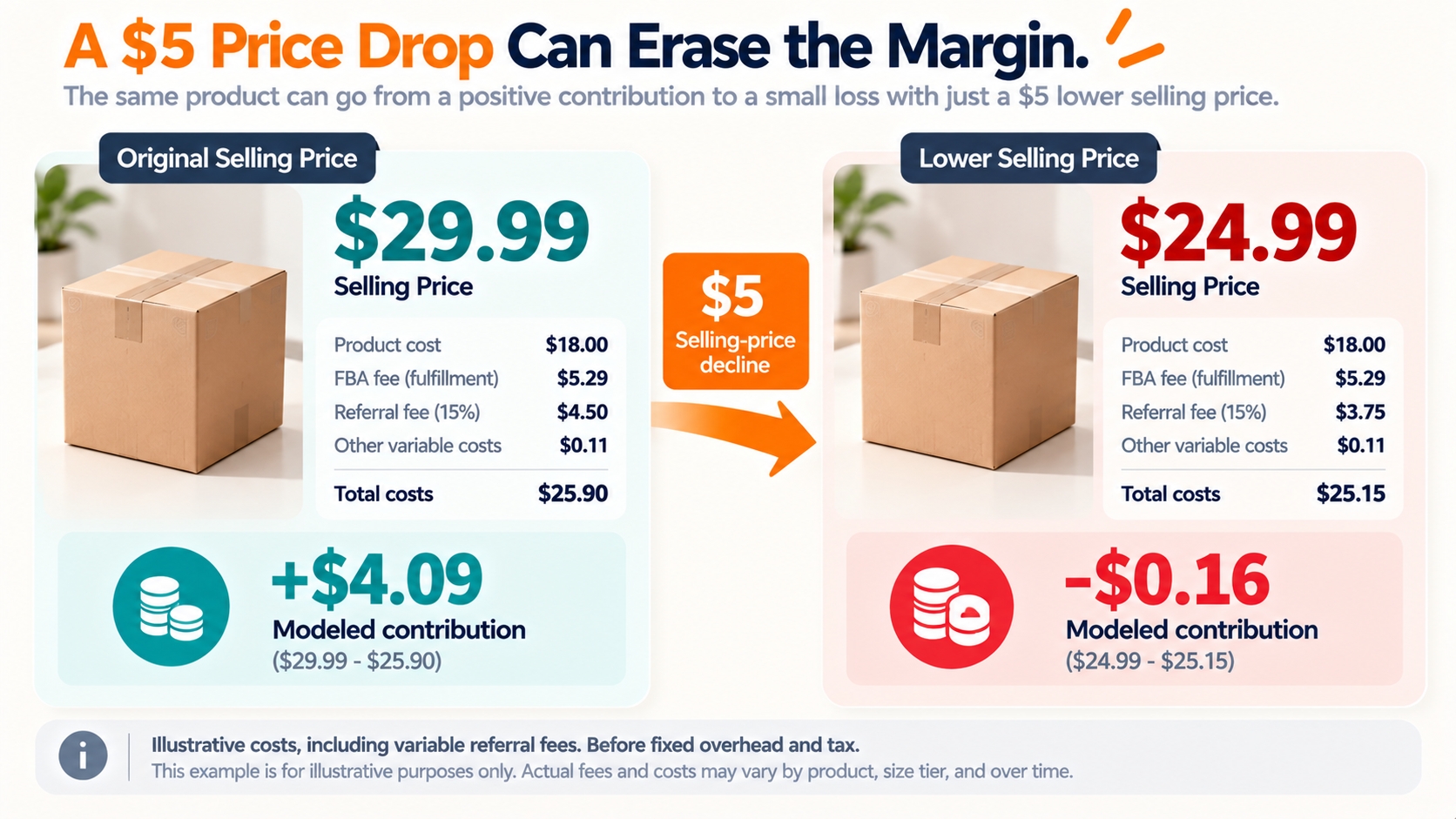
Suppose competitive pricing falls to $24.99 before the seller receives an order. Keep the same modeled acquisition, shipping, preparation, FBA, and reserve costs. Recalculate the illustrative 15% referral fee as $3.75 after rounding.
ORIGINAL PRICE
$29.99
+$4.09 modeled contribution per sold unit.
LOWER COMPETITIVE PRICE
$24.99
-$0.16 modeled contribution per sold unit.
At $24.99, the modeled costs total $25.15, so the seller loses approximately $0.16 per sold unit before fixed overhead and other unmodeled expenses. A $5.00 reduction in selling price has removed the entire estimated contribution.
With the same assumptions and a proportional 15% referral fee, the estimated break-even selling price is approximately $25.18. The equation is $21.40 in other modeled costs divided by 0.85. This is an illustration, not an Amazon price recommendation or a promise of Featured Offer eligibility.
Verify actual fees before the order
Amazon's public fee-estimation guide explains how sellers can compare FBA and self-fulfillment costs using the Revenue Calculator. Run the actual product or appropriate dimensions and category through a current estimate, then add your own sourcing expenses.
Amazon has separate selling-plan, referral, fulfillment, and other potential charges. Fee categories may also differ from the customer-facing browse category, so do not assign a referral percentage solely from the visible listing category.
One Unsold Unit Can Change the Whole Batch
A positive calculation for one completed sale assumes that the purchased unit is actually sold. In arbitrage, inventory may arrive damaged, fail inspection, remain unsold, become ineligible, or need to be returned to the supplier.
That is why the correct unit of analysis is sometimes the entire purchased batch rather than one theoretical sale.
Compare ten purchased units with nine completed sales
Extend the previous example to ten units. Assume that nine units sell for $29.99 and one is never sold or recovered. For simplicity, all ten incur the acquisition, sourcing delivery, preparation, and inbound costs, while Amazon selling and fulfillment charges apply only to the nine completed sales.
| Line item | Amount | Basis |
|---|---|---|
| Revenue from nine completed sales | $269.91 | 9 × $29.99 |
| Acquisition, sourcing delivery, prep, and inbound | -$158.50 | 10 × $15.85 |
| Referral fees on nine sales | -$40.50 | 9 × $4.50 |
| FBA fees on nine sales | -$42.75 | 9 × $4.75 |
| Storage and problem allowance | -$7.20 | 9 × $0.80 |
| Modeled batch contribution | $20.96 | Before unmodeled disposal, removal, fixed overhead, and taxes |
If all ten units had sold under the original per-unit assumptions, modeled contribution would have been $40.90. With one completely unrecovered unit, it falls to $20.96. That is a difference of $19.94 before any additional loss-handling costs.
The example assumes zero salvage or supplier refund for the unsold unit and charges the $0.80 allowance only to completed sales. Actual inventory that remains on hand should be handled according to its recoverable value and relevant accounting treatment. A real batch can also incur removal fees, additional storage, or supplier return costs.
The broader lesson is that healthy per-sale economics do not eliminate batch risk. For a reseller without a reliable supplier-return arrangement, the first few unsellable units may absorb a meaningful share of the expected contribution.
Run a Small Purchase Before Scaling
A useful first purchase is not merely small. It is designed to answer questions that cannot be fully resolved before the product arrives and begins selling.
The seller should have a clear reason for the quantity chosen, a defined maximum loss, and an observation period that reflects actual sourcing and fulfillment lead times.
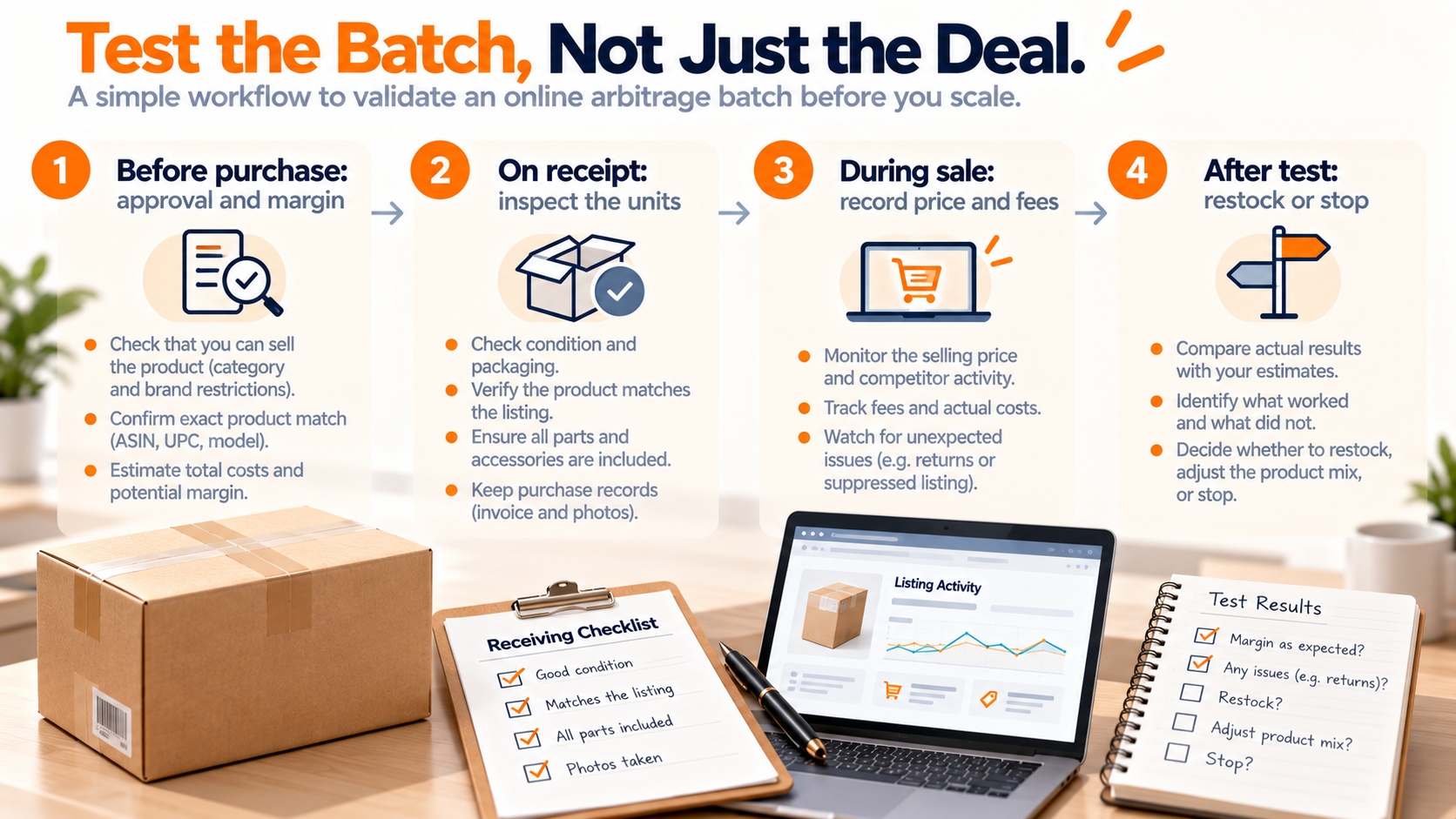
Before the order: record the assumptions
- Confirm the product, brand, condition, and ASIN approval.
- Save the actual retailer offer, order quantity, purchase terms, and available sourcing documents.
- Record the current and historical competitive prices, estimated demand, and seller competition.
- Calculate contribution using the current fee estimate and a lower-price scenario.
- Decide the maximum cash amount and number of units the seller is willing to risk in this batch.
On receipt: inspect and reconcile
Compare the received inventory with the purchase record and Amazon listing. Check quantity, manufacturer identifiers, packaging, included accessories, and product condition. Document discrepancies and supplier returns before creating or sending the fulfillment shipment.
The receiving stage is especially important for online sourcing because a digital listing may not accurately show the version that arrives. Record the actual time between ordering, receipt, preparation, and availability for sale.
After listing: measure what actually happened
Track eligible inventory, completed unit sales, realized selling prices, fees, returns, and inventory that remains unsold. Record whether the seller was eligible for the Featured Offer and how the competing offer environment changed.
A test may end without enough sales to establish a reliable rate. Do not fill the gap with the ASIN's total estimated marketplace sales. The correct conclusion may simply be that the batch has not demonstrated a viable sales pace for the seller.
A Repeatable Source Is Different from a One-Time Flip
An online clearance order may produce a profitable sale once and never be available again. That can still be a valid small transaction, but it is not the same as building a replenishable product line.
As the business grows, the availability of suitable stock and reliable documentation can become more limiting than the ability to find apparent price differences.
Check the source after the opening promotion ends
Ask whether the retailer permits repeat commercial quantities, whether the normal purchase price supports profit, and whether the same product version remains available. Coupons, cashback offers, purchase limits, and cancellation risks should be included in the real acquisition process.
Do not plan a recurring business around a one-time promotional code without a replacement supply strategy. Do not assume that sales-tax exemptions or resale certificates apply automatically to every online retailer or state; tax treatment depends on the applicable rules and circumstances.
Review cash timing as well as margin
Inventory ties up cash from the purchase date until sales proceeds become available, subject to the account's settlement arrangements and any holds. Sourcing, preparation, inbound delivery, and selling delays can extend that period.
For a cash-constrained reseller, a modest-margin product that turns reliably may be easier to sustain than an apparent high-margin product that remains unsold for months. Compare contribution per batch with the time and capital required to realize it.
Know when wholesale sourcing becomes the better model
Repeated success with a product may justify investigating a direct manufacturer or distributor relationship. A qualified wholesale source may offer clearer documentation and more predictable availability, though it can also introduce minimum order quantities, negotiated terms, and other capital commitments.
Switching sourcing models is not necessary for every seller. It becomes worth evaluating when the repeated effort of finding short-lived retail discounts outweighs the commercial benefit of each small batch.
Know When to Walk Away
The best online arbitrage decision is not always the product with the largest advertised discount. It is the product that passes selling eligibility, sourcing evidence, exact-match inspection, competitive demand, and realistic batch economics.
A seller who rejects an uncertain offer before buying has avoided a potential inventory problem. A seller who purchases a small, documented batch and learns how it actually sells has obtained information that can support a better next decision.
That discipline matters more than the number of price gaps found in a sourcing session. The purchase is only the beginning of the resale decision.
FAQs
What is Amazon online arbitrage?
Amazon online arbitrage involves purchasing inventory from online retailers and reselling eligible products through Amazon at prices intended to cover acquisition, fulfillment, and other expenses. The seller must independently verify listing permission, authenticity, condition, and profitability. A retail price difference alone does not establish a viable resale opportunity.
Is online arbitrage allowed on Amazon?
Amazon discusses arbitrage and resale as selling models, but individual products and accounts remain subject to applicable restrictions, authenticity requirements, condition guidelines, and product policies. You cannot assume that a product is approved simply because it is offered by an online retailer.
Can I use a retail receipt to get ungated on Amazon?
Do not assume so. Some Amazon brand applications require an invoice from a manufacturer or distributor, or a qualifying authorization letter. An ordinary retail order receipt may be useful for your records without meeting those approval requirements. Follow the documentation requested in the actual application.
How much money can beginners make with Amazon online arbitrage?
There is no reliable universal profit figure. Returns depend on the products, source costs, competitive selling prices, actual fees, sell-through, and inventory losses. Calculate each deal using the real ASIN and test at a lower selling price. The hypothetical example in this guide produces $4.09 contribution at $29.99 but a small loss at $24.99.
What is the difference between online arbitrage and retail arbitrage?
Online arbitrage sources inventory through ecommerce websites, while retail arbitrage sources from physical stores. Both rely on resale price gaps. Online sourcing adds risks such as substitutions, shipping delays, cancellations, and difficulty inspecting the exact product before purchase.
Is online arbitrage the same as dropshipping?
No. Online arbitrage generally involves purchasing inventory for resale and arranging its compliant fulfillment. Dropshipping uses a supplier to fulfill customer orders under a separate arrangement. Amazon requires dropshippers to be the seller of record and comply with its packaging and fulfillment rules; prohibited retail-to-retail dropshipping is not a substitute for purchasing inventory.
What metrics matter most for Amazon online arbitrage?
Begin with selling eligibility and source reliability. Then evaluate historical BSR and estimated demand, price stability, Featured Offer competition, actual fees, contribution at lower prices, inventory sell-through, and the reliability of future sourcing. No single metric is sufficient.
Should online arbitrage sellers use FBA or FBM?
The appropriate method depends on product size, storage needs, selling speed, shipping costs, and operational capabilities. FBA can simplify customer fulfillment but adds specific fees and inventory requirements. FBM offers direct fulfillment control but requires the seller to manage shipping and service obligations. Compare both using current product-specific costs.
Does a low BSR guarantee that my units will sell?
No. BSR indicates relative product sales performance within a category. It does not reveal how future sales will be divided among competing merchants. Offer eligibility, price, shipping performance, and inventory availability influence a reseller's opportunity to receive orders.
How can SellerSprite help with Amazon online arbitrage?
SellerSprite can support product research through estimated sales, BSR history, pricing trends, and comparison tools. Its browser extension provides quick product research directly on Amazon pages. These tools help assess demand and competition but do not establish listing approval, source authenticity, or actual seller-level profitability.
References
- Amazon: Guide to Reselling in Amazon Stores View
- Amazon: How Dropshipping Works and What Amazon Requires View
- Amazon: Three Ways to Sell Branded Products View
- Amazon: Product Condition Guidelines View
- Amazon: Pricing Strategies and the Featured Offer View
- SellerSprite: Browser Extension Guide View
- SellerSprite: Product Research Guide View
- Amazon: Estimate Selling Fees and Fulfillment Costs View
- Amazon: Standard Selling Fees and Referral Fee Categories View
- Amazon: Guide to FBA Fees, July 2026 View
- Amazon: Seller Policies and Account Health View
By SellerSprite Content Team
The SellerSprite Content Team researches Amazon marketplace competition, product demand, sourcing models, and the financial decisions involved in selling physical inventory online. Our work draws on ASIN-level research, historical price and sales indicators, product documentation, and published marketplace policies.
Last reviewed: October 27, 2026