An Amazon review checker can surface unusual timing, repeated wording, rating shifts, reviewer patterns, and product-variation mismatches. It cannot determine with certainty that a specific review is fake, so sellers should treat the output as a starting point for investigation instead of a verdict.
An Amazon review checker can identify observable anomalies in public review data, but it cannot prove that an individual review is fraudulent or policy-violating. Use checker output to prioritize manual review, preserve the underlying evidence, compare the pattern with catalog and operational changes, and report suspected violations through Amazon's approved channels. Do not publish a checker score as a factual accusation about a reviewer, seller, or competitor.
Key takeaways
- Treat a checker score as a triage signal. A score can help decide what to inspect first, but it is not an enforcement decision or proof of fraud.
- Look for normal explanations before assuming manipulation. Launches, promotions, seasonality, product updates, variation merges, and fulfillment changes can produce unusual review patterns.
- Corroborate public signals with first-party context. Compare reviews with listing changes, returns, support contacts, price history, inventory events, and known product batches.
- Preserve facts separately from interpretations. Record the visible review and surrounding context before describing why it deserves further investigation.
- Use Amazon's reporting process. Sellers cannot edit customer reviews and should not confront or publicly identify reviewers.
What is an Amazon review checker?
An Amazon review checker is a third-party analysis tool or workflow that examines visible review information and highlights patterns that may deserve closer inspection. Depending on the tool, it may analyze review dates, rating distribution, repeated wording, verified-purchase labels, reviewer activity that is publicly visible, images or videos, and the relationship between reviews and product variations.
The useful output is not a binary "real" or "fake" label. It is a structured set of observations: for example, a cluster of reviews appearing shortly after a promotion, a sudden rating shift after a product update, or reviews that describe a different variation from the one currently displayed. Those observations can help a seller decide whether to review catalog history, product changes, operational data, or Amazon policy.
This distinction matters because the seller's job is not to identify a person or declare intent. The seller's job is to document an observable issue, test plausible explanations, and route a credible concern through the correct channel. For the broader operating framework around earning, monitoring, and responding to reviews, see our Amazon Reviews Guide for Sellers: Compliant Growth in 2026.
Signals versus proof: what an Amazon review checker can show
A signal is a visible pattern that increases the value of further investigation. Proof is evidence strong enough to establish what happened and why. Public checker tools usually operate at the signal level because they do not have access to Amazon's complete purchase records, private messages, account relationships, moderation history, or internal enforcement systems.
| Visible signal | What the checker can reasonably say | What it cannot establish | Best next step |
|---|---|---|---|
| Review burst | Review volume increased within a defined time window. | Whether the increase resulted from promotion, seasonality, sampling, manipulation, or another event. | Compare dates with sales, promotions, launches, and variation changes. |
| Repeated phrasing | Multiple reviews contain unusually similar language or structure. | Whether reviewers copied one another, used a template, described the same feature naturally, or coordinated. | Inspect full context, dates, ratings, and product-specific details. |
| Rating shift | The rating distribution changed after a particular date. | Whether the cause was abuse, a product revision, price change, fulfillment issue, or a different buyer mix. | Create before-and-after windows around known business events. |
| Product mismatch | The review appears to describe a different model, size, color, or product. | Whether the review is fraudulent rather than inherited through a catalog or variation change. | Document the current and historical variation relationship. |
A review anomaly is an observable pattern that deserves further investigation. It is not, by itself, proof that a review is fake, coordinated, or in violation of Amazon policy.
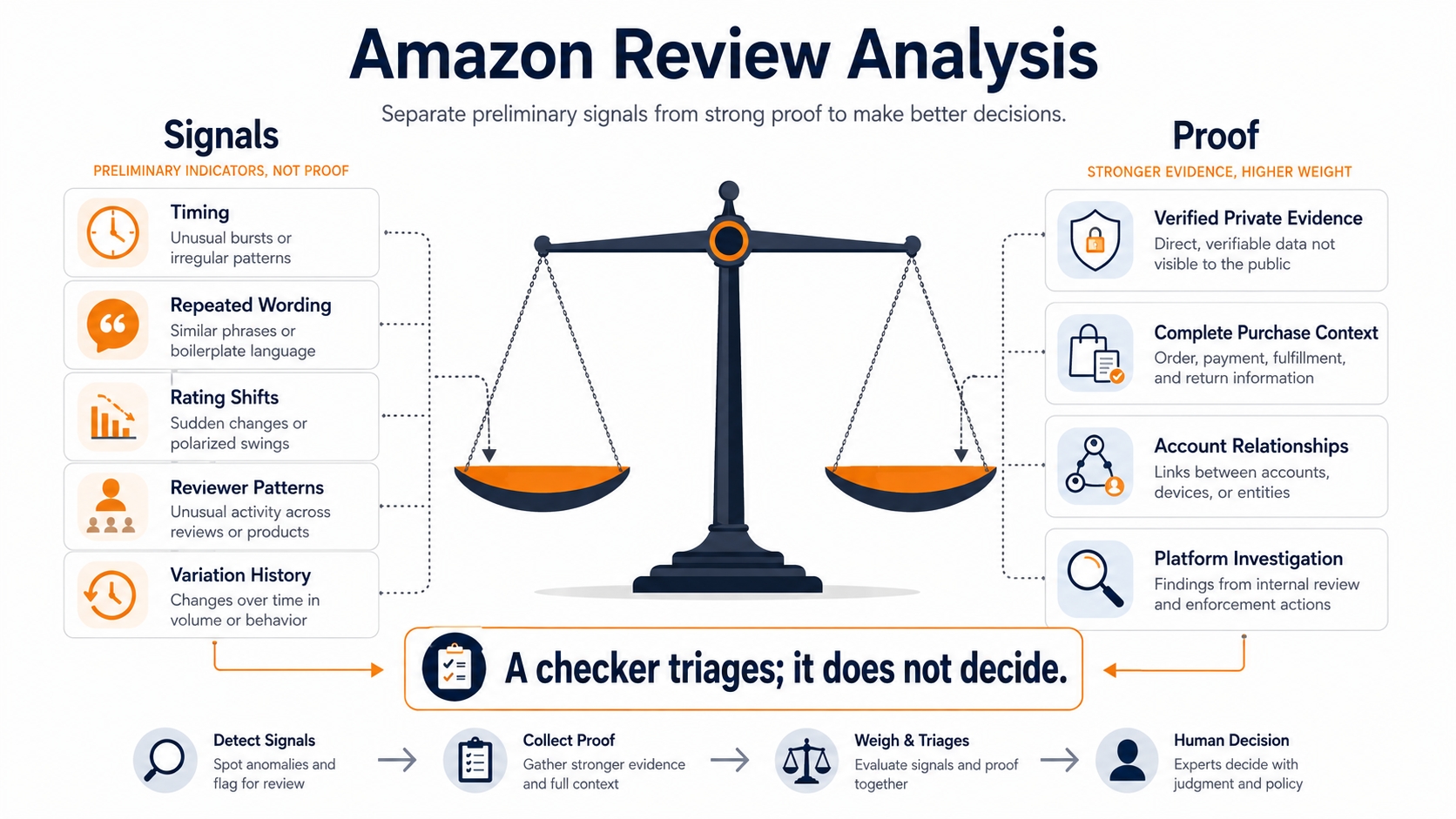
What Amazon review checker tools actually analyze
Review-checker tools do not all use the same data or methodology. Some focus on text, some emphasize reviewer behavior, and others look at rating distribution or timing. A useful evaluation starts by identifying the exact observation behind each score rather than assuming that every tool is measuring the same kind of risk.
Rating distribution
The tool may compare the share of one-, two-, three-, four-, and five-star ratings, then flag sudden changes or distributions that differ from a historical baseline. A change is useful context, but the tool still needs a business event or other evidence to explain it.
Review timing and velocity
A checker can group reviews by day, week, or month and identify clusters. Sellers should compare those clusters with launches, deals, holidays, advertising, stock availability, and the normal delay between purchase and review publication.
Text similarity and language
Tools may flag repeated phrases, unusual vocabulary, very generic praise, or similar sentence structures. Similar wording can result from coordination, but it can also occur when customers describe a simple product feature using the same common terms.
Verified-purchase status
A checker may separate reviews with and without a Verified Purchase label. The label is useful context, but it should not be treated as a complete authenticity test or as proof that every statement in a review is accurate.
Public reviewer activity
Where public information is available, a tool may examine review frequency, category concentration, or repeated behavior. Public history is incomplete and should not be used to identify a reviewer or infer an undisclosed relationship without supporting evidence.
Variation and catalog context
Reviews may appear irrelevant when products have been merged, separated, renamed, or moved between parent-child relationships. A checker can flag the mismatch, but catalog history is often needed to determine whether the issue is structural.
Proprietary scoring can still be useful when it is explainable. The strongest tools let a seller inspect the underlying review set, filters, date range, and observations. A single red or green badge without supporting detail is difficult to validate and easy to misinterpret.
Common suspicious patterns and the false positives behind them
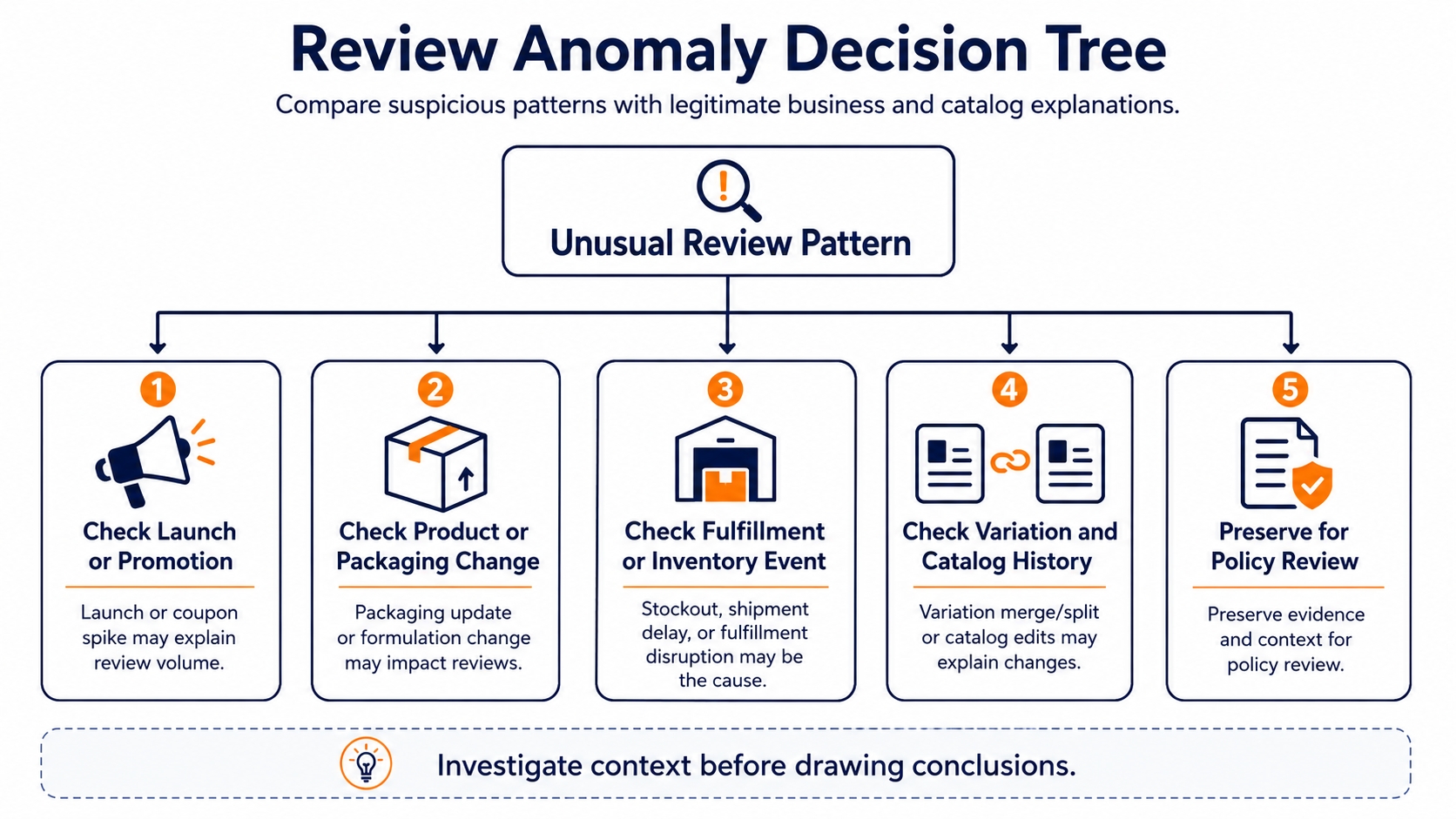
An effective Amazon review check asks two questions at the same time: "Why is this pattern unusual?" and "What legitimate event could produce the same pattern?" This second question reduces false accusations and helps the team identify product or catalog problems that may matter more than authenticity scoring.
| Pattern | Why it may look suspicious | Plausible non-fraud explanation | Evidence to check |
|---|---|---|---|
| Many reviews in a short period | The volume appears inconsistent with the preceding baseline. | A launch, deal event, seasonal peak, influencer exposure, or inventory recovery increased orders. | Order volume, promotion dates, advertising changes, stock history, and review delay. |
| Multiple reviews use the same phrase | The language appears templated or coordinated. | The product has one dominant feature, problem, included phrase, or common use case. | Full review text, product instructions, listing copy, date spread, and other shared details. |
| Sudden increase in negative reviews | The shift may resemble an attack or coordinated campaign. | A supplier, batch, packaging, instruction, compatibility, or fulfillment problem affected real buyers. | Return reasons, support tickets, batch records, FBA events, product-change dates, and variation concentration. |
| Review describes the wrong product | The content appears irrelevant or fabricated. | The detail page inherited reviews through a variation relationship or historical catalog configuration. | Parent-child history, model names, listing revisions, category changes, and visible review date. |
| Unverified review | The tool interprets the missing label as lower confidence. | The reviewer may have received the product as a gift or purchased it outside Amazon. | Review specificity, product-version fit, timing, and other independent signals. |
Why an Amazon fake review checker cannot prove a review is fake
The strongest reason is not that every checker is inaccurate. It is that the relevant evidence is incomplete. A public tool can observe what appears on a product page, but authenticity and policy status may depend on information that is not public.
1. Public-data limitations
A checker generally cannot see the complete order record, private communications, refund history, off-platform contact, household relationships, company-insider relationships, or Amazon's internal account signals. It may not know whether a product was received as a gift, purchased elsewhere, or reviewed after a catalog change.
2. Context limitations
The same visible pattern can have multiple causes. A burst of five-star reviews could follow a legitimate surge in sales. A burst of one-star reviews could reflect a defective batch rather than competitor activity. Similar language may result from a product with only a few obvious characteristics. Without the surrounding operational context, the tool is ranking hypotheses rather than confirming one explanation.
3. Methodology limitations
Two tools may assign different scores because they use different date ranges, thresholds, weights, language models, or definitions of suspicious behavior. A score without an explanation may be difficult to reproduce. Even a transparent model will produce false positives and false negatives when the observable data is incomplete.
4. Authority limitations
A third-party checker does not make Amazon's moderation or enforcement decisions. Amazon determines whether content violates its guidelines and whether a review should be removed. Sellers can preserve and report relevant evidence, but they should not present a third-party conclusion as if it were an Amazon finding.
Use language such as "unusual timing," "review-product mismatch," "repeated wording," "pattern requiring manual review," or "possible policy concern." Avoid statements such as "this reviewer is fake," "the competitor bought reviews," or "the checker proved manipulation" unless a qualified authority has established the facts.
A responsible seller investigation workflow
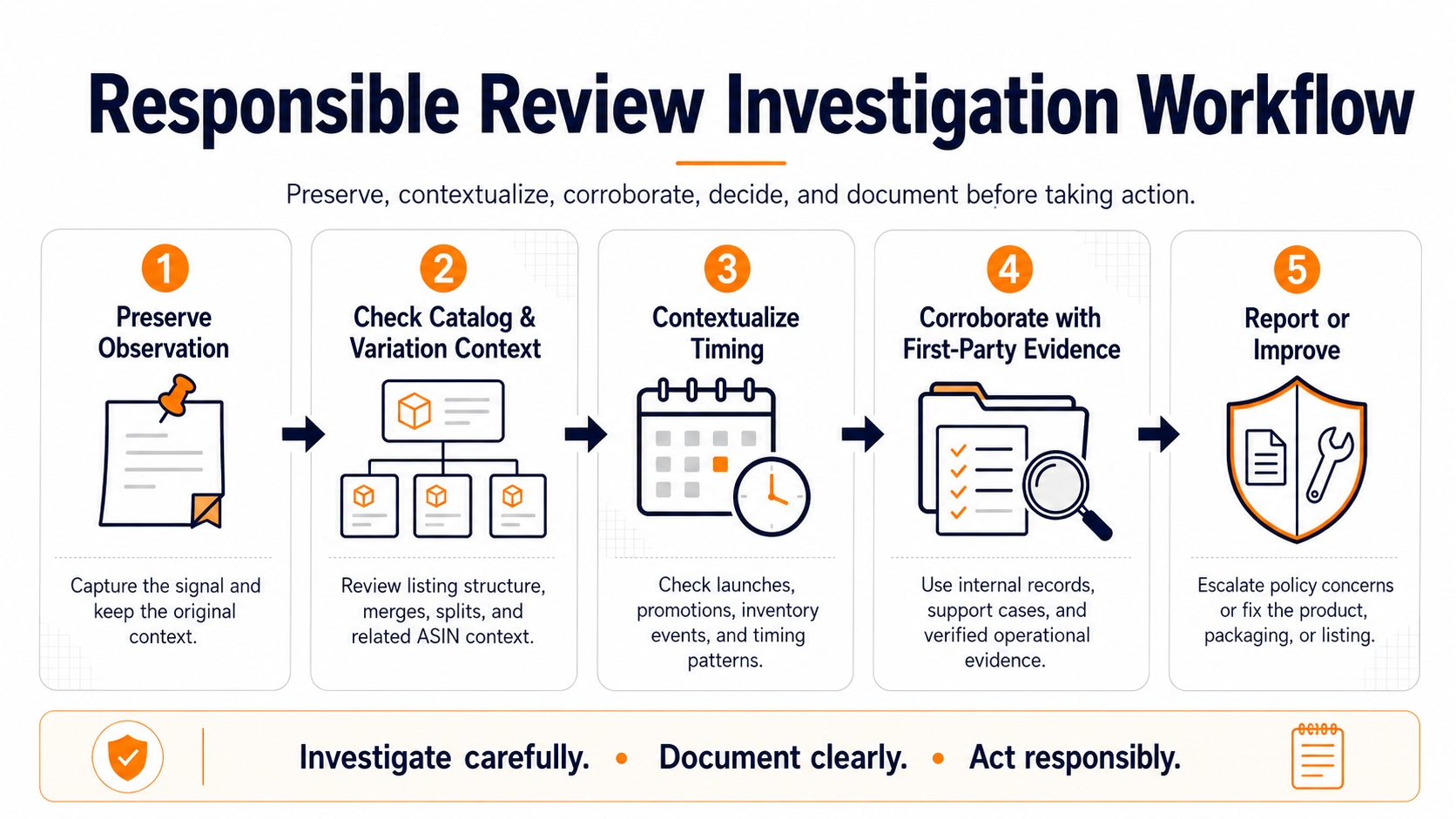
A repeatable workflow prevents the team from jumping directly from a checker alert to an accusation. It also creates a record that is more useful when the real issue is a product defect, variation problem, or listing mismatch.
Preserve the original observation
Record the review URL, ASIN, parent and child variation where visible, rating, title, publication date, screenshot date, and the precise concern. Also record the checker name, version or report date, filters, marketplace, and date range. Preserve facts before adding an interpretation.
Check catalog and variation context
Confirm whether the review matches the current product and variation. Review parent-child relationships, model names, package quantity, size, color, accessories, and historical listing changes. A mismatch may be a catalog issue rather than evidence about the reviewer.
Contextualize the timing
Compare the review period with launches, deals, advertising, price changes, stockouts, restocks, fulfillment changes, supplier changes, packaging revisions, and known product batches. Use a reasonable lag between an order event and a published review.
Corroborate with first-party evidence
Compare the theme with returns, customer-support contacts, warranty claims, quality-control findings, replacement requests, and product-change dates. Use aggregated, privacy-safe business data. Do not attempt to identify the reviewer or connect public information to private customer data outside approved processes.
Choose the correct action
If the evidence points to a product, packaging, listing, or variation issue, assign an owner and fix the customer experience. If the visible review appears to violate Amazon guidelines, report it through Amazon and provide a concise explanation. If the evidence is weak, keep the item in monitoring rather than escalating it as a confirmed violation.
When to report a review and when to improve the product
Review monitoring produces two different types of work. One is policy escalation: documenting content that appears inconsistent with Amazon's community or review rules. The other is operational improvement: fixing a real customer problem revealed by reviews. A responsible process keeps these paths separate.
Consider reporting when
- The review appears unrelated to the product or contains content that may violate applicable community guidelines.
- You can provide the review link and a concise, evidence-based explanation of the suspected issue.
- The concern is about policy compliance rather than disagreement with a customer's opinion.
Prioritize improvement when
- The same complaint appears across reviews, returns, support contacts, or quality checks.
- The problem clusters around a particular variation, batch, supplier, package, or listing version.
- The review is critical but still describes a genuine customer experience or opinion.
Amazon's Customer Reviews tool states that sellers cannot change reviews. If a review appears not to follow community guidelines, sellers can report abuse from the product detail page. Eligible brand representatives can also use the Customer Reviews tool to monitor recent reviews and respond to certain customer concerns through the options Amazon provides.
Reporting should not replace root-cause analysis. Even when a review is removed, a recurring product or listing problem may remain. Conversely, fixing a product issue does not give the seller permission to ask the reviewer to remove or revise the original review.
US legal context for fake and misleading review claims
The FTC's Consumer Reviews and Testimonials Rule took effect on October 21, 2024. It addresses specified deceptive practices involving fake or false reviews, certain sentiment-conditioned incentives, undisclosed insider reviews, review suppression, and related conduct. The rule is separate from Amazon's platform policies: a platform concern is not automatically a legal violation, and a legal risk assessment is not the same as an Amazon enforcement decision.
The FTC's Q&A also shows why context matters. It distinguishes businesses that merely host reviews from businesses that write, buy, procure, or misuse reviews. It explains that clear warning signs can matter in some business relationships, but it does not turn every unusual pattern into proof. For sellers, the practical lesson is to document red flags without overstating what the evidence establishes.
Public accusations create additional risk. A statement that a reviewer or competitor committed fraud is materially different from an internal note that a review cluster has unusual timing. Keep internal records factual, separate observations from inferences, limit access to people who need the information, and obtain qualified legal advice before making legal conclusions or public allegations.
Legal note: This article provides operational guidance for review analysis and documentation. It is not legal advice, and the outcome of any specific situation depends on its facts, marketplace, jurisdiction, contracts, and current platform rules.
How to evaluate an Amazon review checker vendor
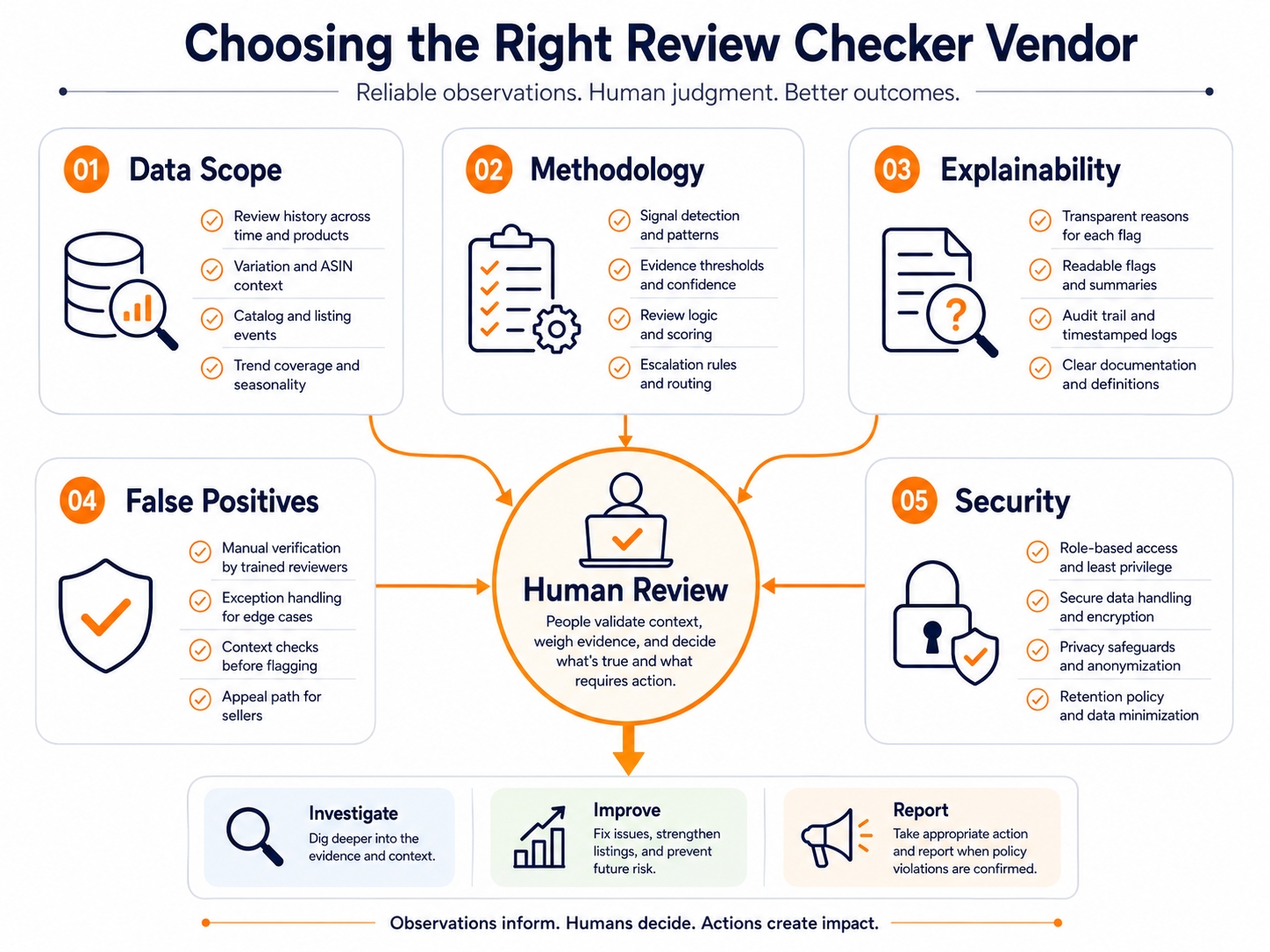
The best review-checker vendor is not necessarily the one that produces the most dramatic score. Choose a tool that makes the underlying evidence easier to inspect, compare, export, and explain. The tool should improve the quality and efficiency of human review rather than replace judgment.
| Evaluation dimension | Questions to ask | Strong sign | Red flag |
|---|---|---|---|
| Data scope | Which marketplaces, review fields, date ranges, languages, and variations are included? | The vendor clearly defines coverage and missing data. | The score is presented without explaining the analyzed dataset. |
| Methodology | What patterns are measured, how are they weighted, and can the output be reproduced? | The tool explains observations and allows filter review. | Claims of secret technology are used to avoid explaining any result. |
| Explainability | Can users see the reviews, dates, phrases, or distributions behind a warning? | Raw observations can be inspected and documented. | Only a "fake percentage" or badge is shown. |
| False positives | How are promotions, launches, variation merges, and product changes handled? | The vendor identifies limitations and alternative explanations. | Every unusual pattern is described as manipulation. |
| Workflow and export | Can the team export evidence, add notes, compare time periods, and share a privacy-safe report? | The output supports repeatable investigation and review. | The tool encourages instant public claims or automated confrontation. |
| Security and retention | What data is stored, for how long, and who can access it? | The vendor documents access, retention, and deletion practices. | The vendor requests unnecessary customer or account information. |
"100% accurate," "guaranteed fake-review detection," "proof accepted by Amazon," "automatic competitor takedowns," or any promise that a public-data score can replace investigation. A responsible vendor describes uncertainty, data coverage, and the need for human review.
How to use SellerSprite Review Analysis responsibly
SellerSprite Review Analysis is designed to organize and analyze public review content for product research, listing optimization, and customer-insight work. It is not an Amazon enforcement system and should not be presented as a tool that proves an individual review is fake.
SellerSprite Review Analysis Guide describes workflows for examining products and variations, rating and review distributions, review sentiment over different time periods, and AI-generated themes such as product strengths and weaknesses, usage scenarios, consumer expectations, profiles, and purchase motivations. These capabilities can reduce manual reading and help teams compare a product with relevant competitors.
A reproducible SellerSprite workflow
- Define a narrow question. Examples include "Which complaint increased after the latest product revision?" or "Which weakness is repeated across the closest competitor variations?"
- Build the comparison set. Include the relevant ASIN and child variations, plus a small group of directly comparable products. Avoid combining unrelated price bands, use cases, or product generations.
- Segment the review evidence. Compare rating levels, variations, and time periods so old reviews or unrelated models do not distort the current conclusion.
- Cluster customer language. Organize comments into practical themes such as fit, durability, usability, compatibility, instructions, packaging, missing parts, noise, or value.
- Validate outside the review tool. Compare the strongest themes with returns, support contacts, product changes, and quality data before assigning an action.
- Document the limitation. State the marketplace, date range, filters, variations, and data gaps. Do not convert a theme or anomaly into an unsupported statement about reviewer intent.
Use SellerSprite to identify themes, compare variations, track sentiment changes, and prioritize product or listing research. Use Amazon's official process, not a SellerSprite analysis result, to report a suspected review-policy violation.
Amazon review checker action checklist
Use review data to improve decisions, not to manufacture certainty
Organize public review themes, compare variations, and validate findings against your own operational data before changing a product or escalating a policy concern.
Frequently asked questions
Can an Amazon review checker prove that a review is fake?
No. A checker can identify unusual timing, language, ratings, reviewer activity, or product context, but public tools normally cannot access all the evidence needed to establish identity, relationships, purchase history, private communications, or policy intent. Treat the output as a reason to investigate, not as a final determination.
What should a seller do after finding a suspicious review pattern?
Preserve the review and checker settings, check product and variation history, compare the dates with promotions and operational events, and corroborate the theme with returns or support data. If the visible content appears to violate Amazon guidelines, use Amazon's reporting process and describe the concern factually.
Are Verified Purchase reviews always authentic?
A Verified Purchase label is useful context because it reflects Amazon's applicable purchase-verification criteria, but it is not a complete guarantee that every statement is accurate or that no other relevant relationship exists. Likewise, the absence of the label does not automatically mean the review is fake. Evaluate it alongside timing, specificity, product fit, and other signals.
Should sellers publish a fake-review score about a competitor?
Avoid publishing unsupported accusations. A proprietary score may be useful for internal research, but it is not an Amazon ruling or legal finding. Publicly identifying a seller, reviewer, or product as fraudulent can create reputational and legal risk when the underlying data supports only an anomaly or probability.
Can SellerSprite determine whether Amazon will remove a review?
No. SellerSprite Review Analysis can help organize review content, identify themes, compare variations, and support product or listing research. Amazon decides whether a review violates its guidelines and whether removal or another enforcement action is appropriate.
How often should sellers perform an Amazon review check?
The cadence should match risk and review volume. Newly launched products, recent product revisions, or high-volume periods may need weekly triage. Stable catalogs can use a monthly review. Trigger an additional check after major promotions, variation changes, packaging revisions, supplier changes, or a sudden cluster of repeated complaints.
References
- Amazon: Customer Reviews tool
- Amazon: How to get authentic customer reviews
- FTC: Consumer Reviews and Testimonials Rule Q&A
Scope and limitations: Unless a source states otherwise, Amazon policy and product references in this article relate to US public pages reviewed on August 10, 2026. Marketplace, account, role, category, product, and interface availability can differ. Third-party checker output is an analytical estimate, not proof of identity, intent, fraud, or policy status. This article is educational and is not legal, tax, accounting, trademark, or financial advice.