TL;DR: A seller increases Amazon advertising spend by 40%. Ad-attributed sales rise, the campaign's ACOS improves, and the product records more orders than the previous week. The marketing report looks encouraging. The finance report tells a different story: less contribution remains after advertising.
This is why Amazon selling and marketing strategies cannot be planned independently. Product selection determines what customers can buy. Pricing and fulfillment determine how much each order contributes. Listing quality affects conversion. Advertising influences traffic, but inventory and customer experience determine whether that traffic creates lasting value.
The goal is not to run every available marketing tactic. It is to identify the constraint on profitable sales, make one meaningful improvement, and verify whether the business is better off afterward.
Key Takeaways
- Selling strategy and marketing strategy solve different problems. Selling determines the product, offer, fulfillment, and economics. Marketing connects the offer with relevant buyers.
- Start with unit contribution, not a universal ACOS target. The amount available for advertising depends on product costs, Amazon fees, and the contribution the business needs to retain.
- Fix conversion obstacles before increasing traffic. A weak offer, unclear listing, or recurring product complaint can make every acquisition channel more expensive.
- Give each marketing channel a defined job. Organic search, Sponsored Products, brand advertising, promotions, and external traffic should not all be judged by one metric.
- Measure growth at the product-business level. More ad-attributed revenue can coincide with lower remaining contribution. Review total sales, costs, inventory, and attribution limitations together.
Table of Contents
- Amazon Selling and Marketing Strategies: Two Systems, One Business
- Know What One Sale Can Actually Contribute
- Find Demand Your Product Can Serve
- Give the Shopper a Reason to Finish the Purchase
- Choose Marketing Channels by the Job They Need to Do
- Make PPC Spending Accountable to Product Economics
- When Better Advertising Metrics Hide Weaker Business Results
- Promotions Must Pass the Margin Test Too
- Inventory Is Part of the Marketing Plan
- Use External Traffic Without Confusing Attribution with Incrementality
- Make One Decision the Weekly Review Can Defend
- Growth Is Useful When It Leaves the Business Stronger
- FAQs
- References
Scope: This guide focuses on physical products sold through Amazon.com in the United States. It covers both newer sellers and established brands, while identifying tools that require additional account eligibility. Product prices, margins, PPC figures, and operating examples are hypothetical. Actual costs, advertising availability, and marketplace requirements should be confirmed in the seller's account.
Amazon Selling and Marketing Strategies: Two Systems, One Business
Selling strategy determines what the business offers, how it competes, and what remains after a transaction. Marketing strategy determines how potential buyers discover that offer and why they might choose it.
The distinction sounds simple until an account starts growing. A campaign manager may want more clicks, the listing team may want a higher conversion rate, and the purchasing team may want to order more stock. Each request can be reasonable in isolation while creating problems for the others.
Selling determines whether the offer is commercially viable
The selling side includes product-market fit, sourcing costs, product quality, selling permissions, pricing, fulfillment, returns, and inventory availability. It determines whether a sale can generate an acceptable financial outcome.
A product with weak differentiation may need a lower price to win customers. A bulky item may incur higher fulfillment costs. A product with recurring quality problems may generate returns that erode the apparent margin. Advertising cannot remove those constraints.
Marketing determines how demand reaches the offer
Marketing includes Amazon search visibility, listing communication, sponsored advertising, promotions, brand awareness, and eligible external acquisition channels.
These activities do not all perform the same job. Keyword optimization can improve relevance and discoverability. Product photography helps customers evaluate the item. Sponsored Products can place a listing in front of shoppers already expressing relevant intent. A promotion can temporarily change the price-value equation.
Diagnose the constraint before choosing a tactic
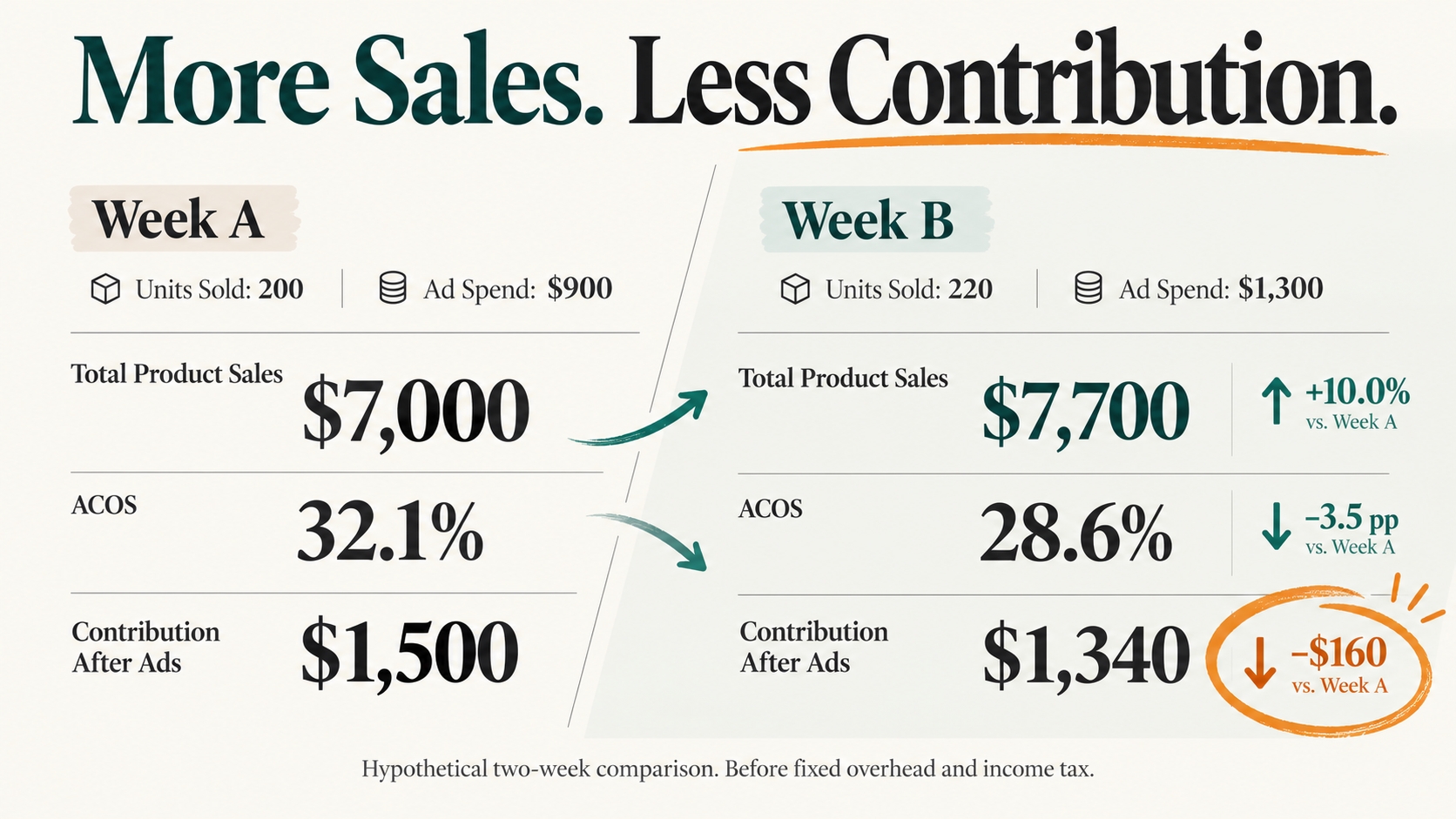
Consider three products with disappointing sales. One has little relevant search exposure. Another receives clicks but rarely converts. The third sells steadily until it runs out of stock.
Those products need different actions. More keyword research may help the first. Better product information or an improved offer may help the second. A replenishment decision matters more for the third.
The central planning question: What is preventing the next profitable sale? The answer might be visibility, relevance, product presentation, price, fulfillment, inventory, or a contribution margin too small to support acquisition.
Know What One Sale Can Actually Contribute
Before setting an advertising budget, the seller needs to know what a completed order contributes after the costs directly associated with selling and fulfilling it.
Gross selling price is not contribution. Neither is revenue after deducting only the manufacturing cost. Amazon fees, fulfillment, logistics, and an appropriate allowance for returns or inventory problems can materially change the amount available for marketing.
A hypothetical $35 product
Imagine a brand selling a compact kitchen accessory for $35.00. The following assumptions are invented to illustrate how selling economics influence the marketing plan.
| Item | Per-unit amount | Assumption |
|---|---|---|
| Selling price | $35.00 | Assumed completed sale without a promotion. |
| Product and inbound cost | -$11.00 | Landed product cost allocated per sold unit. |
| Illustrative Amazon referral fee | -$5.25 | Assumed 15% of $35, not a verified category rate. |
| Illustrative FBA fulfillment cost | -$5.25 | Hypothetical fee for the example product. |
| Storage and returns allowance | -$1.50 | Modeled provision for expected variable expenses. |
| Contribution before advertising | $12.00 | Before advertising, fixed overhead, and income tax. |
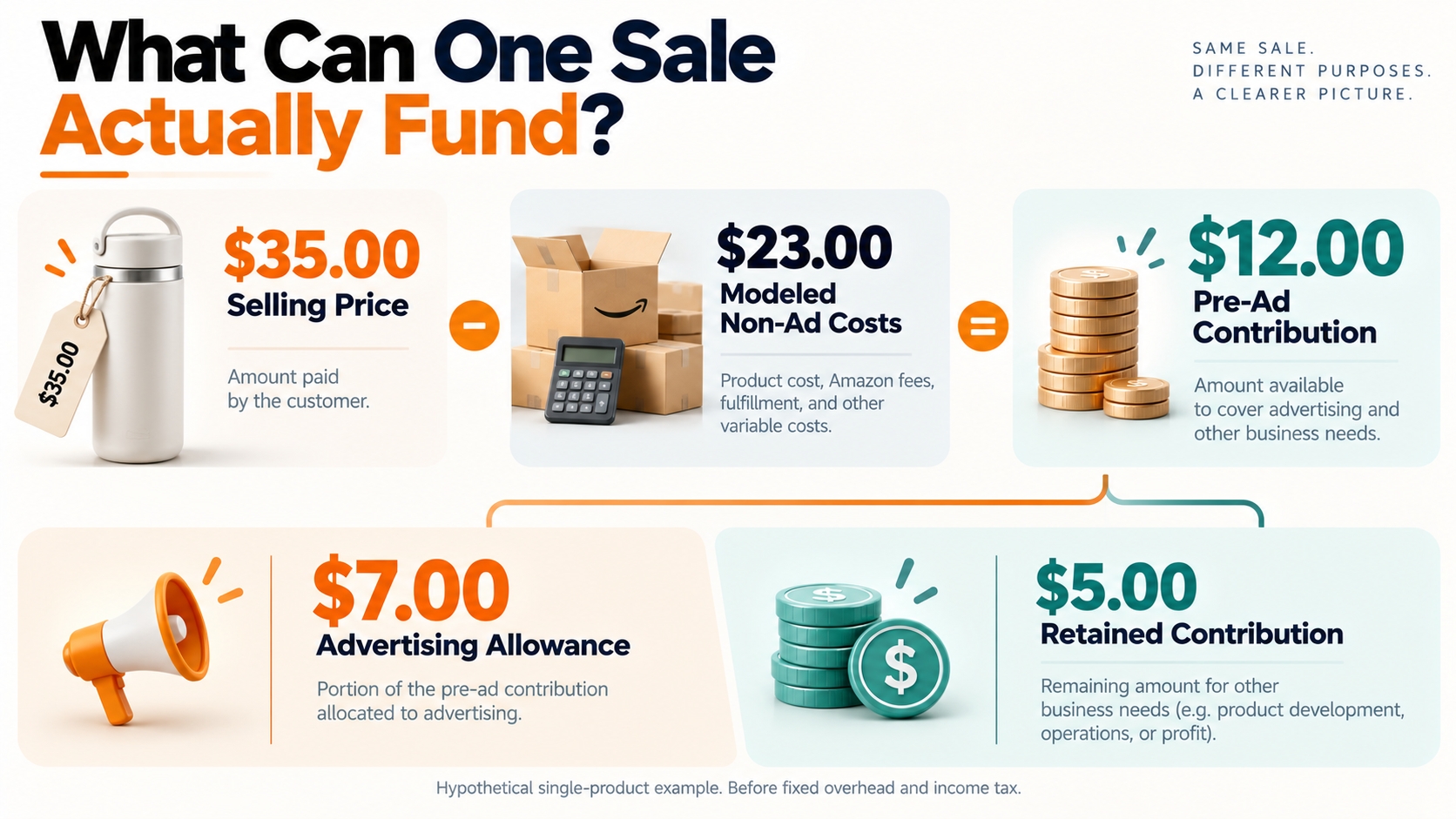
The product generates $12.00 of modeled contribution before advertising, equal to approximately 34.3% of its selling price. That is not the amount the business can necessarily afford to spend acquiring every order. It may need to retain part of the contribution for operating expenses, product development, and profit.
Before relying on an estimate, check actual product-specific charges using Amazon's fee and revenue estimation guidance. The Revenue Calculator supports comparisons between FBA and seller fulfillment. It does not automatically know every sourcing cost or internal expense of a particular business.
Separate the advertising allowance from the full contribution
Suppose the business wants to retain $5.00 per sale toward fixed overhead, additional business needs, and profit. That leaves $7.00 as a planning allowance for advertising.
Hypothetical Marketing Allowance
$12.00 pre-ad contribution - $5.00 retained = $7.00 available for advertising
$7.00 / $35.00 selling price = 20% planning target ACOS
$12.00 / $35.00 selling price = approximately 34.3% pre-overhead break-even ACOS
The difference matters. A campaign operating at 30% ACOS may still produce positive contribution before fixed overhead under these assumptions, but it falls short of the business's chosen $5.00 retention objective.
These thresholds apply to the hypothetical unit economics and simplified attribution assumptions. They are not universal Amazon advertising targets.
Find Demand Your Product Can Serve
A large search market is not automatically a good market for a particular seller. The opportunity depends on whether the product satisfies the searcher's need, how competitors serve that need, and whether the seller can compete at a viable price.
Research should begin with the problem customers are trying to solve. Keyword metrics, historical product data, and competitor listings help establish the size and shape of that demand.
Separate category demand from product relevance
Suppose the example product is a compact kitchen organizer. Customers may search for storage accessories by location, size, mounting method, or the problem they want to solve. Some keywords will describe products that look similar but require different installation methods or dimensions.
Do not select a keyword simply because it has substantial search volume. Inspect the products currently returned for the query. If the search results mainly feature a different product type, the keyword may be poorly matched to the offer.
Use historical data to distinguish persistent and temporary demand
Search demand, estimated sales, Best Sellers Rank, price history, and competitor review trends can provide context. Look for seasonal peaks, recent category expansion, or price increases associated with temporary inventory shortages.
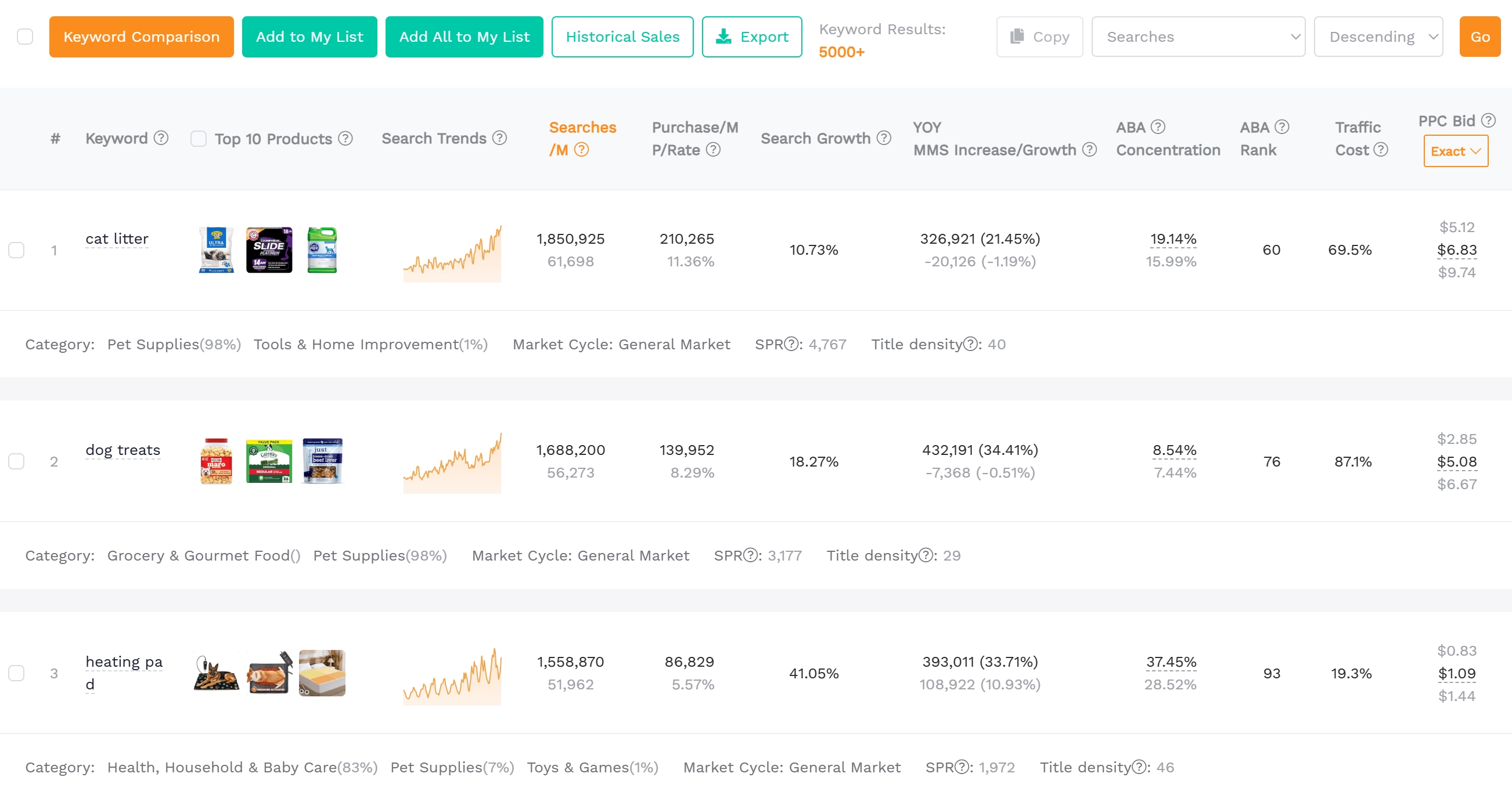
SellerSprite Product Research, Keyword Research, and Reverse ASIN can support different parts of this investigation. Product Research helps compare estimated demand and historical product metrics. Keyword Research explores relevant search queries and marketplace periods. Reverse ASIN helps identify search terms associated with competing products.
These tools are useful when the decision requires product and keyword evidence. Their estimates should not be confused with verified future sales, an individual competitor's confidential performance, or a guarantee that a new listing will rank for the same terms.
Compare competitors for the reason customers choose them
Review a small, relevant set of competing ASINs. Examine their price positions, configurations, main images, review themes, and how clearly they communicate the product's purpose.
The aim is not to reproduce a competitor's title or campaign structure. It is to identify a legitimate differentiation opportunity. Perhaps buyers are dissatisfied with difficult assembly, unclear dimensions, or packaging that does not protect the product. Those observations should be verified before becoming product or marketing claims.
Use first-party data when it is available
For eligible brands enrolled in Amazon Brand Registry, Amazon Brand Analytics includes Search Query Performance and other dashboards that provide aggregated information about relevant search queries, impressions, clicks, cart additions, and purchases.
Use those data to evaluate where shoppers discover the brand and where purchasing behavior changes. Do not combine third-party search estimates with account-level Amazon metrics as if their populations, methods, and reporting periods were identical.
Give the Shopper a Reason to Finish the Purchase
Relevant traffic is valuable only when the product page helps a buyer understand what is being offered. A listing can receive thousands of impressions and clicks while leaving essential purchase questions unanswered.
Before increasing bids or expanding into additional channels, inspect the page as a first-time shopper would.
Check the information customers encounter first
The product title should identify the item accurately. The main image should meet Amazon's image requirements and present the product clearly. Secondary images should explain dimensions, components, and relevant usage.
Bullet points and descriptions should answer real buying questions rather than repeat broad claims. Amazon's public guidance on preparing products for advertising emphasizes informative titles, high-quality images, relevant search terms, and a complete product detail page.
Match the offer to the promise
A listing may describe a high-quality accessory, yet the displayed price, delivery estimate, product condition, or review history may make it less attractive than competing offers.
Compare the full buying proposition. A lower price may help, but it is not always the correct response. Better compatibility information, more accurate dimensions, clearer packaging details, or improved fulfillment can address a different purchase barrier without automatically reducing margin.
Treat reviews as product evidence
Review recurring complaints and favorable product experiences together. Look for patterns involving quality, fit, setup, durability, and unexpected limitations.
Correct a misleading listing when the product is functioning as intended but expectations are unclear. Investigate the supplier or manufacturing process when the product itself is failing. Avoid treating legitimate negative feedback as an obstacle to eliminate through review manipulation.
Experiment with product content when eligible
Brand owners with eligible ASINs can use Amazon Manage Your Experiments to compare alternative titles, images, bullet points, descriptions, or A+ Content. Amazon divides participating shoppers between versions and reports their performance.
An experiment can provide more useful evidence than replacing every image and rewriting the entire listing during the same week. Eligibility and available experiment types must be confirmed in the seller account.
Before buying more clicks: Confirm that the product is available, the offer is competitive, important specifications are accurate, the intended buyer can understand the listing, and there is a plausible path from the traffic source to purchase.
Choose Marketing Channels by the Job They Need to Do
Amazon offers several ways to reach customers, but they should not all receive the same budget or be measured with the same expectations.
A new product trying to discover relevant search terms has a different problem from an established brand defending high-intent branded traffic. An external campaign introducing the brand to unfamiliar customers has a different measurement problem again.
| Channel or tactic | Primary job | Useful signals | Decision risk |
|---|---|---|---|
| Listing SEO | Improve relevance and clarity for existing shopper intent. | Relevant search visibility, clicks, and purchase behavior. | Adding keywords that do not fit the product. |
| Sponsored Products | Acquire product-level visibility and test relevant search or product targets. | Search terms, clicks, spend, orders, and ACOS. | Buying traffic faster than the margin supports. |
| Sponsored Brands | Present the brand or a relevant product collection to shoppers. | Reach, engagement, attributed sales, and eligible new-to-brand metrics. | Judging broad awareness solely by short-term ACOS. |
| Promotions | Change the buyer's price-value decision for a defined period. | Realized selling price, eligible redemptions, units, and contribution. | Higher sales volume at an uneconomic price. |
| External marketing | Introduce demand from search, content, creators, or owned channels. | Qualified visits, attributed actions, costs, and product-level outcomes. | Treating attribution as proven incremental sales. |
Start with the channel closest to the immediate problem
A product with proven conversion but insufficient relevant exposure may justify targeted Sponsored Products investment. A brand with several complementary products may test Sponsored Brands to introduce the wider selection. A product with established demand and price-sensitive buyers may warrant a controlled promotion.
These are choices, not a compulsory sequence. The correct mix depends on account eligibility, product maturity, contribution, competitive pressure, and the evidence already available.
Avoid paying twice to answer the same question
If several campaigns target the same audience and measure the same apparent sales, adding all attributed results together can overstate the total business outcome. Different ad products and measurement systems may attribute shopping activity under different rules.
Keep campaign-level reporting for optimization, but reconcile decisions against product-level sales, spending, and contribution. A marketing channel earns additional budget by supporting a defined business objective, not merely by reporting another attractive dashboard number.
Make PPC Spending Accountable to Product Economics
Sponsored Products is often the most direct way to test whether an Amazon product can attract relevant shoppers at a commercially acceptable cost. But an advertising campaign should begin with a hypothesis about who needs the product, not simply a list of popular keywords.
The unit economics established earlier provide an initial budget boundary. Campaign performance then helps refine the assumptions.
Use automatic targeting to learn and manual targeting to control
Automatic targeting can reveal shopper queries and product placements that the advertiser had not considered. Manual keyword and product targeting offers greater control over the terms or ASINs selected for investment.
For a practical setup and early optimization routine, see SellerSprite's guide to launching a first Sponsored Products automatic campaign. The purpose of the first test is to gather useful targeting evidence without committing an unlimited budget.
Do not assume every converting search term is profitable or that automatic campaigns must always be switched off after manual campaigns begin. Both approaches can continue serving different purposes when their spending and results justify them.
Translate the advertising allowance into a planning CPC
Return to the hypothetical $35 product. Its planned advertising allowance is $7.00 per sale. If the seller assumes that 10% of relevant ad clicks result in a single-unit purchase, the expected cost of acquiring that purchase can be related to the average cost per click.
Hypothetical CPC Planning Estimate
$7.00 allowable ad cost per purchase × 10% assumed purchase rate = $0.70 planning CPC ceiling
At that conversion assumption, ten paid clicks costing an average of $0.70 would total $7.00 for one expected purchase.
The 10% purchase rate is invented. The $0.70 result is a planning estimate, not Amazon's suggested bid, a maximum actual auction charge, or a guaranteed acquisition cost. Real conversion rates, prices, CPCs, and attribution outcomes vary.
Review the search term and the resulting sale
Amazon provides search term, targeting, advertised product, and placement reports for Sponsored Products. These help advertisers investigate where spend occurs, which queries generate engagement, and which products receive attributed sales.
Separate irrelevant traffic from relevant but expensive traffic. An irrelevant query may need exclusion. A relevant query with weak economics may need a lower bid, better listing, improved offer, or further evidence before more investment.
Negative targeting should address genuine mismatches or demonstrated waste, not simply every search term that has not produced a purchase during a small sample.
When Better Advertising Metrics Hide Weaker Business Results
ACOS and ROAS are useful advertising metrics, but neither represents the final profit of an Amazon product. They describe advertising spend relative to attributed revenue.
Amazon defines ACOS as advertising spend divided by attributed advertising sales, multiplied by 100. ROAS reverses the relationship: attributed sales divided by advertising spend.
ACOS answers an advertising question, not the whole business question
If a campaign spends $100 and reports $400 in attributed sales, its ACOS is 25% and its ROAS is 4.0. Those results do not reveal the product's manufacturing cost, fulfillment fees, refunds, or the sales that might have occurred without advertising.
Sellers often also calculate total advertising cost of sales, or TACOS, as advertising spend divided by total product sales during a selected period. TACOS is a seller-side planning ratio. It should not be confused with Amazon's ACOS or treated as a direct measure of incremental advertising effectiveness.
A two-week comparison with different conclusions
Continue the hypothetical $35 product example. Assume that the selling price and the $12.00 pre-ad contribution per completed unit remain constant. Compare two separate seven-day periods with sufficient inventory and no additional promotion.
| Metric | Week A | Week B |
|---|---|---|
| Total completed units sold | 200 | 220 |
| Total product sales | $7,000 | $7,700 |
| Advertising spend | $900 | $1,300 |
| Ad-attributed sales | $2,800 | $4,550 |
| ACOS | 32.1% | 28.6% |
| Illustrative TACOS | 12.9% | 16.9% |
| Total contribution before ads | $2,400 | $2,640 |
| Contribution after ads | $1,500 | $1,340 |
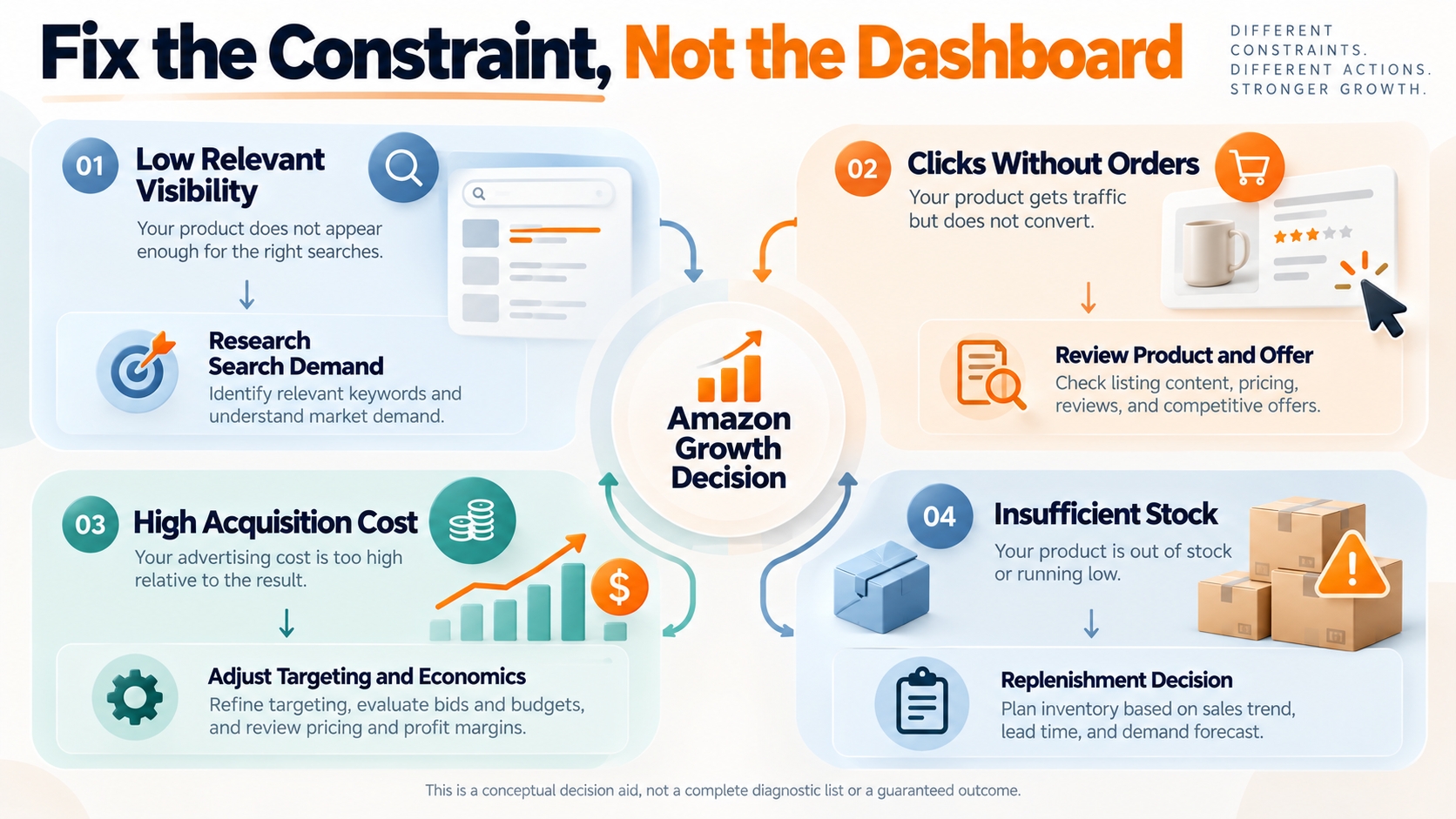
In Week B, total product sales increase by $700 and ad-attributed sales increase by $1,750. The advertising campaign's ACOS improves from approximately 32.1% to 28.6%.
Yet advertising spend rises by $400. The additional 20 completed units contribute only $240 before advertising under the assumed unit economics. As a result, contribution after advertising falls by $160.
The Business-Level Calculation
Week A: (200 × $12.00) - $900 = $1,500
Week B: (220 × $12.00) - $1,300 = $1,340
Change: $1,340 - $1,500 = -$160
Why the advertising and business reports disagree
They answer different questions. ACOS evaluates spend relative to attributed advertising revenue. The contribution calculation accounts for all completed product sales and modeled costs before deducting advertising.
The example assumes one product, a constant selling price, stable unit costs, aligned reporting periods, and no additional promotion. It does not establish that advertising caused the additional 20 units, nor that all ad-attributed orders were incremental.
In real accounts, attributed sales and completed-order reports can use different windows, product scopes, or timing. Do not mechanically subtract advertising-attributed sales from total revenue and call the remainder verified organic sales without understanding the definitions.
What should the seller do next?
The answer is not necessarily to cut all advertising. The business should investigate which campaigns received the extra spend, whether the increased traffic reached relevant customers, and whether the account's objectives justified the lower remaining contribution.
A temporary launch investment may have a different rationale from an established product's ongoing acquisition budget. However, a seller should define the expected benefit and acceptable financial exposure before using potential long-term gains to justify current losses.
Promotions Must Pass the Margin Test Too
Discounts can improve the attractiveness of an offer and support defined promotional objectives. They also change the revenue and contribution earned on each completed sale.
A strategy that evaluates only the resulting order volume can mistake a temporary promotional spike for a sustainable improvement.
Recalculate at the realized selling price
Suppose the $35 example product is sold for $30 during a price reduction. Assume that the referral fee remains 15% of the lower selling price and all other modeled per-unit costs stay unchanged.
STANDARD SELLING PRICE
$35.00
$12.00 modeled pre-ad contribution per unit.
REDUCED SELLING PRICE
$30.00
$7.75 modeled pre-ad contribution per unit.
At the lower price, the illustrative referral fee becomes $4.50. The remaining modeled costs are $11.00, $5.25, and $1.50. Contribution is therefore:
$30.00 - $11.00 - $4.50 - $5.25 - $1.50 = $7.75
The selling price declines by $5.00, while contribution declines by $4.25 because the illustrative referral fee also falls. This is a simplified price-change scenario, not a complete Amazon coupon calculation.
Promotions can add costs beyond the price reduction
Amazon distinguishes promotions, deals, coupons, and other discounts. Eligibility, fees, scheduling, and price requirements vary by program.
If the seller uses a coupon or deal rather than directly changing the selling price, calculate the actual discount, applicable promotion charges, referral fees, and advertising costs according to the current program rules. Do not reuse the simplified $7.75 figure as if it includes those additional expenses.
Define the reason for the promotion
A promotion may be intended to introduce a product, encourage trial, move aging stock, or respond to a temporary competitive situation. Each purpose calls for a different evaluation.
Before launching, decide what additional sales volume or other measurable value would justify the reduced margin. Monitor actual contribution, not only redemption counts or a temporary improvement in conversion.
Inventory Is Part of the Marketing Plan
Traffic and inventory planning are often handled by different teams. That separation becomes expensive when marketing accelerates demand shortly before inventory runs out.
A product needs available, eligible stock to convert demand into completed orders. Excessive inventory creates a different cost through storage, cash exposure, and aging products.
Plan replenishment against the expected sales pace
A basic reorder-point estimate uses the expected daily unit demand during replenishment lead time, plus a safety-stock allowance chosen for the product's uncertainty.
Hypothetical Reorder-Point Estimate
Expected demand: 8 units per day
Replenishment lead time: 20 days
Safety-stock allowance: 40 units
(8 × 20) + 40 = 200 units
Under these assumptions, the seller would consider reordering when its relevant inventory position approaches 200 units. Inventory position should account for available stock and outstanding replenishment, not simply one warehouse's on-hand count.
The result is not an Amazon-recommended threshold. Real reorder planning should account for variable demand, supplier reliability, receiving delays, stock already on order, and expected promotions.
Coordinate campaign increases with stock coverage
Before substantially increasing ad budgets, check inventory coverage and replenishment timing. If a product has limited stock and no reliable near-term restock, aggressive acquisition can create fulfillment gaps instead of sustainable growth.
Conversely, a product with aging inventory may justify a controlled promotion, provided the resulting margin, recovery value, and program costs are understood.
Watch fulfillment and customer experience after scaling
An increase in orders can expose packaging failures, quality inconsistencies, customer-service bottlenecks, or inaccurate product information that were less visible at a smaller scale.
Monitor these issues alongside sales and advertising. A business that sells more units but experiences higher returns or fulfillment costs may not be creating the growth it expected.
Use External Traffic Without Confusing Attribution with Incrementality
External marketing can introduce products to customers who were not actively searching for them on Amazon. Search engines, useful articles, video demonstrations, creator partnerships, and a brand's own channels can each play a role.
These channels need their own content and measurement plans. Sending unfamiliar visitors directly to a product page without explaining why the product matters may produce traffic without meaningful purchasing intent.
Match the content to the customer's question
A practical demonstration can answer compatibility or installation questions before directing the audience to the product. An educational article can compare the criteria customers should evaluate. A creator partnership can show a real use case, provided the relationship and claims are disclosed appropriately.
The destination should match the promise of the external content. Do not send readers to an unrelated variation or a listing that lacks the feature being demonstrated.
Use Amazon Attribution where eligible
Amazon Attribution helps eligible advertisers measure non-Amazon marketing activity leading to Amazon shopping actions. Its documented methodology uses a 14-day, last-touch attribution model.
The Amazon Attribution measurement guide explains supported performance metrics and how campaign tags connect external activity with shopping outcomes.
Attributed sales are not necessarily additional sales
A shopper who clicks a creator link may already have intended to buy. A customer may encounter several marketing channels before purchasing. Attribution describes how credit is assigned under a specific measurement method; it does not automatically establish what would have happened without that marketing activity.
Do not add external-attributed revenue to product-level total sales as though it represents a separate set of orders. When evaluating external marketing, compare the measured results with actual costs, total product performance, and the limitations of the attribution method.
Make One Decision the Weekly Review Can Defend
A useful Amazon operating review should not end with a long list of metrics. It should identify the strongest constraint on the product, explain the evidence, and assign a concrete next action.
The framework below can be adapted to a new launch, an established product, or a portfolio review. It is a decision aid rather than a mandatory reporting template.
01 / IS THERE A REAL DEMAND OPPORTUNITY?
Review relevant search behavior, product demand, historical trends, and competitor offers. If the opportunity depends on a temporary price spike or an unrelated keyword, reconsider the product or positioning before spending more.
02 / IS THE PRODUCT READY TO CONVERT?
Check the offer, price, stock, product-page clarity, reviews, and actual customer expectations. Resolve an identifiable conversion obstacle before assuming higher bids are the solution.
03 / DOES THE ACQUISITION COST FIT?
Compare campaign performance with the product's contribution and advertising allowance. Identify which spending is intended to produce near-term orders and which supports a different, explicitly budgeted objective.
04 / CAN THE BUSINESS FULFILL THE GROWTH?
Check inventory coverage, supplier lead time, fulfillment issues, and expected returns. A campaign should not scale beyond what the operation can reasonably support.
05 / WHAT CHANGED IN THE BUSINESS RESULT?
Reconcile units, total product sales, advertising spend, realized contribution, and material inventory changes. State the uncertainty whenever attribution, promotions, or timing prevent a clean comparison.
Select one meaningful test
A useful test starts with a measurable hypothesis. For example: "Customers may be abandoning this product because the size comparison is unclear." The intervention could be a verified dimension image, evaluated through an eligible content experiment or an appropriately controlled observation.
Another test might focus on reducing bids for expensive but relevant queries while keeping qualified discovery traffic active. Record the starting conditions, cost exposure, intended measure, and stopping rule before changing the campaign.
Review the result against the original business question
If conversion improves, examine whether the change occurred with stable pricing, stock, and traffic composition. If advertising ACOS improves, check whether total contribution and sales remain healthy. If inventory sells faster, consider whether the supplier can sustain replenishment.
SellerSprite Product Tracker and Keyword Tracker can support ongoing observation of product trends, keyword rankings, price, ratings, and BSR. These are useful contextual signals, but the seller's own completed sales, advertising costs, and accounting records remain necessary for a full business evaluation.
Expand, revise, or stop
Expand when the product and marketing results support the next level of spending, inventory, and operational work. Revise when demand exists but a defined conversion, cost, or fulfillment problem remains. Stop when the evidence cannot support a viable offer or the risks exceed the resources available.
An unresolved question is not a reason to increase budgets indefinitely. It is a reason to design a smaller, more informative test.
Growth Is Useful When It Leaves the Business Stronger
Effective Amazon selling and marketing strategies connect decisions that are often managed separately. Product demand determines the opportunity. Unit economics set the financial limits. Listing quality influences the purchase decision. Marketing creates access to shoppers, and inventory determines whether the business can serve them.
None of these elements can be evaluated responsibly through one dashboard metric. Higher sales, lower ACOS, stronger ranking, and faster inventory movement can all be encouraging, but each needs to be interpreted alongside the costs and trade-offs that produced it.
The best next action is the one the evidence supports. Sometimes that means increasing advertising. Sometimes it means correcting a product image, renegotiating a cost, repairing a quality issue, or delaying a launch until inventory is ready.
A sustainable growth plan makes those choices visible before the money is spent.
FAQs
What are Amazon selling and marketing strategies?
Amazon selling strategies determine the products, sourcing, pricing, fulfillment, and economics of the business. Amazon marketing strategies help relevant customers discover and evaluate those products through listing optimization, advertising, promotions, and other acquisition channels. An effective plan connects both to total sales and remaining contribution.
What should a new Amazon seller prioritize first?
Start with product eligibility, real customer demand, supplier and fulfillment costs, and the quality of the offer. Build a clear listing and estimate the contribution available for marketing. Paid advertising is easier to evaluate when the product, price, inventory, and customer promise are already credible.
How are Amazon selling strategies different from marketing strategies?
Selling strategy concerns the commercial offer and the ability to fulfill it profitably. Marketing strategy concerns customer discovery, consideration, and acquisition. For example, choosing a better product variation is a selling decision, while testing an appropriate Sponsored Products keyword is a marketing decision.
How much should Amazon sellers spend on advertising?
There is no universal budget or target ACOS. Estimate the product's contribution after relevant selling costs, then decide how much the business can allocate to advertising while retaining sufficient contribution for other needs. Set a test budget that fits the product's objective, search costs, available inventory, and financial exposure.
What is the difference between ACOS, ROAS, and TACOS?
ACOS is advertising spend divided by attributed advertising sales. ROAS is attributed advertising sales divided by advertising spend. TACOS is commonly calculated by sellers as advertising spend divided by total product sales for a defined period. None of these ratios alone establishes net profit or incremental advertising impact.
Should sellers improve Amazon SEO before running PPC?
Important product information and relevance problems should generally be addressed before spending heavily on paid traffic. PPC can then help sellers test relevant search terms and product targets. SEO and PPC can inform each other, but a higher keyword count or larger campaign does not guarantee better sales.
Can Amazon sales grow while profitability declines?
Yes. Advertising spend, promotions, higher fulfillment costs, returns, or lower selling prices can absorb more contribution than the additional sales create. Compare completed units, realized prices, variable costs, advertising spend, and remaining contribution rather than relying only on sales growth.
Which Amazon marketing channel should sellers start with?
Choose the channel according to the immediate constraint and business objective. Sponsored Products can be useful for testing relevant shopping intent, while listing improvements address the purchasing experience. Sponsored Brands, promotions, or external marketing may become appropriate when the product, account eligibility, and commercial goals support them.
How can sellers measure traffic from outside Amazon?
Eligible advertisers can use Amazon Attribution to measure supported non-Amazon marketing activity. Its documented model assigns conversion credit within a 14-day, last-touch window. These attributed outcomes are useful for channel evaluation but are not automatic proof of incremental purchases.
How does inventory affect Amazon marketing performance?
Inventory availability determines whether the business can fulfill demand generated by advertising and other channels. Stockouts can interrupt selling activity, while excess inventory ties up cash and may increase storage expenses. Sellers should coordinate replenishment lead time, sales forecasts, and promotion plans.
How can SellerSprite support Amazon selling and marketing decisions?
SellerSprite Product Research, Keyword Research, Reverse ASIN, and product or keyword tracking can help sellers evaluate market demand, competitors, search opportunities, and historical product trends. These tools provide research and monitoring inputs. Actual ad spend, completed sales, fulfillment costs, and profitability should be reconciled with authorized Amazon reports and the seller's own business records.
How often should an Amazon growth strategy be reviewed?
Review urgent inventory, quality, or campaign problems as they occur. A weekly operating review can assess spending, conversion, and stock coverage, while a broader monthly or seasonal review can examine product contribution, demand changes, and sourcing priorities. The appropriate schedule depends on sales volume, lead times, and campaign activity.
References
- Amazon: Estimate Selling Fees and Fulfillment Costs View
- Amazon: Brand Analytics and Search Query Performance View
- Amazon Ads: How to Improve Product Detail Pages for Advertising View
- Amazon: Manage Your Experiments for Listing Optimization View
- Amazon Ads: Sponsored Products Best Practices and Reporting View
- Amazon Ads: Advertising Cost of Sales, Calculation and Interpretation View
- Amazon: Promotions, Coupons, Deals, and Discounts View
- Amazon: Inventory Management Techniques and Best Practices View
- Amazon Ads: Complete Guide to Amazon Attribution View
- SellerSprite: Amazon Keyword Research New User Guide View
- SellerSprite: Reverse ASIN for Beginners View
- SellerSprite: Product Research Quick Tips View
- Amazon: Using Customer Reviews to Improve Products and Listings View
- SellerSprite: Sponsored Products Ads Intro and Your First Auto Campaign View
- SellerSprite: Product & Keyword Tracker Guide View
By SellerSprite Content Team
The SellerSprite Content Team studies Amazon marketplace decisions across product research, search behavior, competitive positioning, and seller operations. For growth-strategy topics, our editorial work connects keyword and product evidence with advertising measurement, fulfillment economics, and the practical limits of performance attribution. Our approach distinguishes estimated marketplace opportunities from realized business outcomes, with particular attention to how sellers can evaluate a change before committing more budget or inventory.
Last reviewed: October 28, 2026