TL;DR: Amazon FBA and fulfillment terms describe different parts of the same operating system: the service handling an order, the identifiers on the product, the status of inventory, and the costs of moving and selling it. Learn those distinctions before comparing suppliers or placing a purchase order. An attractive sales estimate is not enough if the packaged product, inbound plan, or replenishment timing makes the economics unworkable.
Key Takeaways
- Separate the service from the shipment. FBA handles eligible Amazon customer orders; upstream storage and orders from other channels have different service arrangements.
- Match the identifier to the job. A catalog ASIN, a seller SKU, a unit barcode, and an inbound box label are not interchangeable.
- Count sellable inventory, not just physical units. Delivered, receiving, reserved, and available do not mean the same thing.
- Model the complete cost once. Keep landed inventory cost, selling fees, fulfillment, storage, returns, and advertising visible without double-counting.
Table of Contents
- Quick Answer: Amazon FBA and Fulfillment Terms Explained
- Fulfillment Models: FBA, FBM, MCF, AWD, and 3PL
- Product IDs, Labels, and Inbound Shipping Terms
- Inventory Statuses: Delivered Is Not the Same as Available
- Landed Cost and FBA Fees: Build the Right Cost Stack
- Inventory Metrics: Sell-Through, IPI, and Capacity
- Reorder Terms: Lead Time, Safety Stock, and Coverage
- A Practical FBA Workflow Before Every Purchase Order
- Common FBA Terminology Mistakes to Avoid
- The Bottom Line
- FAQs
- References
Scope: This guide covers Amazon US fulfillment and inventory operations. It is an operational glossary, not a substitute for your seller agreement. Check current Seller Central requirements for the product, shipment, and fee period involved. Numerical examples are illustrative rather than Amazon fee quotes.
Quick Answer: Amazon FBA and Fulfillment Terms Explained
FBA stands for Fulfillment by Amazon. Sellers send eligible products to Amazon's fulfillment network, and Amazon stores inventory and picks, packs, and ships customer orders while handling associated customer service and returns. Sellers still need to make product, supply, preparation, and replenishment decisions.
The most useful way to learn Amazon FBA and fulfillment terms is by the decision each one changes. Ask: which service am I using, what item or shipment is being identified, when can it sell, and which costs will apply?
The operating test: Before approving an order, confirm that the product is eligible, its final packaging has been measured, the shipment can be received correctly, and projected contribution remains acceptable.
Fulfillment Models: FBA, FBM, MCF, AWD, and 3PL
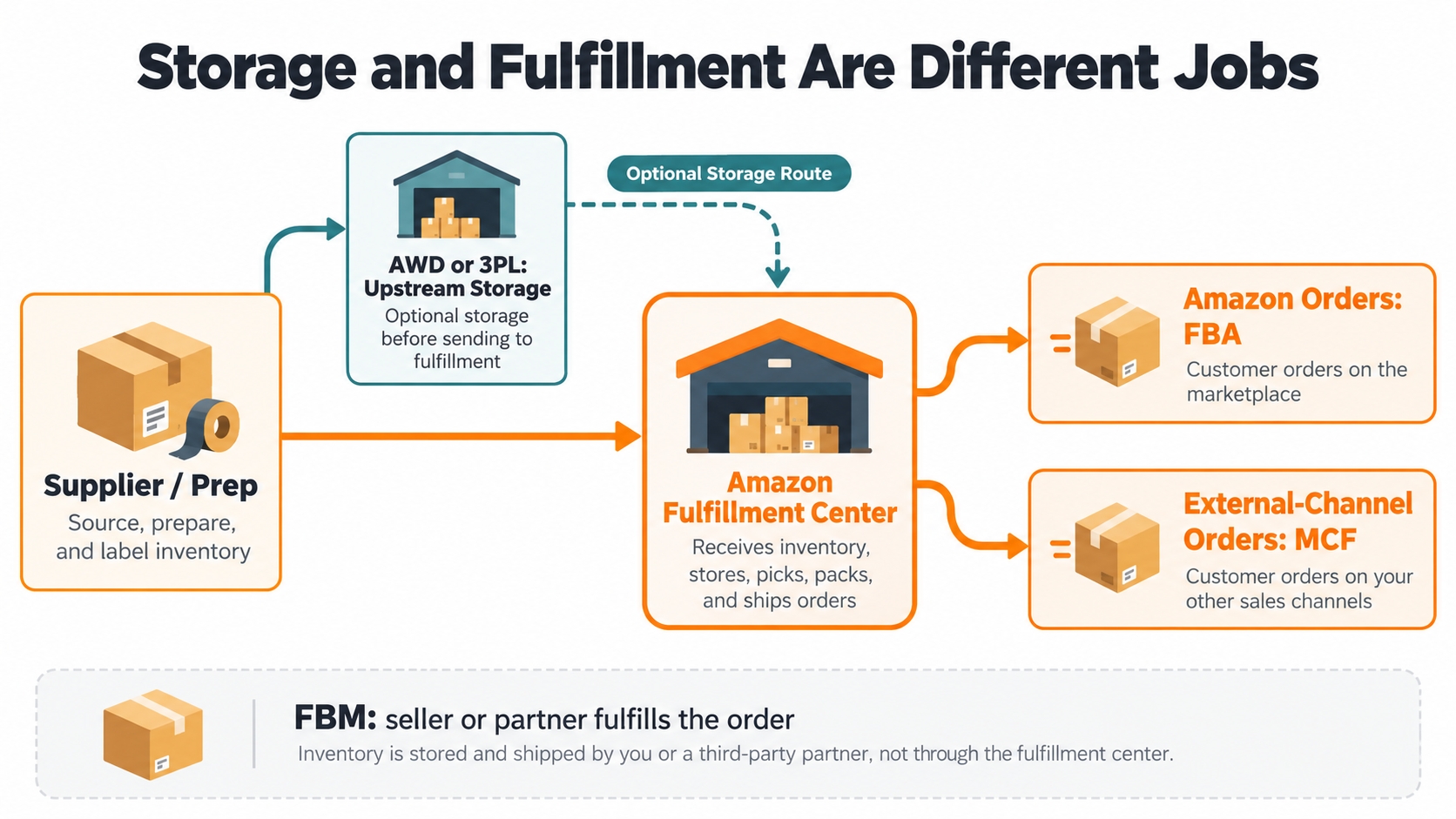
These names describe different responsibilities, not five versions of the same shipping fee. Choose a service according to where stock sits and which orders it needs to fulfill.
| Term | Meaning | Use it to decide |
|---|---|---|
| FBA | Fulfillment by Amazon: Amazon handles fulfillment for eligible orders placed in its store. | Whether to outsource Amazon-order fulfillment. |
| FBM | Fulfilled by Merchant: you manage fulfillment from your own or partnered locations. | Whether your own operation or a logistics partner is a better fit for a SKU. |
| MCF | Multi-Channel Fulfillment: Amazon fulfills orders placed on channels outside Amazon, using its fulfillment network. | How to serve external-channel orders; do not assume FBA pricing applies. |
| AWD | Amazon Warehousing and Distribution: upstream bulk storage with distribution and FBA replenishment options. | Where to hold reserve inventory before it is needed for customer orders. |
| 3PL | Third-party logistics provider: an outside business performing contracted storage, preparation, shipping, or related services. | Which work to delegate, what the quote covers, and who remains accountable. |
A 3PL can prepare inbound stock for FBA or fulfill FBM orders; it is a provider role, not an Amazon sales channel. Likewise, AWD inventory and FBA inventory serve different stages of the supply chain. Define the handoff and quote scope instead of treating every warehouse as equivalent.
Product IDs, Labels, and Inbound Shipping Terms
An identifier answers "which item?" while a shipment label answers "which box or shipment?". Keeping those questions separate helps prevent a correctly listed product from arriving with the wrong physical labels.
ASIN, SKU, FNSKU, and GTIN
ASIN: the catalog product
Amazon Standard Identification Number identifies a product in Amazon's catalog.
SKU: your inventory reference
Stock keeping unit is the seller's reference for an inventory item or offer. Keep it mapped to the correct product and configuration.
FNSKU: the FBA inventory identifier
Fulfillment Network Stock Keeping Unit identifies inventory within FBA. An Amazon-barcode FNSKU links the unit to the seller's inventory.
GTIN / UPC: the retail product identifier
Global Trade Item Number is a standardized product identifier; a UPC is a common GTIN format. It does not replace every FBA labeling requirement.
Print unit labels from the correct inventory record. The carton's FBA box label, carrier shipping label, and any required pallet labels serve separate purposes; follow the labels generated for that shipment rather than reusing an old carton layout.
US labeling check: Amazon ended US FBA prep and item-labeling services for shipments created from January 1, 2026. Its barcode rules also changed on March 31, 2026: resellers must use Amazon barcodes for new inbound inventory, while eligible brand owners can use manufacturer barcodes. Confirm the rule for your role, product, and shipment before production packing.
Inbound, Outbound, FC, SPD, LTL, and FTL
Inbound is the movement of stock into a facility; outbound is its movement out. An FC is a fulfillment center. An inbound delivery to an FC is not the same event as an outbound delivery to a customer.
SPD means small parcel delivery, generally shipping individual cartons through a parcel carrier. LTL means less than truckload; FTL means full truckload. Freight shipments have carrier, pallet, routing, and appointment requirements that differ from sending individual parcels.
Use Amazon's Send to Amazon workflow to select inventory, confirm packing and shipment information, and generate the appropriate labels. Compare the offered placement arrangement and transport cost together. A cheaper carrier quote may not be the cheaper inbound plan once shipment splits and preparation are included.
Inventory Statuses: Delivered Is Not the Same as Available
A shipment arriving at a building does not establish that every unit is ready to fulfill an order. Read shipment progress and inventory status as two related records rather than interchangeable totals.
- Inbound / receiving: stock is on its way into the network or being processed after arrival; do not automatically count it as immediately sellable.
- Fulfillable / available: units available to be picked, packed, and shipped under the report's definition.
- Reserved: units allocated to orders or held for processing, measurement, or another internal activity.
- Unfulfillable: inventory that cannot currently be sold, such as damaged or expired units.
- Researching: units Amazon is investigating, for example potentially misplaced or warehouse-damaged stock.
- Stranded: inventory in the network without an active offer. This is an offer-status problem, not necessarily a shortage of physical units.
For example, a record containing 500 physical units is not a promise of 500 immediately buyable units. Check the available quantity, the reasons for reserved or unavailable units, and the offer status before ordering more stock to solve the wrong problem.
Choose the action from the status: Replenish a genuine supply shortage; resolve a stranded listing through the applicable workflow; investigate unavailable units using the relevant inventory report. Do not treat every status as a forecast of when units will become sellable.
Landed Cost and FBA Fees: Build the Right Cost Stack
A supplier's unit price and Amazon's fulfillment fee describe only parts of the economics. Build a cost model that states where each charge belongs and uses a consistent per-unit basis.
Cost convention used in this guide: Landed inventory cost covers buying the product and getting it to the chosen stocking location, including allocated freight, duties, clearance, and prep where applicable. We show inbound placement and subsequent selling, fulfillment, storage, and marketing charges separately. Your accounting convention may differ; the essential rule is to count each charge once.
Size Tier, Unit Weight, and Dimensional Weight
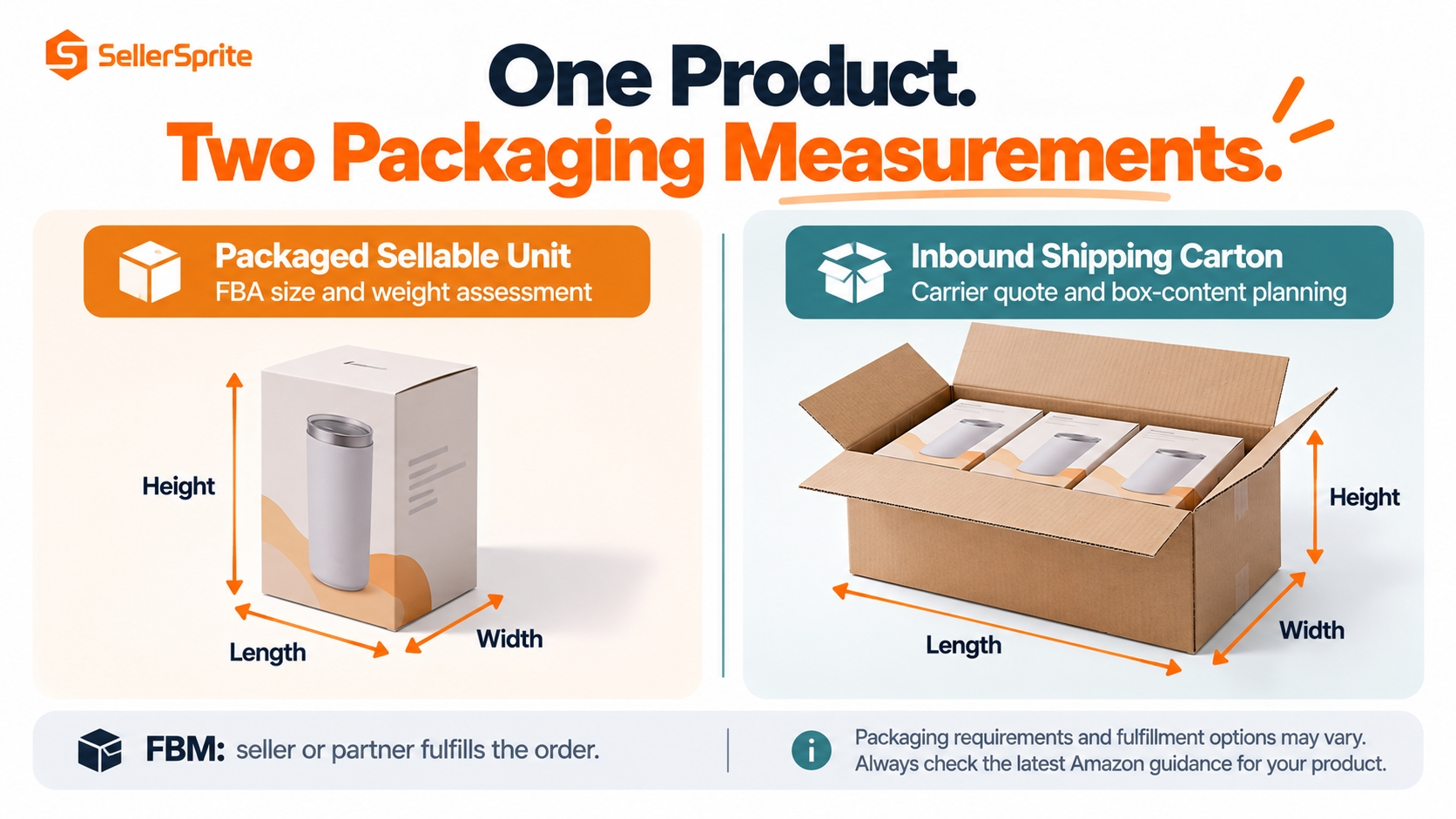
A product size tier classifies the packaged sellable item using relevant dimensions and weight. Unit weight is its physical packaged weight; dimensional weight is a volume-based weight used where the fee rules require it. The applicable shipping weight can depend on the tier, so do not assume a single weight rule for every product.
Measure the final packaged unit, not only the bare product and not the master carton used for inbound freight. A packaging change can alter several cost inputs even when the product itself has not changed. Confirm the applicable tier rather than relying on a supplier's informal "standard size" description.
The Main Fee Categories Are Not Interchangeable
| Term | What drives it | What to check |
|---|---|---|
| Referral fee | The selling charge associated with the product category and applicable sales-price basis. | Do not assume every category has the same rate. |
| FBA fulfillment fee | A charge for fulfilling the unit, under the applicable product and fee schedule. | Use the correct size, weight, price conditions, and effective period. |
| Inbound placement service fee | The selected arrangement for distributing inbound inventory across the network. | Compare placement fees plus freight across available shipment options. |
| Monthly inventory storage fee | Occupied storage volume and the applicable monthly rate; eligible surcharges may also apply. | Storage is not included in one universal per-order fulfillment price. |
| Aged inventory surcharge | An additional charge when inventory reaches applicable age bands. | Use current age reports and the relevant assessment schedule. |
| Low-inventory-level fee | A conditional fee tied to Amazon's historical days-of-supply calculation. | Do not substitute today's forward coverage estimate for that metric. |
| Returns, removal, disposal, and other applicable charges | Separate events or services may produce additional costs. | Check applicability instead of assuming every return or removal is free. |
Recheck Amazon's fee-estimation tools using the actual packaged product and the expected sale period. The 2026 fee schedule includes effective-date distinctions, peak periods, and a fuel and logistics-related surcharge; do not treat an earlier annual announcement or an old screenshot as the complete current quote.
Worked Example: A $30 Product Is Not a $30 Contribution
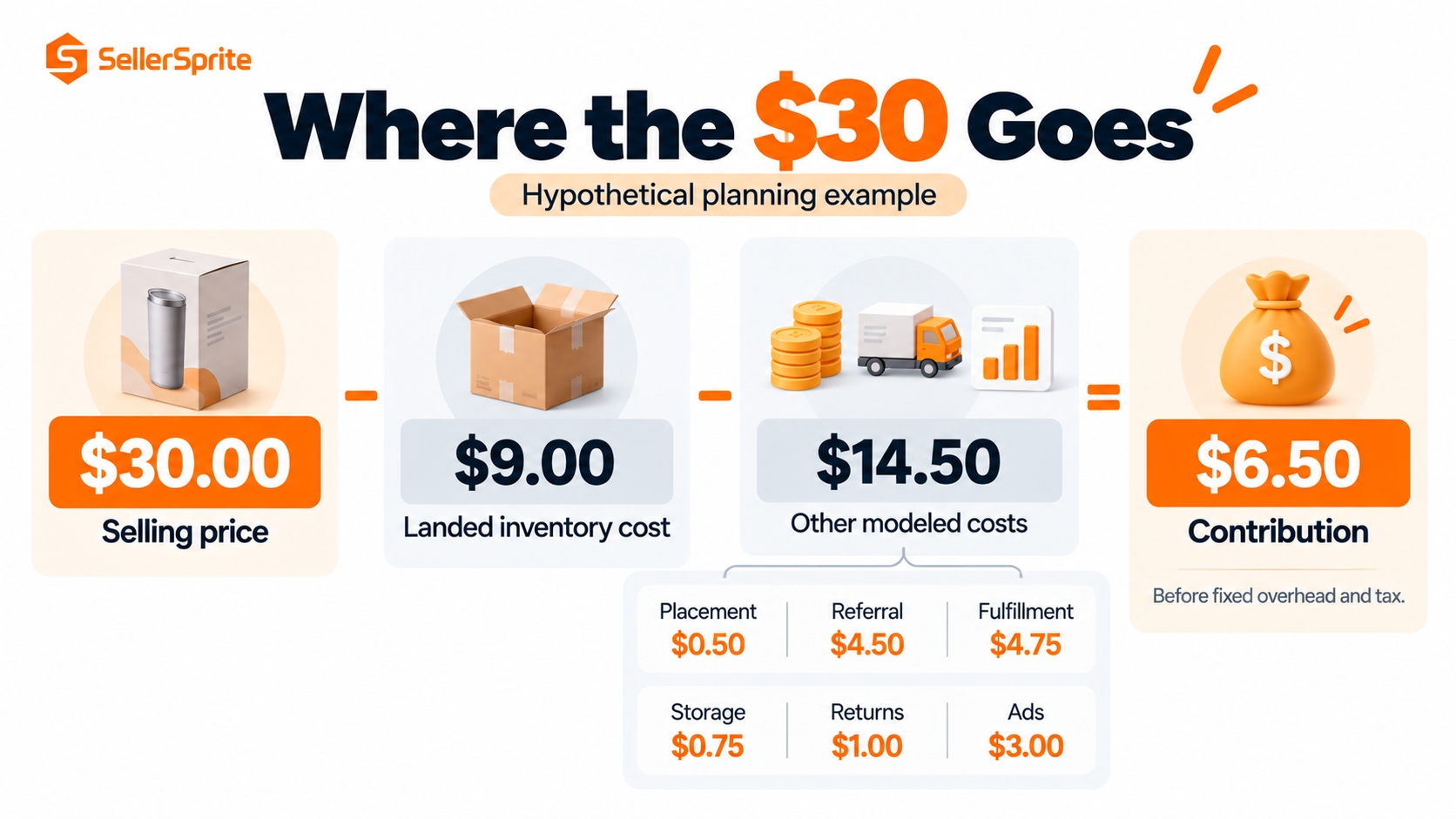
Hypothetical planning inputs, not a fee quote: a $30 net selling price, $7 product cost, and $2 per unit for combined inbound freight, duties, and prep. Landed inventory cost is therefore $9. The remaining figures below are assumed planning allocations, including any applicable fulfillment surcharge in the fulfillment line.
| Cost or result | Amount |
|---|---|
| Landed inventory cost: product + allocated inbound costs | $9.00 |
| Inbound placement, shown separately | $0.50 |
| Referral fee: assumed 15% of $30 | $4.50 |
| Fulfillment fee, including assumed applicable surcharges | $4.75 |
| Storage allowance over the expected holding period | $0.75 |
| Expected returns and related variable-cost allowance | $1.00 |
| Advertising allocated per unit sold | $3.00 |
| Total modeled variable cost | $23.50 |
| Contribution before fixed overhead and tax | $6.50 |
If inbound costs increase by $2 per unit and advertising rises by another $1, contribution falls from $6.50 to $3.50. That sensitivity is why the full model matters more than a single fee number. Keep subscription, staff, and other fixed overhead separate, and replace the example allocations with your own data.
For the distinction between demand and profitability, see SellerSprite's guide to sales estimates versus profit calculations. A product can have meaningful demand and still fail your cost test.
Inventory Metrics: Sell-Through, IPI, and Capacity
Inventory metrics answer different questions about movement, efficiency, and constraints. Preserve the definition and time window instead of comparing numbers that only happen to sound similar.
FBA Sell-Through Is a Ratio, Not a General Sales Percentage
Amazon's FBA sell-through rate divides units shipped over the previous 90 days by average units on hand in its fulfillment centers during that period. For example, 900 units shipped divided by 300 average units is a ratio of 3.0; it does not mean that 3% of your inventory sold.
IPI and Capacity Are Related, but Not Identical
The Inventory Performance Index (IPI) measures FBA inventory-management performance. Amazon highlights excess inventory, sell-through, stranded inventory, and in-stock performance in its improvement guidance. The score is not a profit metric or an approval for a particular purchase quantity.
FBA capacity limits control permitted capacity by storage type and period. Check the current Capacity Monitor, including usage and estimated future limits. Capacity is influenced by IPI and other factors, so a good score does not make every proposed shipment possible.
Forward Coverage Is Not Historical Days of Supply
Your forecasted days of coverage estimates how long current available stock might last. Amazon's historical days of supply looks backward and is used for low-inventory-level fee assessment under its own rules and exclusions. A replenishment arriving today does not make the historical metric identical to your new forecast.
Return Rate and Seasonality Need Their Own Context
Define an internal return rate using returned units and sold or shipped units from a matched group, allowing comparable time for returns to occur. Do not divide one month's returns from older orders by an unrelated month's sales. Use return reasons and expected losses to test margin, especially for fragile or fit-sensitive products.
Seasonality is a recurring demand pattern tied to the calendar. Compare like periods and record promotions separately. BSR is a relative sales rank, not an exact order count; historical ranks and third-party sales estimates can inform scenarios, but your own order records are the basis for actual demand.
Reorder Terms: Lead Time, Safety Stock, and Coverage
A reorder plan connects demand to the date replacement stock becomes usable. A cheaper unit price is not enough if the purchase locks up cash or arrives after you run out.
Lead time
The elapsed time through the stages needed to make replenishment sale-ready: production where relevant, prep, transport, receiving, and processing.
Safety stock
A deliberately chosen inventory buffer for uncertainty in demand or lead time, not a fixed quantity that fits every product.
Inventory position
Usable on-hand stock plus relevant confirmed on-order supply, minus outstanding commitments that are not already excluded. Track timing as well as quantity.
Two simplified planning formulas:
Days of coverage = available sellable units ÷ expected daily demand
Reorder point = expected daily demand × replenishment lead time + safety stock
These simplified formulas require a positive, usable demand estimate and consistent units. Use them as planning aids, not as Amazon fee or capacity calculations.
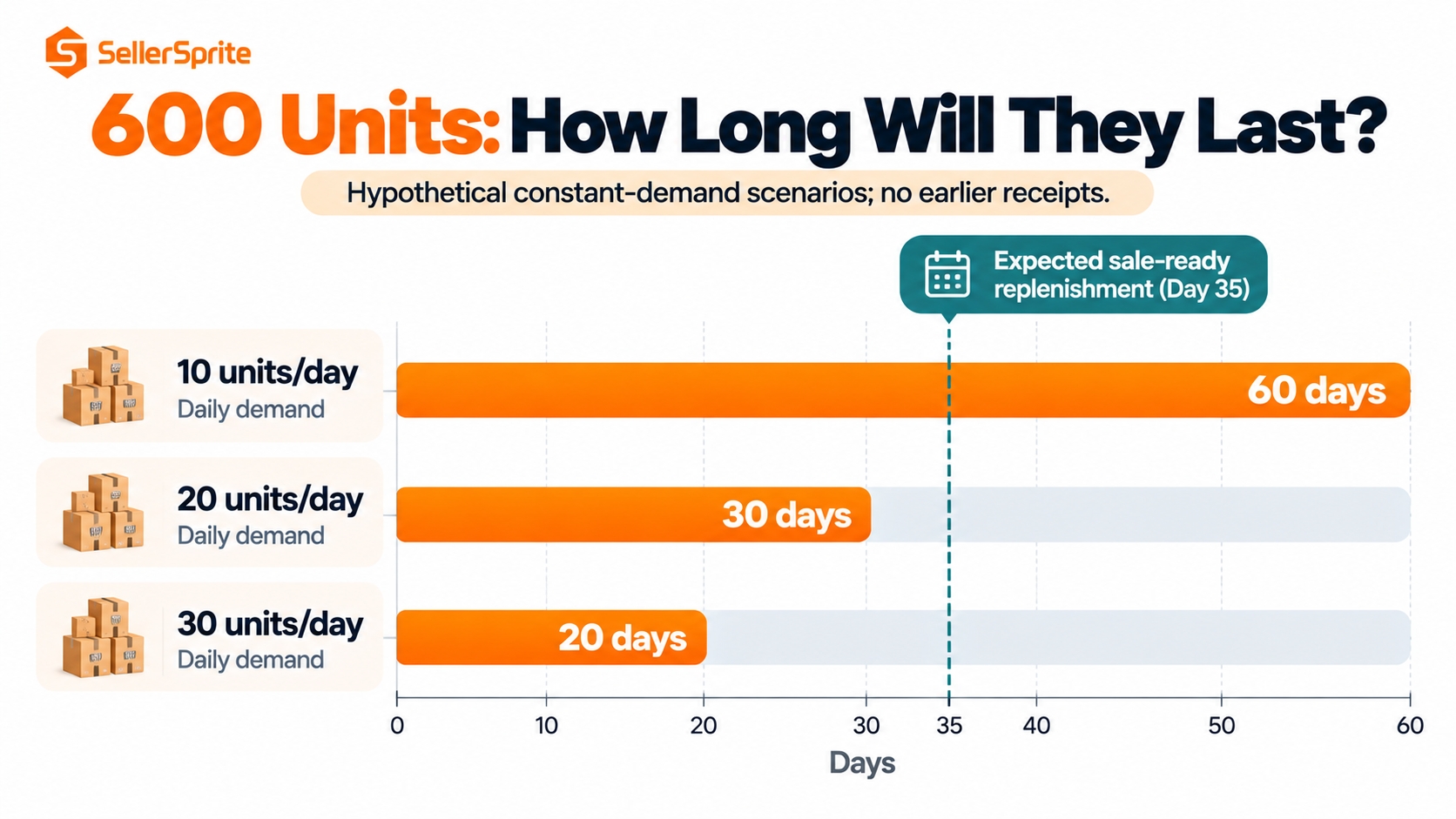
Hypothetical example: assume 600 available units, 20 units of expected daily demand, 35 days until a new replenishment becomes sale-ready, 100 units of safety stock, and no earlier incoming supply. Coverage is 30 days, while the reorder point is (20 × 35) + 100 = 800 units. Current inventory position is already below the trigger, with a projected five-day supply gap.
The 800-unit trigger is not an instruction to order 800 units. Order quantity also depends on existing commitments, target stock, supplier minimum order quantity (MOQ), shipment economics, capacity, and cash. Inbound units arriving after the projected stockout do not prevent the earlier gap.
Recalculate with lower and higher demand cases. At 10 units per day, the same 600 units cover 60 days; at 30 per day, they cover 20. Before expanding a promotion or Sponsored Products budget, check whether the supply plan can support the extra demand.
A Practical FBA Workflow Before Every Purchase Order
The terms become useful when they change a purchase or shipment decision. Use the following sequence to test the product, demand, cash commitment, and execution plan before committing more inventory.
01 Confirm eligibility and the physical product.
Check category and FBA restrictions, required documentation, packaging, unit measurements, prep ownership, and barcode selection. A supplier's assurance does not replace the current requirements for your offer.
02 Build conservative and upside demand cases.
Use your own in-stock sales where available and comparable historical market evidence for new products. Separate recurring seasonality from promotion-driven spikes.
03 Compare the complete fulfillment alternatives.
Calculate FBA and merchant-fulfilled economics for the same SKU and service assumptions. Include freight, placement, storage, returns, and operational costs instead of comparing one FBA fee with one postage quote.
04 Set a reorder calendar and cash limit.
Work backward from the sale-ready date. Include lead-time uncertainty, supplier payment dates, MOQ, available capacity, and the risk of leftover inventory.
05 Recheck the quote, then run a controlled shipment.
Confirm final packaging, transport charges, fee effective dates, and labeling instructions. For a new SKU, use a manageable initial quantity where feasible, inspect receiving outcomes, and reconcile actual charges before scaling.
For the research step, SellerSprite Product Research provides historical sales, price, and BSR context for comparing potential products. Use it to challenge your demand assumptions, not as a certification of FBA eligibility or an exact quote for your future shipment. The product sample, current Amazon fee tools, and supplier or carrier quote still need to agree.
Common FBA Terminology Mistakes to Avoid
Most expensive terminology errors hide a missing cost or an incorrect assumption about inventory. Check these distinctions whenever a shipment, forecast, or profit estimate looks unexpectedly favorable.
- FBA fee is not total cost. A fulfillment charge does not absorb sourcing, freight, referral fees, storage, ads, and every exception charge.
- Supplier price is not landed cost. State whether transport, duty, preparation, and delivery to the stocking location are included.
- Delivered is not fully received or immediately available. Reconcile the shipment and the actual inventory status.
- ASIN is not SKU, and neither is a carton label. Keep catalog, seller-inventory, unit-barcode, and shipment records mapped correctly.
- A reorder point is not an order quantity. It triggers a review; the quantity needs a separate supply, capacity, and cash calculation.
- An old prep or barcode tutorial is not a current requirement. Check the rules for your role and shipment date before labels are printed.
The Bottom Line
Amazon FBA and fulfillment terms matter because they change what you buy, what you pay, and when stock can sell. The useful glossary is the one that stops a cost from being omitted, a label from being confused, or an unavailable unit from being counted as ready inventory.
Before the next purchase order, verify the packaged product, identify each cost layer, and match the replenishment timeline to realistic demand. Use market research to support the forecast, and use your own operational records and current Amazon requirements to execute it.
FAQs
What does FBA mean, and what does Amazon handle?
FBA means Fulfillment by Amazon. Amazon stores eligible inventory and handles picking, packing, shipping, customer service, and returns for relevant Amazon orders. The seller still manages the product and supply decisions needed to keep that inventory ready.
What is the difference between FBA, MCF, and AWD?
FBA serves Amazon customer orders; MCF fulfills orders from external channels; AWD provides upstream bulk storage and distribution, including FBA replenishment options. They serve different stages or order sources and should not be assumed to use identical pricing.
Are an ASIN, SKU, and FNSKU the same thing?
No. An ASIN identifies the catalog product, a SKU is the seller's inventory or offer reference, and an FNSKU identifies inventory within the FBA network. Amazon-barcode labels and shipment labels also have different purposes.
Does Amazon still prepare and label US FBA inventory?
Amazon discontinued US FBA prep and item-labeling services for shipments created from January 1, 2026. Arrange required preparation and labeling before sending inventory, using your own operation, supplier, or an appropriate service provider.
Are landed cost and FBA fees the same?
No. In this guide, landed inventory cost covers acquiring stock and bringing it to the chosen stocking location. Selling and downstream fulfillment costs are modeled separately. Whatever convention you use, show the inclusions and avoid charging the same component twice.
Why can inventory be delivered but not available to sell?
Units can still be inbound or processing, reserved for orders, unfulfillable, or under investigation. A stranded unit may physically exist without an active offer. Review the inventory and offer status rather than assuming every received unit is immediately buyable.
How is FBA sell-through different from days of coverage?
FBA sell-through compares units shipped during the previous 90 days with average stock over that period. Forward days of coverage divides current available stock by expected daily demand. One describes historical movement; the other is a planning estimate.
Does a good IPI score guarantee enough storage capacity?
No. Capacity limits are influenced by IPI and other factors. Check your current usage, storage-type limits, and shipment feasibility in the Capacity Monitor before committing to an inbound quantity.
References
- Amazon: Fulfillment by Amazon View
- Amazon: Fulfilled by Merchant View
- Amazon: FBA vs. Multi-Channel Fulfillment View
- Amazon: How AWD Works With FBA View
- Amazon: Product IDs and GTINs View
- Amazon: FBA Barcode Choice and Labeling FAQ View
- Amazon: Create Shipments With Send to Amazon View
- Amazon: Shipping and Routing Requirements View
- Amazon: FBA Prep Service Discontinuation View
- Amazon: Inventory Buyability View
- Amazon: Selling Fees and Pricing View
- Amazon: Product Size Tiers View
- Amazon: FBA Inbound Placement Service Fee View
- Amazon: 2026 US FBA Fulfillment Fee Changes View
- Amazon: Monthly Inventory Storage Fees View
- Amazon: Low-Inventory-Level Fee View
- Amazon: Inventory Performance and FBA Sell-Through View
- Amazon: FBA Capacity Limits View
- Amazon: Estimate Fees and Costs View
By SellerSprite Content Team
SellerSprite publishes practical guidance on Amazon marketplace research and seller operations. This guide combines official Amazon definitions with practical inventory and costing examples.
Last reviewed: October 16, 2026