TL;DR: Competitor keyword gap analysis reveals high-opportunity keywords your Amazon listings are missing but competitors rank for, unlocking traffic, conversions, and long-tail profit. This step-by-step guide shows you how to find, prioritize, and act on these gaps.
Key Takeaways
- A keyword gap is any search term your competitors rank for that you don't; these represent untapped traffic and conversion opportunities on Amazon.
- Use reverse ASIN tools to extract competitor keywords, then compare them to your organic and PPC data to build a gap table.
- Prioritize gaps using relevance, intent, profitability, and feasibility to focus only on high-impact, winnable keywords, especially long-tails.
Table of Contents
- What a Keyword Gap Analysis Is (And Why It Finds "Hidden Wins")
- The 3 Types of Keyword Gaps Sellers Should Track
- Set Your Goal and Scope (So You Don't Drown in Data)
- Step 1: Choose the Right Competitors (Garbage In, Garbage Out)
- Step 2: Collect Keyword Data (Reverse ASIN + Your Own Data)
- Step 3: Build the Gap Table (The Simple "Set Difference" Method)
- Step 4: Prioritize Opportunities (Not All Gaps Are Worth Chasing)
- Step 5: Turn Gap Keywords Into Action (SEO Mapping + PPC Testing)
- Step 6: Validate With SERP Reality (So You Don't Chase Phantom Keywords)
- Example Walkthrough: A Gap Analysis in 20 Minutes (Template Format)
- Common Mistakes (And How to Avoid Them)
- FAQ
- References
Note on marketplaces: This guide is specifically optimized for the US market.
What a Keyword Gap Analysis Is (And Why It Finds "Hidden Wins")
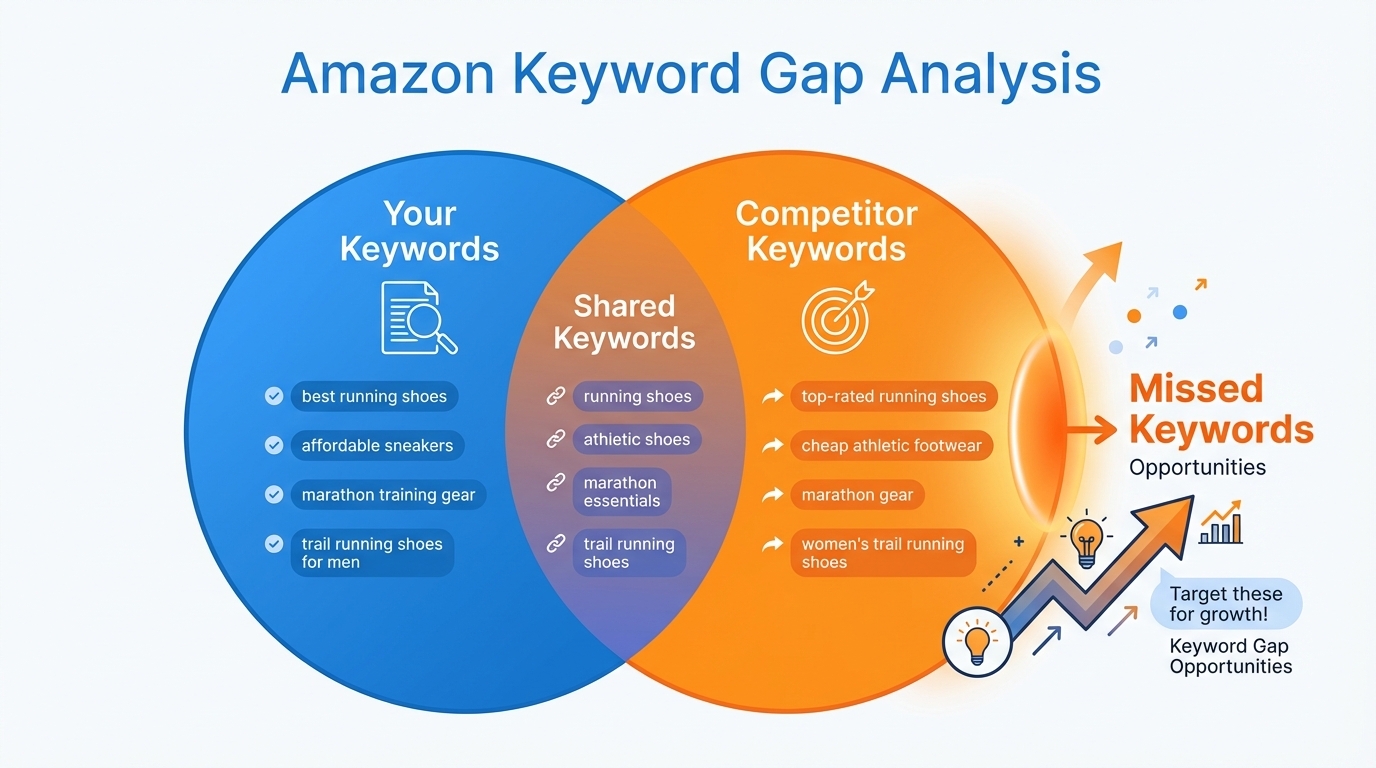
A keyword gap is any search term your competitors rank for organically or via PPC, but you don't. These gaps represent missed visibility, traffic, and sales. On Amazon, where 70% of shoppers start with a search, missing even a few high-intent keywords can cost you thousands in lost revenue.
Definition: Keyword Gap Analysis
A keyword gap analysis compares your Amazon listing's keyword performance against top competitors to identify search terms they rank for that you're missing. It's a strategic audit to uncover hidden SEO and PPC opportunities.
Why does this matter? Because Amazon's algorithm rewards relevance. If your competitors rank for terms like "waterproof hiking backpack 30L" and you don't, Amazon assumes your product isn't as relevant, even if it is. You lose impressions, clicks, and conversions.
Why Gaps Matter: Missed Traffic, Missed Conversions, Missed Defense
Ignoring keyword gaps means:
- Missed traffic: You're not showing up in search results for high-volume or high-intent terms.
- Missed conversions: Even if you rank, poor keyword alignment reduces click-through and conversion rates.
- Missed defense: Competitors dominate terms you should own, making it harder to regain share.
When to Run a Keyword Gap Analysis
Run this analysis when:
- Launching a new product: Ensure your listing targets all relevant search terms from day one.
- Sales plateau: Diagnose why growth has stalled, likely missing key keyword clusters.
- Rank drop: Identify if competitors have captured terms you previously ranked for.
- PPC inefficiency: High ACoS? You might be bidding on low-intent terms while missing high-converting long-tails.
The 3 Types of Keyword Gaps Sellers Should Track
Not all keyword gaps are created equal. Understanding the type helps you decide how to act.
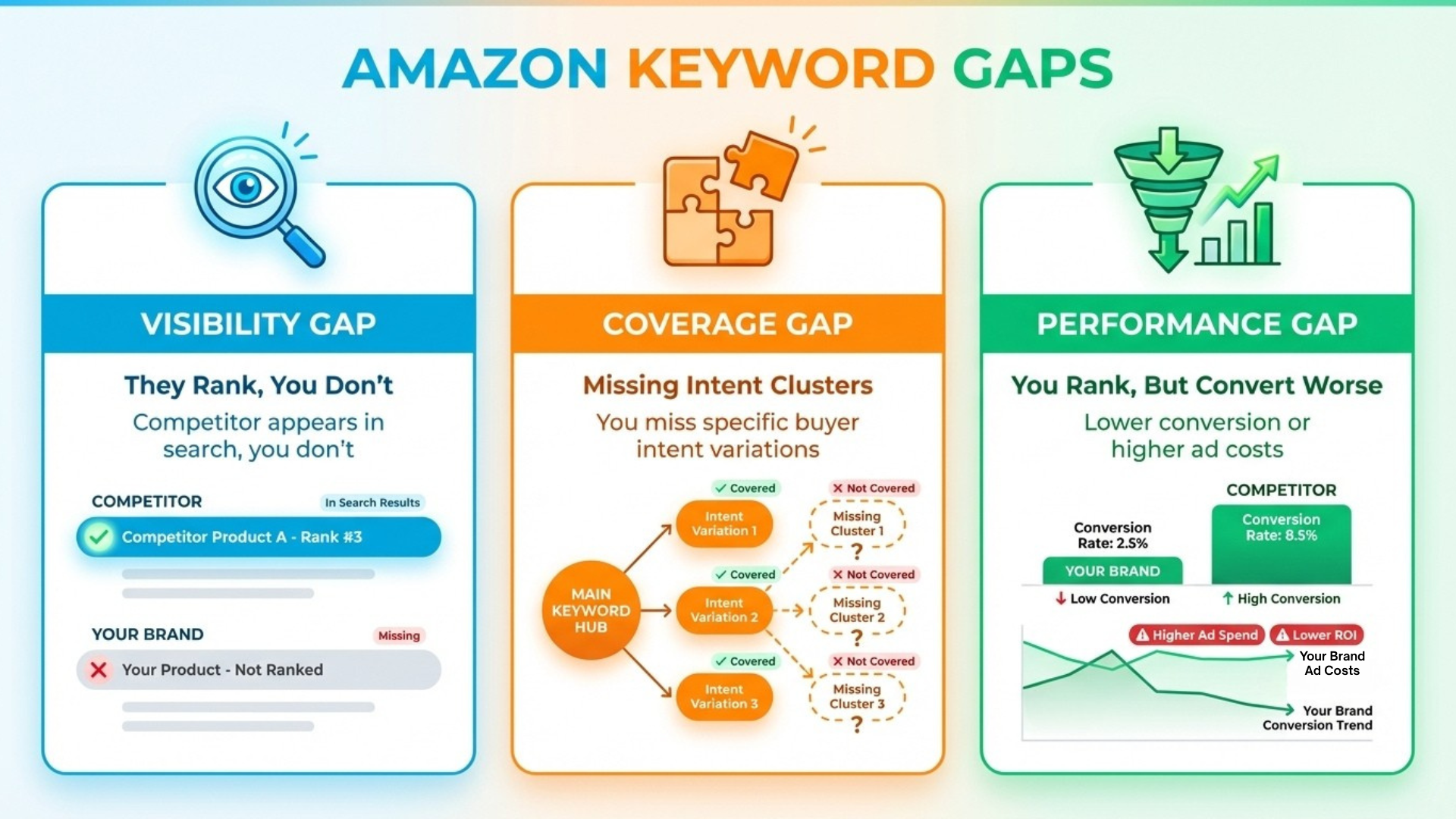
Visibility Gap (They Rank, You Don't)
This is the most common gap. Your competitor appears in search results for a term like "lightweight camping tent for 2" but your listing doesn't. This could be due to missing keywords in title, bullets, or backend. Fix: Optimize listing content and monitor indexing.
Coverage Gap (They Cover Intent Clusters You're Missing)
You might rank for core terms like "yoga mat" but miss entire intent clusters, such as eco-friendly, non-slip, or travel-sized variants. Competitors using phrases like "eco-friendly non-slip travel yoga mat" capture more specific buyer intent. Fix: Expand keyword mapping across use cases and attributes.
Performance Gap (You Rank, But Convert Worse / Pay More)
You appear in search results but have lower conversion or higher ACoS than competitors. This suggests your listing isn't as compelling, or you're bidding inefficiently. Fix: A/B test images, copy, and bid strategies for those keywords.
Set Your Goal and Scope (So You Don't Drown in Data)
Without clear goals, keyword gap analysis becomes a data dump. Define scope and outcomes first.
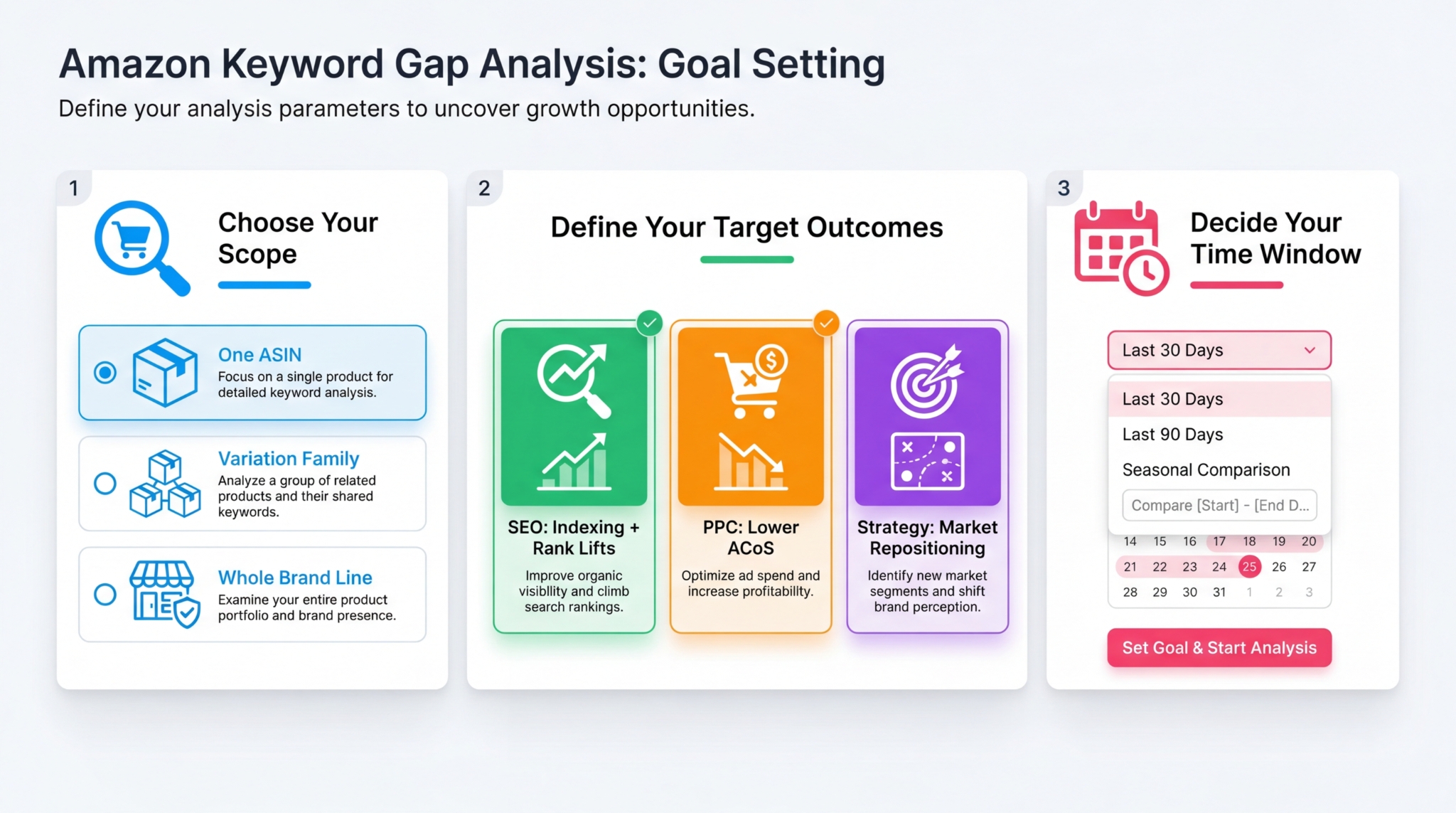
Choose Your Scope
- One ASIN: Ideal for new launches or underperforming products.
- Variation family: Analyze all sizes/colors together to find shared gaps.
- Whole brand line: For brand-level strategy, identify category-wide keyword weaknesses.
Define Your Target Outcomes
SEO: Indexing + Rank Lifts for Specific Clusters
Goal: Get your listing indexed and ranking for 10+ high-intent long-tail keywords within 60 days.
PPC: Lower ACoS via High-Intent Long-Tails
Goal: Reduce ACoS by 15% by shifting spend from broad to long-tail, competitor-gap keywords.
Strategy: Repositioning vs. the Market Leader
Goal: Identify 5+ keyword clusters where you can differentiate (e.g., "vegan leather", "recycled materials").
Decide Your Time Window
Use recent data:
- Last 30 days: Best for fast-moving categories (e.g., electronics).
- Last 90 days: Ideal for seasonal or slower-turning products.
- Seasonal: Compare holiday vs. off-season data for products like grills or heaters.
Step 1: Choose the Right Competitors (Garbage In, Garbage Out)
Your gap analysis is only as good as your competitor selection. Pick the wrong ASINs, and you'll chase irrelevant keywords.
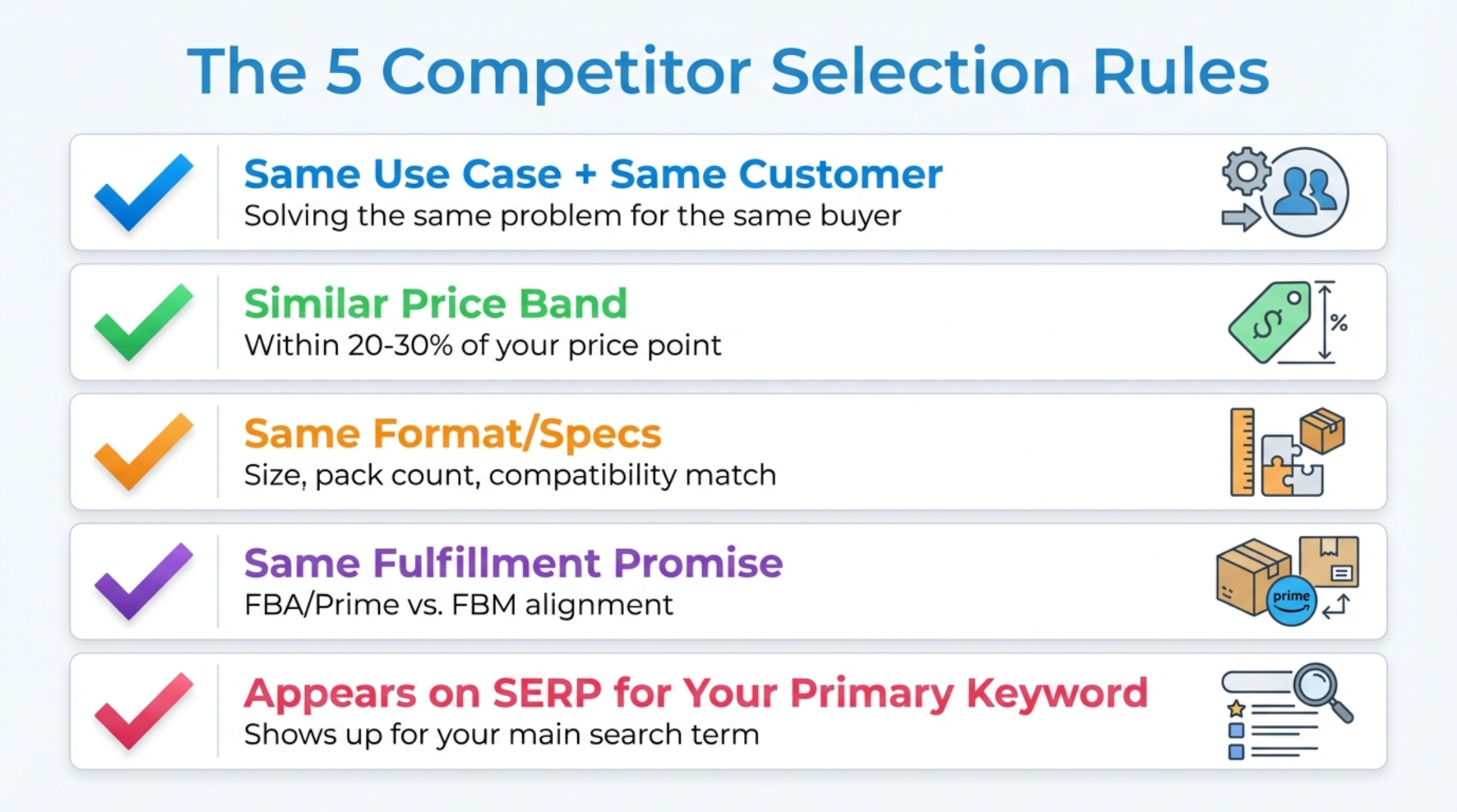
The 5 Competitor Selection Rules (Fast Checklist)
- Same use case + same customer: Are they solving the same problem for the same buyer?
- Similar price band: Within 20-30% of your price point.
- Same format/specs: Size, pack count, compatibility (e.g., iPhone 15 case vs. iPhone 15 case).
- Same fulfillment promise: FBA/Prime vs. FBM. Prime eligibility affects visibility.
- Appears on SERP for your primary keyword: If they don't show up when you search for your main term, they're not a real competitor.
Avoid "Dataset Poison" ASINs
Exclude:
- Category giants: Brands like Anker or Philips dominate with brand search.
- Bundles vs. singles: A 6-pack of phone cases isn't a fair comparison to your 1-pack.
- Off-position variants: A competitor's large-size variant shouldn't be compared to your medium.
Competitor ASIN List (Example: Waterproof Backpacks)
- B08X123456: Same 30L size, $49.99, Prime, top 3 in "hiking backpack"
- B08Y789012: Eco-friendly material, $52.99, FBA, appears in same searches
- B08Z345678: Compact design, $47.99, Prime, high review count
Step 2: Collect Keyword Data (Reverse ASIN + Your Own Data)
Now gather the raw data. You need two sets: competitor keywords and your own keyword reality.
Pull Competitor Keyword Lists (Reverse ASIN)
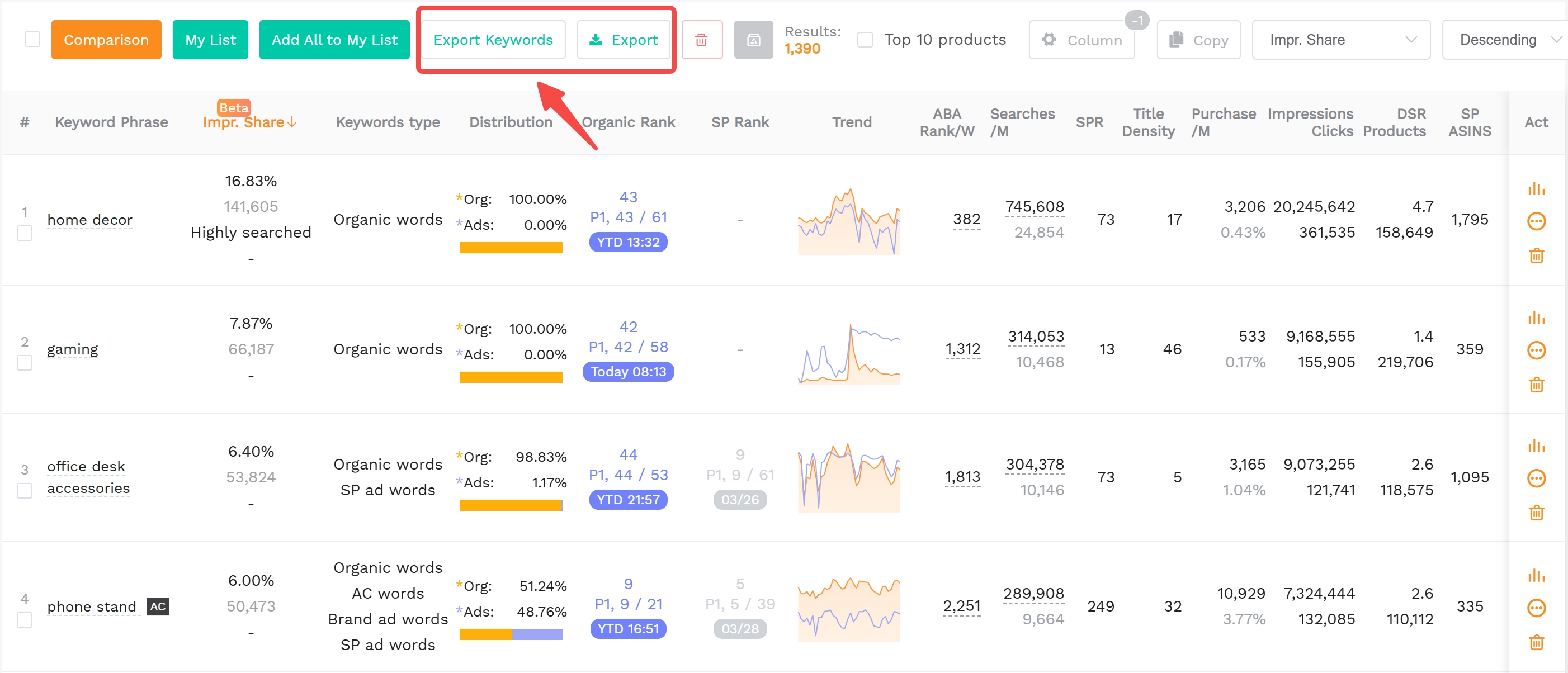
Use a reverse ASIN tool like SellerSprite to extract keywords competitors rank for. Export:
- Keyword
- Rank type (organic, sponsored)
- Estimated search volume or trend proxy
Pull Your Keyword Reality (Your Rankings + PPC Search Terms)
Organic Rankings List
Use Amazon Brand Analytics (ABA) or a rank tracker to see where your ASIN appears organically.
PPC Search Term Report
Download from Seller Central. This shows what buyers actually typed before clicking your ad, gold for long-tail discovery.
Normalize and Clean the Dataset
- Remove duplicates: "waterproof backpack" vs. "waterproof backpacks"
- Remove irrelevant terms: Competitor brand names, unrelated categories
- Remove branded terms you can't win: “Yeti cooler alternative”; you won't rank for that
Step 3: Build the Gap Table (The Simple "Set Difference" Method)
Now create the core of your analysis: the gap table.
Create Three Lists
- Competitor keywords: All terms from your competitor set
- Your keywords: From organic rankings and PPC reports
- Shared keywords: Terms both you and competitors rank for
Identify "Missed" Keywords (Competitor-Only Terms)
Use Excel or Google Sheets to subtract your list from the competitor list. The remainder is your gap list.
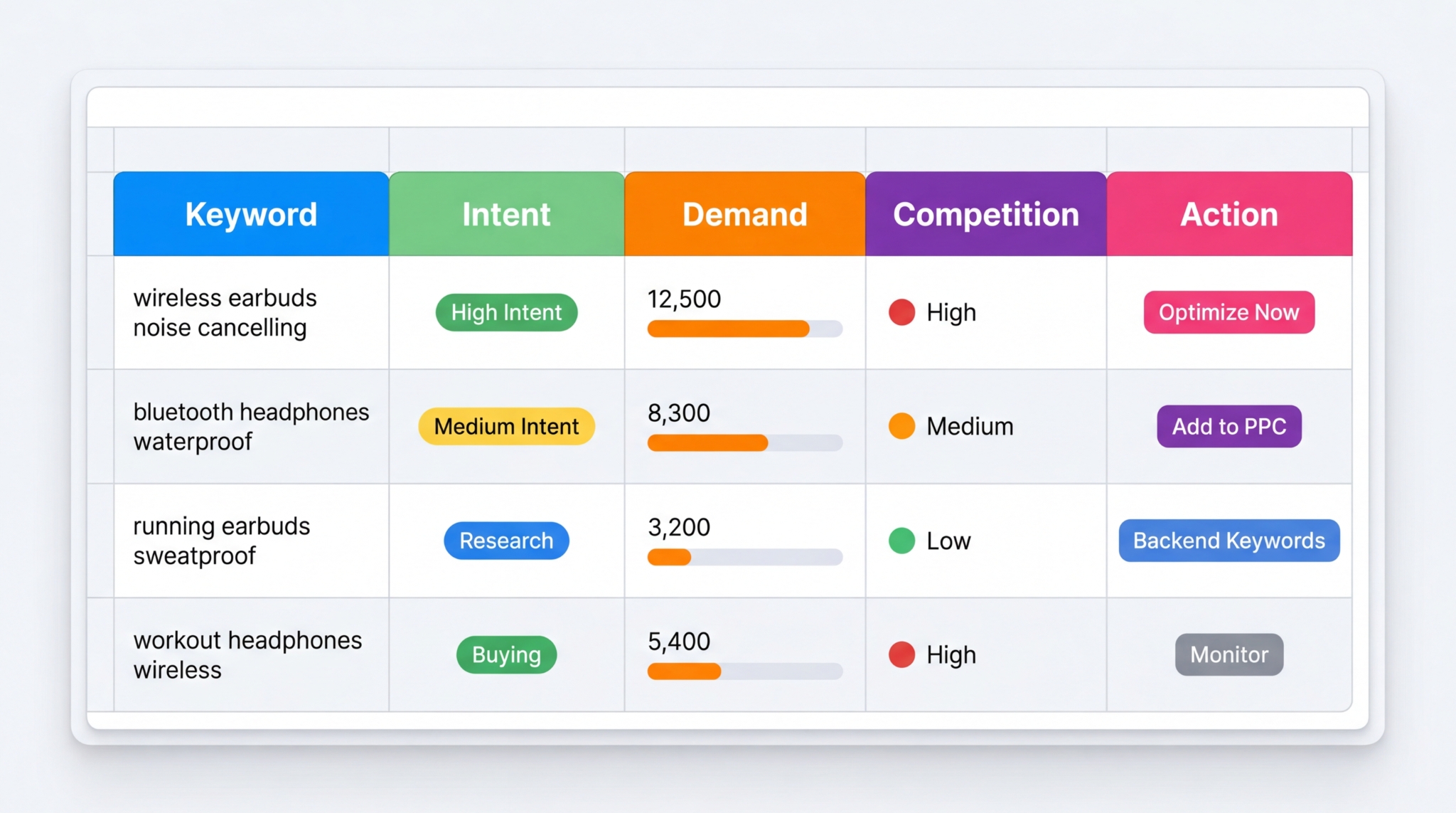
Add Context Columns So Gaps Become Decisions
Turn raw gaps into actionable insights by adding:
- Intent cluster: Core, attribute, use case, compatibility, problem
- Estimated demand: Volume or trend proxy
- Ability-to-win: Competition level, review count, SERP density
- Recommended channel: SEO, PPC, or both
Gap Table Column Template (Copy/Paste)
Keyword | Intent Cluster | Est. Demand | Relevance (1-5) | Competition | Ability-to-Win (1-5) | Channel | Action
Step 4: Prioritize Opportunities (Not All Gaps Are Worth Chasing)
You'll likely find hundreds of gaps. Not all are worth pursuing. Apply filters.
The 4 Filters That Remove "Fake Opportunities"
- Relevance filter: Does the keyword match your exact product? (e.g., "iPhone 15 case" for your iPhone 15 case)
- Intent filter: Is it purchase-ready? Avoid "best hiking backpack" if you can't win reviews yet.
- Profitability filter: Can you afford the expected CPC and still maintain margin?
- Feasibility filter: Can your listing out-convert the current SERP? Check images, price, reviews.
A Simple Scoring Model (Copy/Paste)
Opportunity Score Formula
Opportunity Score = Relevance × Intent × Profitability × Feasibility
Example: 5 (perfect fit) × 4 (high intent) × 3 (moderate CPC) × 4 (strong listing) = 240
The Best "Gap Wins" Are Often Long-Tails
Long-tail keywords like "lightweight waterproof hiking backpack for women 30L" have lower search volume but higher intent, lower CPC, and easier indexing. These are profit engines.
Decision Tree: Should You Act on This Gap?
If gap is relevant + high intent + winnable → act; else → ignore.
Step 5: Turn Gap Keywords Into Action (SEO Mapping + PPC Testing)
Now deploy your findings.
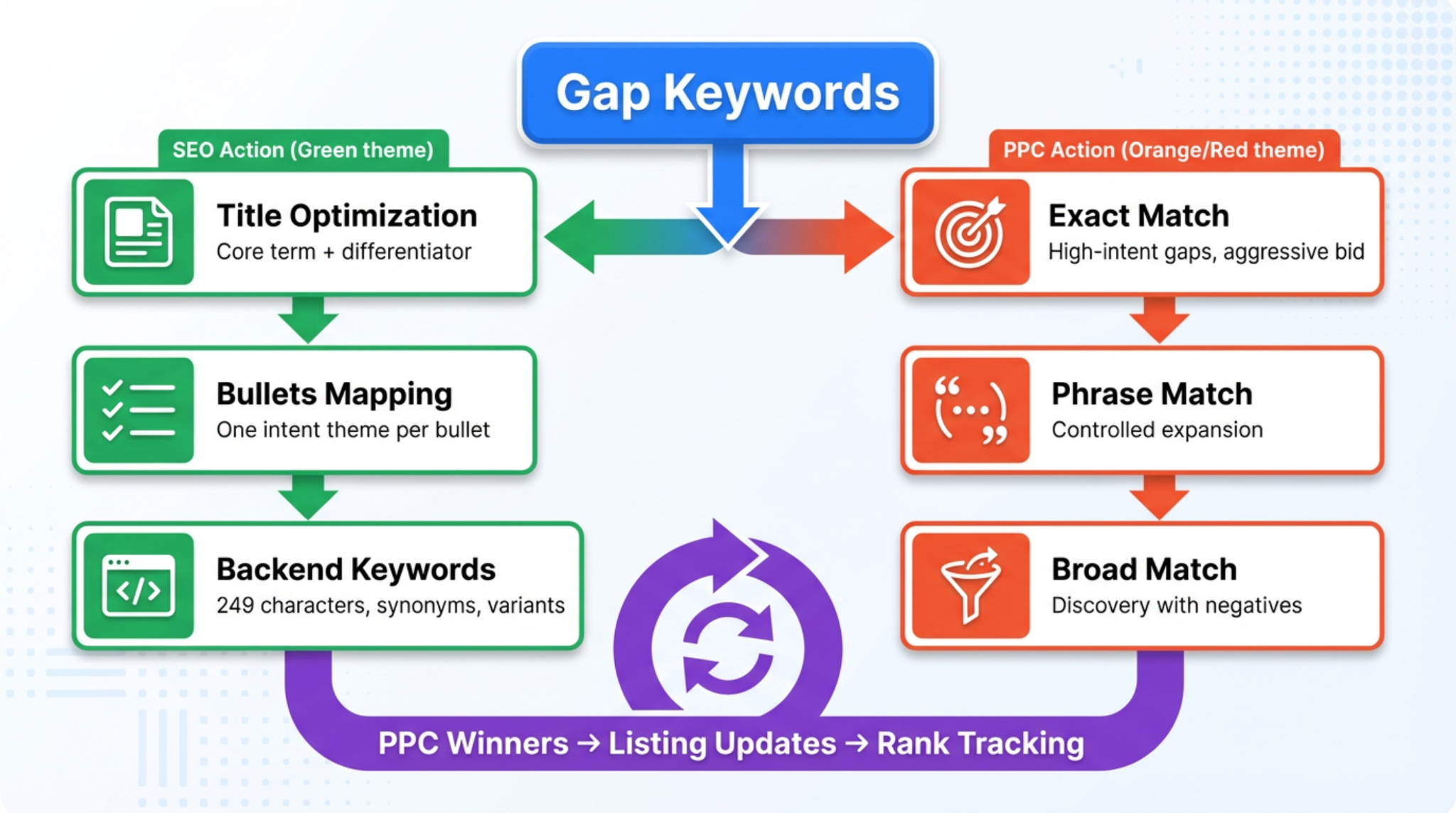
SEO Action: Keyword Mapping Plan
Title: Only the strongest core term + differentiator
Example: "Waterproof Hiking Backpack 30L - Lightweight & Eco-Friendly"
Bullets: Map clusters (one intent theme per bullet)
Dedicate each bullet to a gap cluster: durability, capacity, eco-materials, etc.
Backend: Variants, synonyms, leftover long-tails
Use all 249 characters. Include plurals, misspellings, and technical terms.
PPC Action: Test Plan by Match Type
Exact: For high-intent gaps (scale potential)
Bid aggressively on terms like "waterproof hiking backpack 30L".
Phrase: For controlled expansion
Capture variations like "best waterproof hiking backpack".
Broad: For discovery (with negatives)
Find new long-tails, but add negative keywords to avoid waste.
Close the Loop: PPC Winners → Listing Updates → Rank Tracking
Winning PPC keywords should be added to your listing. Then track organic rank improvements.
Step 6: Validate With SERP Reality (So You Don't Chase Phantom Keywords)
Before acting, manually check the SERP for each high-priority gap keyword.
Manual SERP Check: Does Your Product Belong?
Ask: Is your product a natural fit for this search? If all results are premium brands and you're budget-tier, you may not win.
Spot SERP Traps
- Wrong subcategory: "backpack" vs. "laptop backpack"
- Accessory vs. main item: "backpack rain cover" isn't the same as a backpack
- Brand-dominated terms: “North Face backpack” - you can't win that
Confirm Indexing After Changes
Use a tool to verify Amazon has indexed your updated keywords before expecting rank movement.
Example Walkthrough: A Gap Analysis in 20 Minutes (Template Format)
Choose 5 Competitor ASINs
Follow the 5 rules. Example: B08X123456, B08Y789012, etc.
Export Keywords and Clean Lists
Use SellerSprite to reverse ASINs. Remove duplicates and branded terms.
Cluster + Score Opportunities
Group by intent. Score top 20 using the 4-factor model.
Create an SEO/PPC Action Plan with 10 "Gap Targets"
Example: Add "eco-friendly" to title, launch exact match PPC on "lightweight hiking backpack 30L".
20-Minute SOP: Competitor Keyword Gap Analysis
- Select 5 competitors using the 5 rules
- Reverse ASIN to extract keywords
- Clean and deduplicate lists
- Build gap table with context columns
- Score and prioritize top 20
- Deploy 10 high-impact actions (SEO + PPC)
Common Mistakes (And How to Avoid Them)
Picking the Wrong Competitors (Wrong Intent = Wrong Gaps)
Fix: Use SERP presence and product specs to validate.
Chasing High-Volume Gaps You Can't Convert For
Fix: Apply the feasibility filter. Don't bid on "best" terms if you have 10 reviews.
Ignoring Long-Tail Clusters (Where Profit Lives)
Fix: Prioritize long-tails with high intent and low CPC.
Not Tracking Results (No Baseline, No Learning)
Fix: Track rank, impressions, and ACoS before and after changes.
FAQ
What is the best tool for competitor keyword gap analysis on Amazon?
SellerSprite's Reverse ASIN tool is one of the most accurate for extracting competitor keywords. It shows organic and sponsored terms, estimated search volume, and demand trend, making it ideal for building gap tables. Combine it with your PPC search term reports for full visibility.
How do I find hidden keywords my Amazon competitors are ranking for?
Use a reverse ASIN tool to extract the keywords your competitors rank for. Then compare that list to your own organic rankings and PPC search terms. The difference, competitor-only terms, is your "hidden" keyword opportunity list. Focus on long-tail, high-intent phrases for the best ROI.
Why is keyword gap analysis important for Amazon sellers?
It reveals missed traffic and conversion opportunities. If competitors rank for terms you don't, you're losing sales. Gap analysis helps you close those gaps through SEO optimization and targeted PPC, improving visibility, relevance, and profitability.
How many competitors should I include in a gap analysis?
Start with 5-7 well-chosen competitors. Too few, and you miss opportunities. Too many, and you dilute relevance. Use the 5 selection rules to ensure they're true competitors in price, specs, and SERP presence.
What if competitors dominate every head term?
Shift focus to long-tail keywords and niche intent clusters (e.g., "eco-friendly", "compact", "for women"). These have lower competition and higher conversion potential. Use them in PPC first, then optimize listings to gain organic traction over time.
Next Steps
- Try SellerSprite's Reverse ASIN tool to start your gap analysis today.
- Learn how to uncover competitor backend keywords for deeper insights.
- Get 3-day free trial today to explore SellerSprite Amazon seller tools.
References
- Reverse ASIN Strategy Guide View
- How to Spy on Amazon Competitor Backend Keywords View
- Choose the Right Competitors for Reverse ASIN View
By SellerSprite Success Team
The SellerSprite Success Team combines deep Amazon algorithm expertise with real-world seller experience. We've helped thousands of brands and sellers optimize listings, run data-driven PPC, and outmaneuver competitors using reverse ASIN and keyword gap analysis. Our insights are rooted in platform updates, A/B testing, and continuous research, ensuring you get actionable, up-to-date strategies.