TL;DR: Amazon's A10 algorithm in 2026 prioritizes customer-centric metrics like conversion rate, relevance, and post-purchase satisfaction. Understanding its core mechanics and optimizing for key ranking factors can significantly boost your product's visibility and sales on Amazon US.
Key Takeaways
- The Amazon A10 algorithm, launched in 2025 and refined through 2026, emphasizes real-time customer behavior, conversion velocity, and post-purchase satisfaction over static keyword matching.
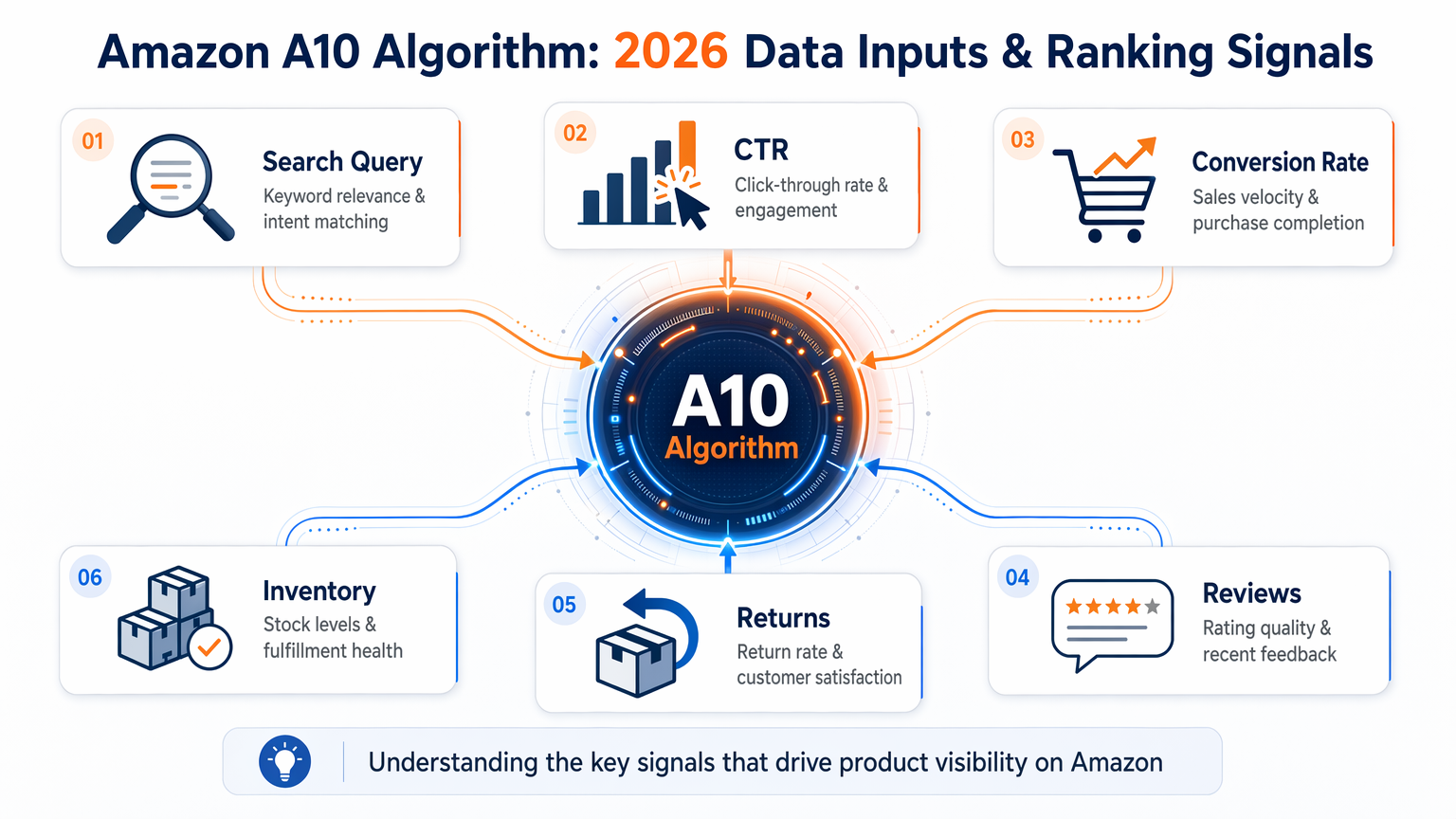
- Key ranking factors include conversion rate, click-through rate (CTR), relevance signals, customer reviews, return rates, and inventory availability.
- Optimization requires a holistic approach: high-converting listings, strategic keyword placement, enhanced content (A+ pages, videos), and proactive reputation management.
- Sellers must shift from keyword stuffing to creating compelling, trustworthy, and frictionless shopping experiences that align with Amazon’s goal of maximizing customer satisfaction.
- Tools like SellerSprite provide data-driven insights into keyword performance, competitor analysis, and listing optimization to stay ahead under A10.
Table of Contents
- Introduction: The Evolution of Amazon’s Search Algorithms
- What Is the Amazon A10 Algorithm? A Foundational Overview
- A10 vs. A9: Key Differences and Why They Matter in 2026
- Amazon A10 Ranking Factors in 2026: What Really Drives Visibility?
- A10 Algorithm Optimization: 7 Proven Strategies for 2026
- Common A10 Optimization Mistakes and How to Avoid Them
- The Future of Amazon SEO: A10, Cosmo, and Beyond
- FAQ
- References
Note on marketplaces: This guide is specifically optimized for the US market.
Introduction: The Evolution of Amazon’s Search Algorithms
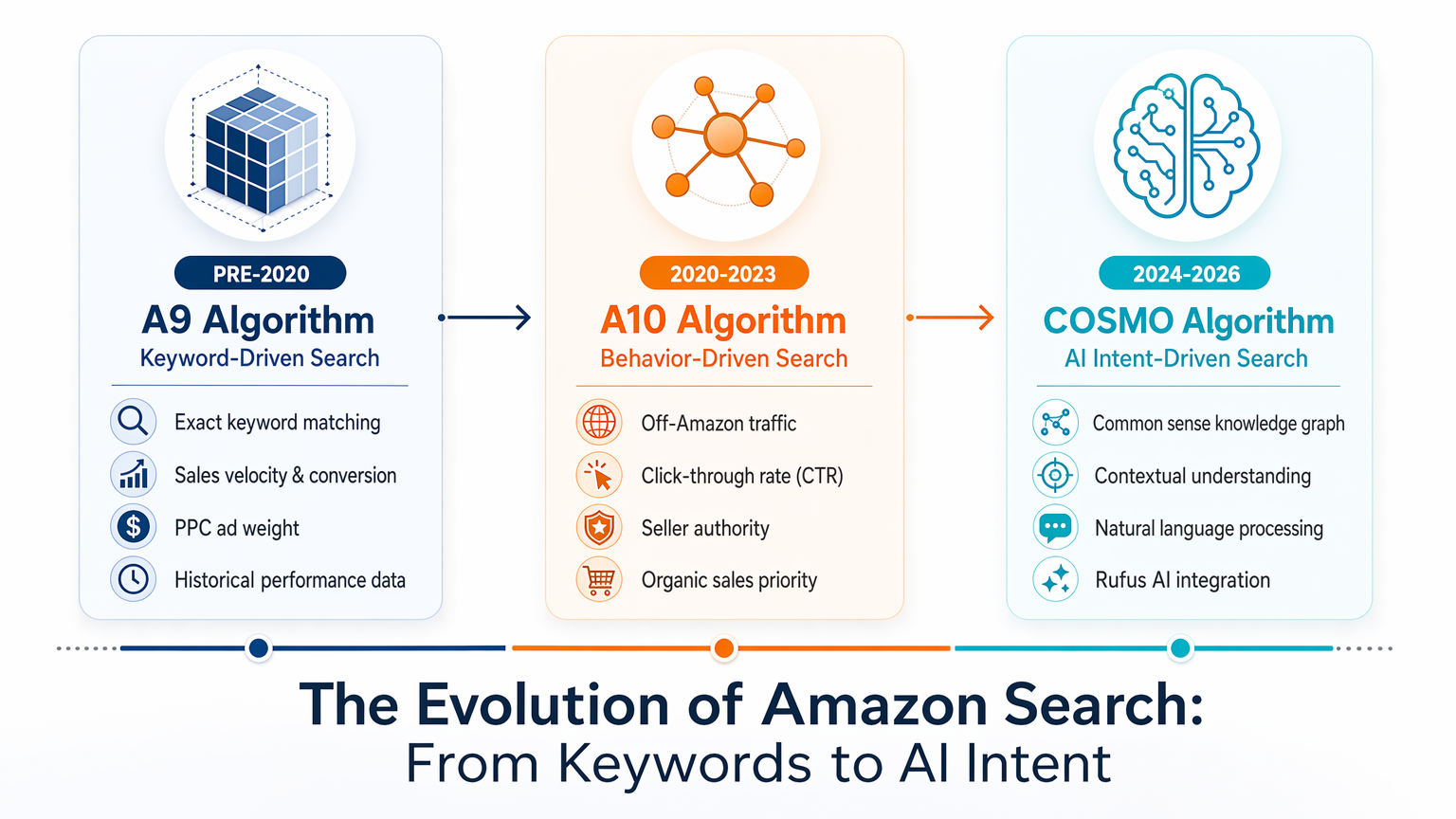
Amazon’s search engine has undergone a dramatic transformation over the past decade. From the early days of the A9 algorithm, which focused heavily on keyword matching and basic sales velocity, we’ve now entered the era of A10—a smarter, more customer-obsessed system designed to deliver the most relevant and satisfying shopping experience possible.
Launched in late 2025 and fully operational across the Amazon US marketplace by 2026, the A10 algorithm represents a quantum leap in how products are ranked and surfaced in search results. Unlike its predecessors, A10 doesn’t just ask, “Does this product match the search query?” Instead, it asks, “Will this product satisfy the customer’s intent and lead to a successful purchase?”
This shift reflects Amazon’s broader strategic pivot toward long-term customer loyalty and lifetime value. With increasing competition from Walmart, Shopify, and AI-powered marketplaces, Amazon can no longer rely solely on volume. It must ensure that every click leads to a high probability of conversion, low return rates, and positive post-purchase behavior.
For sellers, this means the old tricks—keyword stuffing, fake reviews, or gaming the system with rapid discount cycles—are no longer effective. The A10 algorithm sees through these tactics and penalizes listings that prioritize short-term gains over customer satisfaction. Instead, success under A10 requires a deep understanding of how the algorithm interprets user behavior, ranks products in real time, and rewards listings that deliver genuine value.
In this comprehensive guide, we’ll break down how the Amazon A10 algorithm works in 2026, explore the key ranking factors that drive visibility, and provide actionable optimization strategies to help you thrive in this new era of Amazon SEO. Whether you’re a seasoned seller or just getting started, this guide will equip you with the knowledge and tools to stay ahead of the curve.
What Is the Amazon A10 Algorithm? A Foundational Overview
The Amazon A10 algorithm is the latest iteration of Amazon’s core search and ranking engine, succeeding the long-standing A9 algorithm. Officially rolled out in Q4 2025 and refined throughout 2026, A10 is designed to be more adaptive, predictive, and customer-centric than any previous version.
At its core, A10 uses a combination of machine learning, real-time behavioral data, and predictive analytics to determine which products appear in search results and in what order. Unlike A9, which primarily relied on historical sales data and keyword relevance, A10 places greater emphasis on immediate user interactions and post-purchase outcomes.
One of the defining features of A10 is its ability to process and react to user behavior in near real time. When a customer searches for “wireless earbuds,” A10 doesn’t just look at which products have historically sold well for that term. Instead, it analyzes how users are currently interacting with those listings—how many are clicking, how long they’re staying on the page, whether they’re adding to cart, and ultimately, whether they complete the purchase.
This real-time feedback loop allows A10 to dynamically adjust rankings within hours, not days. A product that suddenly sees a spike in conversion rate due to a well-timed promotion or improved listing content can climb the rankings rapidly. Conversely, a product with declining CTR or rising return rates may be demoted just as quickly.
Another key innovation in A10 is its integration with Amazon’s broader ecosystem of services, including Prime, Subscribe & Save, and Amazon Live. The algorithm now considers factors like subscription likelihood, video engagement, and customer service interactions when evaluating a product’s overall performance. This holistic view enables A10 to reward sellers who create not just good listings, but great customer experiences.
For sellers, understanding A10 means moving beyond traditional SEO tactics and embracing a more strategic, data-driven approach. It’s no longer enough to optimize for keywords alone. You must also optimize for conversion, trust, and long-term customer satisfaction—because those are the signals A10 values most.
A10 vs. A9: Key Differences and Why They Matter in 2026
To truly grasp the impact of A10, it’s essential to compare it with its predecessor, the A9 algorithm. While A9 laid the foundation for Amazon’s search capabilities, A10 represents a fundamental shift in philosophy and execution.
The biggest difference lies in the time horizon each algorithm uses. A9 was largely backward-looking, relying on historical sales data, keyword match rates, and long-term conversion trends. A10, by contrast, is forward-looking and adaptive, using real-time behavioral signals to predict future performance.
For example, under A9, a product might rank highly for “organic dog food” simply because it had strong sales over the past 30 days. But if users are now clicking less, spending less time on the listing, or returning the product at a higher rate, A9 would continue to rank it highly until the historical data caught up. A10, however, detects these negative trends immediately and adjusts rankings accordingly.
Another major distinction is the role of customer satisfaction. A9 treated reviews as a secondary signal—important, but not decisive. A10, on the other hand, integrates post-purchase metrics like return rates, customer service tickets, and even voice-of-customer feedback from Alexa interactions. A product with a 4.8-star rating but a 15% return rate may be penalized under A10, while a 4.3-star product with a 3% return rate could be rewarded.
A10 also places greater weight on engagement signals beyond the click. While A9 focused on whether a user clicked on a listing, A10 tracks what happens after the click: time on page, scroll depth, image zooms, video views, and add-to-cart rate. This allows A10 to distinguish between listings that attract clicks but fail to convert, and those that deliver a compelling, trustworthy experience.
Finally, A10 is more personalized than A9. It tailors search results based on individual user behavior, purchase history, and even device type. A Prime member searching from a mobile app may see different results than a non-Prime user on desktop, even for the same query. This personalization increases relevance but also makes it harder for sellers to predict rankings without deep analytics.
The bottom line? A9 rewarded consistency and keyword optimization. A10 rewards agility, customer focus, and data-driven decision-making. Sellers who fail to adapt will see their visibility erode, while those who embrace the new paradigm can gain a significant competitive advantage.
Amazon A10 Ranking Factors in 2026: What Really Drives Visibility?
Understanding the key ranking factors of the A10 algorithm is critical for any seller aiming to improve product visibility in 2026. Unlike older models that prioritized a few dominant signals, A10 uses a complex, weighted blend of over 200 factors—many of which are dynamic and context-dependent.
Below are the most influential ranking factors under A10, based on industry analysis, seller reports, and reverse-engineering of search behavior:
1. Conversion Rate (CVR)
The single most important factor in A10 is conversion rate—the percentage of users who click on your listing and go on to make a purchase. A10 interprets high CVR as a strong signal of relevance and customer satisfaction. Listings with CVRs above 15% consistently outperform those below 8%, even if the latter have more reviews or lower prices.
2. Click-Through Rate (CTR)
CTR measures how often users click on your listing when it appears in search results. A10 uses CTR to assess the appeal of your title, image, and price. A low CTR suggests your listing isn’t compelling enough, even if it’s relevant. Optimizing for CTR involves A/B testing thumbnails, using emotional triggers in titles, and ensuring price competitiveness.
3. Relevance Signals
While A10 has moved beyond simple keyword matching, relevance is still crucial. The algorithm evaluates how well your product matches the search intent, using natural language processing (NLP) to understand synonyms, context, and semantic meaning. For example, a search for “durable laptop backpack” may prioritize products with keywords like “water-resistant,” “padded,” and “commuter-friendly,” even if “durable” isn’t in the title.
4. Customer Reviews and Ratings
Reviews remain a powerful trust signal. A10 doesn’t just look at star ratings—it analyzes review sentiment, keyword frequency, and the rate of new reviews. Listings with a steady stream of positive, detailed reviews (especially those mentioning specific use cases) are favored. Conversely, a sudden spike in negative reviews can trigger an immediate ranking drop.
5. Return Rate and Customer Service Metrics
A10 now tracks return rates at the ASIN level. High return rates—especially for reasons like “not as described” or “poor quality”—are strong negative signals. The algorithm also considers customer service interactions, such as the number of messages sent to the seller via Amazon’s messaging system. Frequent buyer inquiries may indicate listing inaccuracies or poor product clarity.
6. Inventory Availability and Fulfillment Method
Products that are consistently in stock and fulfilled by Amazon (FBA) receive a ranking boost. A10 penalizes listings with frequent stockouts or long shipping times. Prime eligibility is also a subtle but important factor, as A10 prioritizes fast, reliable delivery options for Prime members.
7. Engagement and Dwell Time
A10 tracks how users interact with your listing after clicking. Metrics like time on page, scroll depth, image zooms, and video views indicate engagement. Listings with rich media (A+ Content, comparison charts, demo videos) tend to have higher dwell times and better rankings. This is especially true for complex or high-consideration products.
These factors are not static weights. A10 dynamically adjusts its importance based on category, price point, and user intent. For example, in competitive categories like electronics, CVR and CTR dominate. In niche categories like organic skincare, review sentiment and ingredient transparency may carry more weight.
A10 Algorithm Optimization: 7 Proven Strategies for 2026
Optimizing for the A10 algorithm requires a strategic, multi-layered approach. Here are seven proven strategies to improve your product visibility and ranking in 2026:
1. Optimize for Conversion, Not Just Keywords
Shift your focus from keyword density to conversion optimization. Use high-quality images, compelling bullet points, and clear value propositions. Highlight unique selling points (USPs) like eco-friendly materials, lifetime warranties, or bundle deals. Test different pricing strategies and monitor how they impact CVR.
2. Leverage A+ Content and Enhanced Brand Content
A+ Content is no longer optional—it’s a ranking signal. Use comparison charts, lifestyle images, and video embeds to increase dwell time and reduce buyer hesitation. Brands with A+ Content see up to 10% higher conversion rates on average. In 2026, A10 rewards rich, informative content that educates the buyer.
3. Monitor and Improve Customer Feedback
Proactively manage your reviews. Use Amazon’s Request a Review button, follow up with buyers via non-spammy messaging, and address negative feedback promptly. Consider including a product insert that guides customers on how to use the product correctly—this can reduce returns and improve satisfaction.
4. Use Real-Time Analytics to Track Performance
Tools like SellerSprite provide real-time insights into CTR, CVR, and keyword performance. Use this data to identify underperforming listings and make data-driven optimizations. For example, if your CTR is low but your CVR is high, your title or image may need improvement.
5. Optimize for Mobile and Voice Search
Over 60% of Amazon searches now occur on mobile devices. Ensure your listings are mobile-friendly with concise titles, scannable bullet points, and fast-loading images. Also, optimize for voice search by using natural language phrases like “best wireless earbuds for running” in your backend keywords.
6. Maintain Inventory and Fulfillment Excellence
Nothing kills momentum like a stockout. Use inventory forecasting tools to maintain optimal stock levels. Prioritize FBA to ensure Prime eligibility and fast shipping. A10 rewards sellers who deliver a seamless, reliable experience.
7. Conduct Regular Competitor Analysis
Stay ahead by analyzing top-ranking competitors. What keywords are they targeting? How are they structuring their A+ Content? What pricing and promotions are they running? Tools like SellerSprite’s competitor analysis can reveal hidden opportunities and gaps in your own strategy.
Common A10 Optimization Mistakes and How to Avoid Them
Even experienced sellers make mistakes when adapting to A10. Here are the most common pitfalls and how to avoid them:
Mistake 1: Over-Optimizing for Keywords
Stuffing your title or bullet points with keywords may have worked in the A9 era, but it hurts readability and trust under A10. Instead, use keywords naturally and focus on clarity and persuasion.
Mistake 2: Ignoring Post-Purchase Metrics
Focusing only on sales and ignoring returns or customer service tickets is a recipe for ranking decline. Monitor your Order Defect Rate (ODR) and take action to improve product quality or listing accuracy.
Mistake 3: Neglecting Mobile Optimization
Long, cluttered titles and dense bullet points don’t translate well on mobile. Keep your content concise and scannable. Test your listings on a mobile device regularly.
Mistake 4: Failing to Update Listings
A10 rewards freshness. If your listing hasn’t been updated in months, the algorithm may assume it’s stale. Regularly refresh images, update bullet points, and add new keywords based on performance data.
Mistake 5: Not Using Analytics Tools
Relying on gut instinct or Amazon’s basic reports is no longer enough. Invest in tools like SellerSprite to gain deeper insights into customer behavior and algorithmic performance.
The Future of Amazon SEO: A10, Cosmo, and Beyond
While A10 dominates Amazon SEO in 2026, it’s not the final evolution. Amazon is already testing its next-generation AI system, Amazon Cosmo, a large language model-powered assistant that could eventually replace traditional search altogether.
Cosmo is designed to understand natural language queries in context, much like a human shopping assistant. Instead of typing “best coffee maker under $100,” a user might ask, “I need a coffee maker that’s easy to clean and makes strong coffee for my office.” Cosmo would interpret the intent and recommend products based on detailed attributes, usage scenarios, and even brand reputation.
For sellers, this means the future of SEO will shift from keyword targeting to intent mapping. You’ll need to optimize your content to answer specific customer questions, highlight use cases, and demonstrate expertise. Structured data, rich snippets, and FAQ sections will become even more important.
In the meantime, mastering A10 is your best preparation for what’s coming. The skills you develop—creating high-converting, customer-centric listings, leveraging data analytics, and building trust through transparency—are exactly what will be needed in the Cosmo era.
The bottom line? Amazon SEO is no longer just about getting found. It’s about earning the customer’s trust, delivering value, and creating a seamless journey from search to satisfaction. Those who embrace this philosophy will thrive under A10 and beyond.
FAQ
How does the Amazon A10 algorithm determine product ranking in 2026?
The Amazon A10 algorithm determines product ranking by analyzing real-time customer behavior, including click-through rate (CTR), conversion rate (CVR), dwell time, and post-purchase metrics like return rates and reviews. It uses machine learning to predict which products are most likely to satisfy a customer’s search intent and deliver a positive shopping experience. Unlike previous algorithms, A10 updates rankings dynamically based on immediate performance signals, making agility and customer focus critical for visibility.
What are the key changes in Amazon SEO for the A10 algorithm in 2026?
The key changes in Amazon SEO under A10 include a shift from keyword-centric optimization to customer-centric performance. A10 prioritizes conversion rate, real-time engagement, and post-purchase satisfaction over static keyword matching. It also personalizes search results based on user history and device, integrates with Amazon’s ecosystem (Prime, Subscribe & Save), and penalizes high return rates and poor customer service. Sellers must now focus on holistic listing quality, not just keyword placement.
How can Amazon sellers improve visibility under the A10 algorithm in 2026?
Sellers can improve visibility under A10 by optimizing for conversion rate, click-through rate, and customer satisfaction. Key strategies include creating high-quality listings with compelling images and A+ Content, monitoring and improving reviews, maintaining inventory accuracy, using real-time analytics tools like SellerSprite, and conducting regular competitor analysis. Avoiding common mistakes like keyword stuffing and neglecting mobile optimization is also essential for long-term success.
Next Steps
- Review your current listings and identify areas for improvement in CTR, CVR, and engagement using SellerSprite’s analytics tools.
- Study top-ranking competitors in your niche and apply the A10 optimization strategies outlined in this guide.
- Explore our 2026 Ultimate Guide to Amazon SEO for a comprehensive overview of best practices.
References
- Amazon A9 Algorithm: The Foundation of Amazon Search View
- Amazon A10 Algorithm Keyword Strategy 2025 View
- What Is Amazon Cosmo? The Future of AI-Powered Shopping View
- Amazon SEO and Listing Optimization: The 2026 Ultimate Guide View
By SellerSprite Success Team
The SellerSprite Success Team is a group of Amazon SEO and e-commerce optimization experts with over 50 years of combined experience helping sellers grow on Amazon. We specialize in data-driven strategies, algorithmic insights, and real-world testing to deliver actionable, up-to-date guidance. Our content is rooted in E-E-A-T principles—Experience, Expertise, Authoritativeness, and Trustworthiness—ensuring you receive reliable, proven advice for dominating Amazon in 2026 and beyond.