TL;DR: Short-tail keywords drive traffic but cost more and convert poorly; long-tail keywords convert better with lower ACoS. Winning Amazon sellers balance both using a tiered keyword portfolio aligned to business goals and product lifecycle.
Key Takeaways
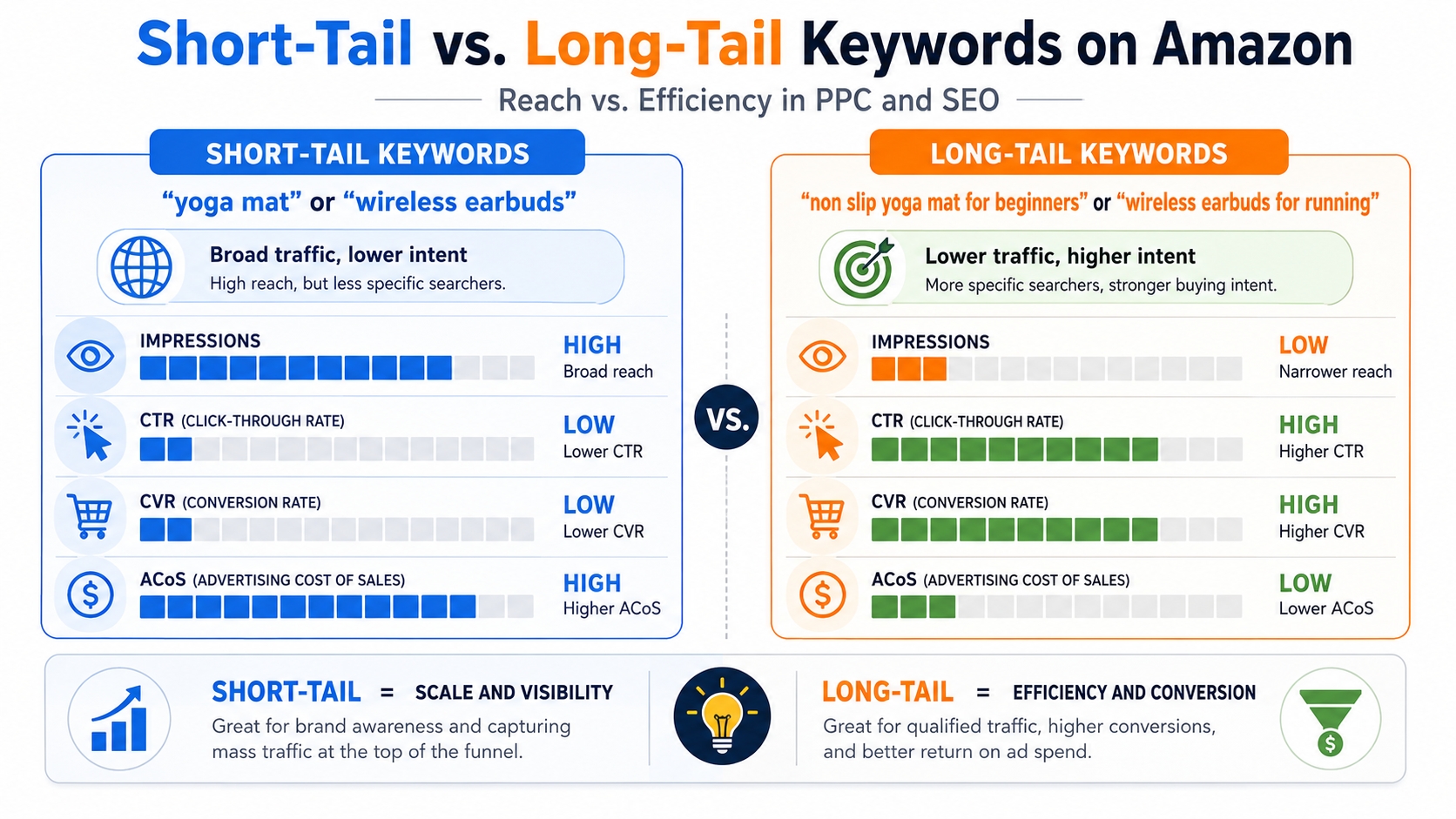
- Short-tail keywords (1-2 words) offer high traffic but face fierce competition and lower conversion due to broad intent.
- Long-tail keywords (3+ words) have lower search volume but higher buyer intent, leading to better CVR and lower ACoS.
- A balanced keyword portfolio, tiered by visibility, growth, and profit, maximizes both reach and ROI across SEO and PPC.
Table of Contents
- What Short-Tail and Long-Tail Keywords Mean on Amazon
- The Tradeoff: Traffic vs. Conversion (Why Sellers Must Balance Both)
- The Amazon Keyword Funnel: Where Each Keyword Type Wins
- Choose Your Objective Before Selecting Keywords
- How to Identify High-Intent Long-Tail Keywords (That Actually Convert)
- How to Use Short-Tail Keywords Without Burning Budget
- The Balanced Keyword Portfolio Strategy (SEO + PPC Together)
- Apply the Strategy to Amazon SEO (Keyword Prioritization & Placement)
- Apply the Strategy to Amazon PPC (Match Types + Scaling)
- Mini Case Framework (Template You Can Reuse)
- Common Mistakes When Balancing Short-Tail and Long-Tail Keywords
- FAQ
- References
Note on marketplaces: This guide is specifically optimized for the US market.
What Short-Tail and Long-Tail Keywords Mean on Amazon
Understanding the difference between short-tail and long-tail keywords is foundational to any Amazon keyword strategy. These terms describe how specific or broad a search query is, and directly impact your product's visibility, competition, and conversion potential.
Definition: Short-tail keywords are 1-2 word phrases (e.g., "yoga mat") with high search volume and broad intent. Long-tail keywords are 3+ word phrases (e.g., "non-slip thick yoga mat for women") with lower volume but higher purchase intent and specificity.
Short-tail = traffic potential, broad intent, higher competition
Short-tail keywords like "coffee maker" or "blender" attract massive traffic on Amazon. However, this traffic is often early in the buyer journey: users may be browsing, comparing, or just researching. Because of their popularity, these terms are highly competitive, with top spots dominated by established brands and heavy PPC spenders. In some categories, the top 3 results for high-volume keywords may capture over 60% of all clicks, making ranking difficult without strong conversion metrics.
Long-tail = clearer intent, higher conversion, lower CPC (often)
Long-tail keywords reflect users who know exactly what they want. For example, a search for "cordless vacuum for pet hair on hardwood floors" signals strong purchase intent. These queries have lower search volume individually, but collectively they can make up over 70% of all Amazon searches. Because fewer sellers target them, CPCs are often lower, and conversion rates are typically 2-3x higher staffing a better ACoS.
Myth vs. Fact: "High volume = best keyword" (not always)
Many new sellers assume high-volume keywords are automatically the best targets. This is a myth. High volume often means high competition and low conversion. For example, "protein powder" gets 200,000 monthly searches, but conversion rates hover around 5%. In contrast, "vegan protein powder for women with iron" may get only 5,000 searches, but converts at 18%. The long-tail version delivers more sales per impression and protects profitability.
The Tradeoff: Traffic vs. Conversion (Why Sellers Must Balance Both)
Amazon success isn't about choosing between traffic and conversion; it's about balancing both. Relying solely on short-tail keywords risks high ad spend and low ROI. Over-indexing on long-tail limits scalability. The key is understanding the KPI triangle and building a diversified keyword portfolio.
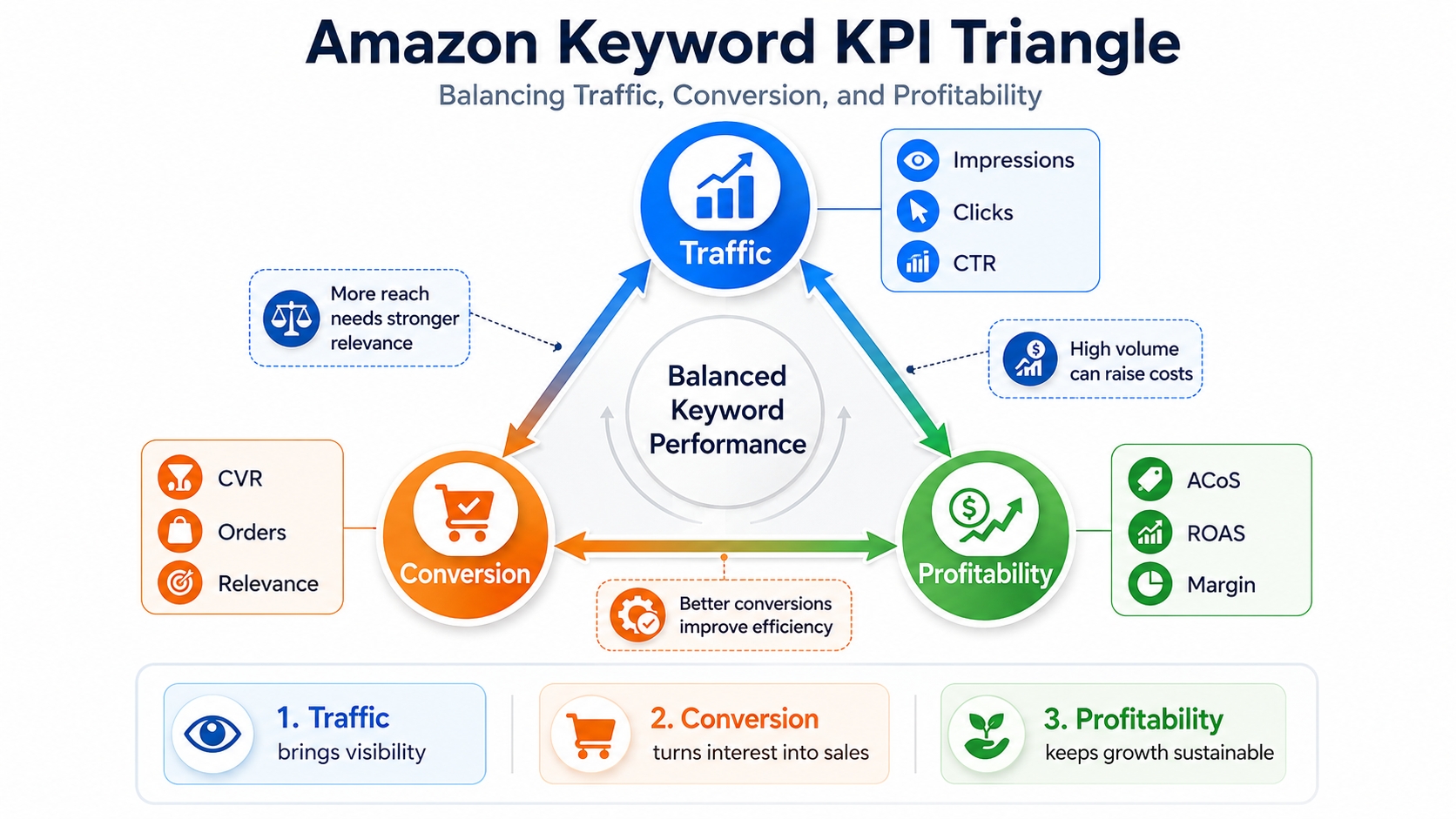
The KPI triangle: sessions, CVR, and profitability
Every keyword decision impacts three core metrics: traffic (sessions), conversion rate (CVR), and profitability (ACoS or margin). Short-tail keywords boost sessions but often drag down CVR and increase ACoS. Long-tail keywords improve CVR and protect margins but limit top-of-funnel reach. The goal is equilibrium, driving enough traffic while maintaining healthy conversion and profit.
Why short-tail keywords can tank ACoS (broad intent + expensive auctions)
Short-tail keywords often lead to poor ACoS because they attract window shoppers. For example, bidding on "headphones" may generate clicks, but many users are comparing brands or price-checking. Without strong differentiators (e.g., noise cancellation, battery life), your listing won't convert. Meanwhile, CPCs can exceed $1.50 due to auction competition. This combination with high cost and low conversion destroys profitability.
Why long-tail keywords can cap growth (limited demand ceiling)
While long-tail keywords convert well, each has limited monthly search volume. Relying only on them means hitting a growth ceiling. For example, "organic baby shampoo for sensitive skin" might convert at 20%, but only gets 1,200 searches/month. To scale, you need broader terms, but only after proving conversion efficiency.
The right goal: build a keyword portfolio, not a single "winner"
Amazon keyword strategy should mirror investment portfolio theory: diversify to manage risk and return. A balanced mix of short, mid, and long-tail keywords ensures visibility, growth, and profitability. A marketplace report shows top-performing brands use 60% long-tail, 30% mid-tail, and 10% short-tail in early stages and shift as they gain traction.
The Amazon Keyword Funnel: Where Each Keyword Type Wins
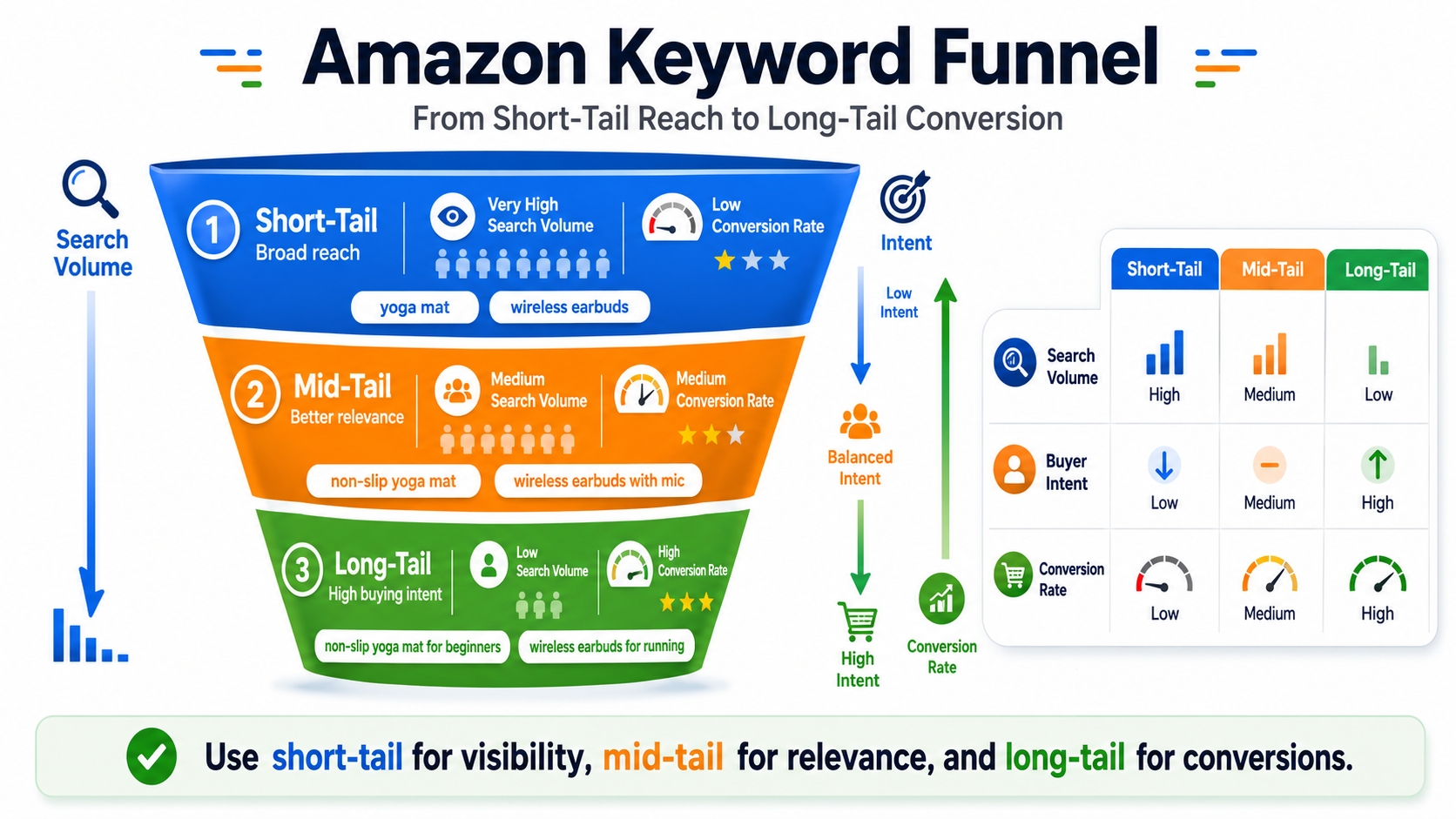
Think of Amazon search as a funnel. Different keyword types perform best at different stages. Mapping your keywords to this funnel ensures you capture users at every point in their journey from discovery to purchase.
Top of funnel: discovery queries (short-tail heavy)
At the top, shoppers are exploring. They use broad terms like "desk lamp" or "coffee mug." These keywords are ideal for building brand awareness and earning impressions. However, expect low conversion. Use them strategically in Sponsored Brands or awareness-focused campaigns.
Mid funnel: refined category queries (mid-tail bridge terms)
Mid-funnel users are narrowing options. They search for "adjustable desk lamp with USB port" or "insulated coffee mug 20 oz." These mid-tail keywords (2-4 words) balance volume and intent. They're the sweet spot for growth, so target them aggressively in Sponsored Products with phrase match.
Bottom of funnel: high-intent long-tails (best conversion)
Bottom-funnel shoppers are ready to buy. They use precise terms like "LED desk lamp for reading with timer and dimmer." These long-tail keywords convert at the highest rates. Prioritize them in exact match campaigns and optimize your listing to answer their specific needs.
A simple model: Launch on long-tail → expand to mid-tail → earn short-tail
New products should start with long-tail keywords to build early sales and reviews. As conversion rates stabilize, expand into mid-tail terms. Only after achieving strong organic rank and positive reviews should you test short-tail keywords. This model reduces risk and builds sustainable momentum.
If your goal is: Launch momentum → Prioritize: Long-tail
If your goal is: Profitability → Prioritize: Long-tail + mid-tail
If your goal is: Scale → Prioritize: Mid-tail + selective short-tail
If your goal is: Brand dominance → Prioritize: All tiers with defense strategy
Choose Your Objective Before Selecting Keywords
Your keyword strategy must align with business objectives. A launch-phase brand needs different keywords than a mature brand aiming for category dominance. Define your goal first, and then select keywords accordingly.
Objective A: launch and ranking momentum
Focus on long-tail keywords with moderate volume and high intent. These help generate early sales, reviews, and organic rank. Use SellerSprite's Keyword Mining to discover niche opportunities with low competition.
Objective B: profitability and low ACoS
Double down on high-converting long-tail keywords. Use exact match campaigns, tight negatives, and strong listing optimization. Monitor ACoS weekly and pause underperformers. Refer to our guide on low-ACoS long-tail PPC for advanced tactics.
Objective C: category dominance and scale
Expand into mid-tail and selective short-tail keywords. Invest in Sponsored Brands and auto-campaigns to capture broad traffic. Use portfolio-level reporting to allocate budget efficiently across tiers.
Objective D: defense (protect your core terms)
Bid on your branded and top-performing generic terms to prevent competitors from stealing visibility. Use exact and phrase match to control placement. This is critical for maintaining market share.
How to Identify High-Intent Long-Tail Keywords (That Actually Convert)
Not all long-tail keywords are created equal. The best ones contain modifiers that signal purchase readiness. Use these six families to generate high-converting variants.
The 6 modifier families that create buyer intent
Attribute: size, material, pack, strength, feature
Examples: "large", "organic", "pack of 12", "extra strength", "with timer".
Use case: for travel, for kids, for hiking
Examples: "yoga mat for travel", "shampoo for toddlers".
Compatibility: fits, works with, replacement for
Examples: "replacement filter for Dyson V11", "case for iPhone 17 Pro Max".
Problem/solution: for back pain, for acne, for dry skin
Examples: "pillow for neck pain", "moisturizer for eczema".
Quality/spec: heavy duty, waterproof, rechargeable
Examples: "waterproof hiking boots", "rechargeable LED lantern".
Comparison: vs, alternative (use carefully)
Examples: "Nespresso Vertuo vs. Original", "eco-friendly alternative to plastic wrap". Caution: avoid trademarked terms.
Long-tail quality checklist (relevance + specificity + purchase readiness)
Before targeting a long-tail keyword, ask:
- Does it match my product's core features?
- Is it specific enough to filter out irrelevant traffic?
- Does it include a purchase-triggering modifier?
Common long-tail traps (ultra-specific but wrong intent)
Avoid keywords like "blue yoga mat 6mm thick for cat yoga", which is too niche, possibly fictional demand. Validate with tools like SellerSprite Keyword Mining to ensure real search volume and buyer intent.
How to Use Short-Tail Keywords Without Burning Budget
Short-tail keywords aren't off-limits; they're just high-risk. Only pursue them when your listing is optimized for conversion and you can compete on key metrics.
Short-tail prerequisites: offer strength (images, price, reviews, Prime, CVR)
Amazon's algorithm favors listings that convert. Before bidding on "coffee maker", ensure:
Competitive price band
Price within 10-15% of top sellers.
Review and rating threshold (category-dependent)
Aim for 4.3+ stars and 50+ reviews in competitive categories.
Strong main image + clear differentiation
High-res, lifestyle image with unique selling proposition (USP) visible.
Inventory depth (don't rank then stock out)
Maintain at least 60 days of stock to sustain momentum.
Short-tail execution rules: controlled testing, tight targeting, defend profit
Start with small daily budgets ($5-$10), use phrase and exact match, and add strict negatives. Monitor ACoS daily. If it exceeds 35% after 50 clicks, pause and optimize.
When to pause short-tail (signals you're not ready)
Pause if: CVR is below category average, ACoS is rising, or impressions are high but clicks low (poor CTR). Revisit once listing improvements are made.
The Balanced Keyword Portfolio Strategy (SEO + PPC Together)
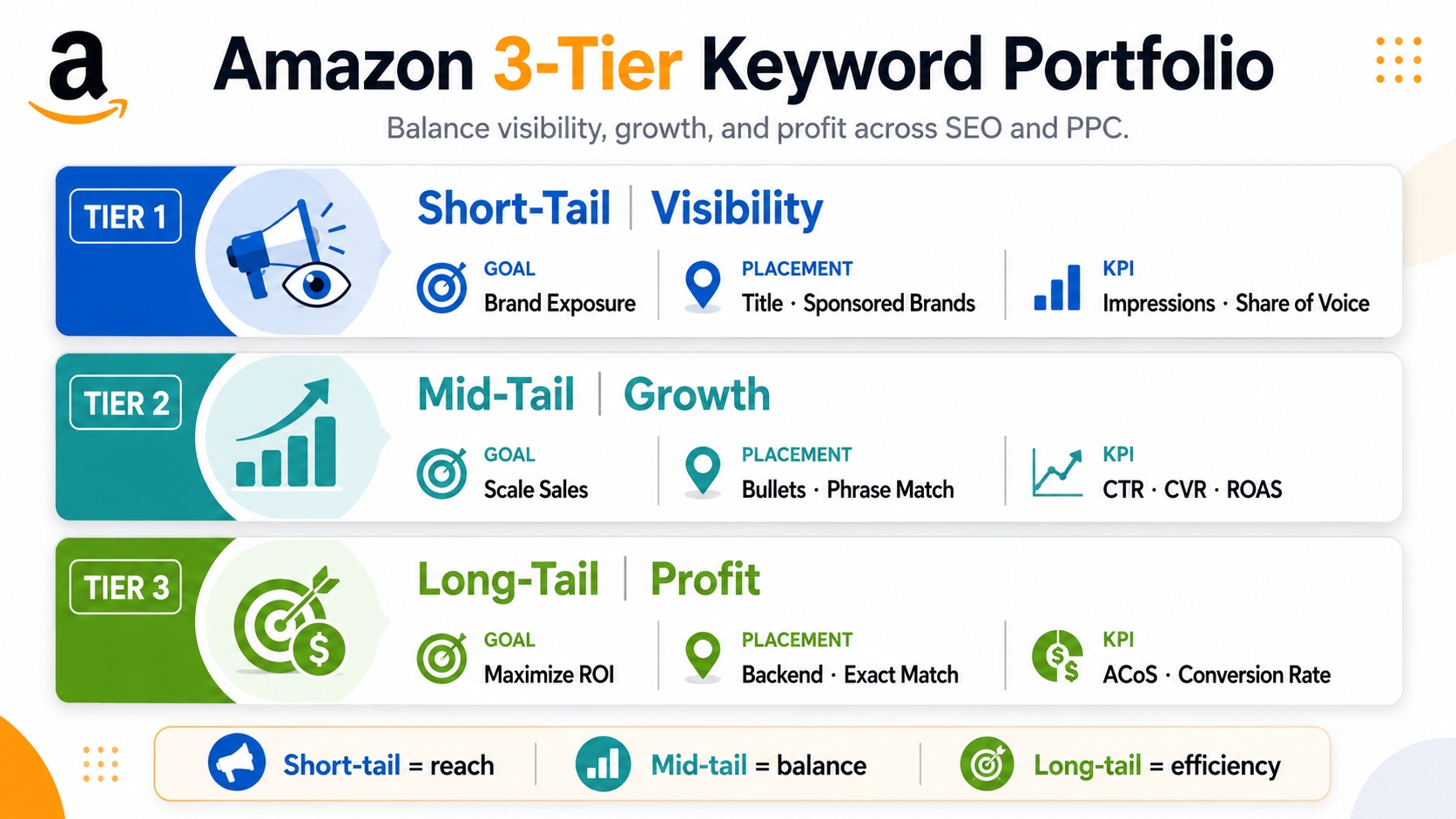
Winning on Amazon requires aligning SEO and PPC under a unified keyword strategy. Use a three-tier portfolio to organize and prioritize.
The 3-tier portfolio
Tier 1: short-tail "visibility" terms (limited, high scrutiny)
Goal: Brand exposure. Placement: Title, Sponsored Brands. KPI: Impressions, share of voice.
Tier 2: mid-tail "growth" terms (best balance)
Goal: Scale sales. Placement: Bullets, phrase match campaigns. KPI: CTR, CVR, ROAS.
Tier 3: long-tail "profit" terms (high intent, low waste)
Goal: Maximize ROI. Placement: Backend, exact match. KPI: ACoS, conversion rate.
Allocation by lifecycle (launch vs. mature)
Launch: 70% long-tail, 25% mid-tail, 5% short-tail.
Mature: 40% long-tail, 40% mid-tail, 20% short-tail.
Portfolio rules to prevent cannibalization (one cluster, one owner)
Avoid running the same keyword in multiple campaigns. Assign each keyword cluster to one campaign type (e.g., exact match only) to prevent self-competition and skewed data.
Apply the Strategy to Amazon SEO (Keyword Prioritization & Placement)
On-Amazon SEO determines organic visibility. Strategic keyword placement boosts indexing and ranking.
Title: the best primary term (usually short/mid-tail) + differentiator
Example: "Organic Shampoo for Dry Scalp – Sulfate Free, 16 oz". Includes primary keyword and key differentiators.
Bullets: map long-tail clusters by intent (one theme per bullet)
Each bullet should address a specific customer need tied to a long-tail cluster (e.g., "Perfect for color-treated hair").
Backend search terms: leftover variants and long-tails (no repetition)
Use backend fields for synonyms, misspellings, and ultra-specific long-tails not used in visible content.
Indexing sanity checks: confirm coverage before expecting rank lifts
Use tools like SellerSprite to verify Amazon has indexed your keywords. No index = no rank.
Apply the Strategy to Amazon PPC (Match Types + Scaling)
PPC amplifies visibility. Match types determine how broadly your ads trigger.
Long-tail PPC: Exact/Phrase to protect low ACoS
Use exact match for high-intent long-tails to minimize wasted spend.
Short-tail PPC: controlled tests with strict negatives
Use phrase match with negative keywords to filter irrelevant traffic.
Promotion workflow: discover → prove → scale
Broad/Phrase discovery for mid/long-tail expansion
Run auto or broad campaigns to find converting search terms.
Promote winners to Exact
Move high-CVR terms to exact match for efficiency.
Add negatives to stop waste
Block non-converting queries at campaign and account level.
Budget split example (portfolio-based, not one-campaign chaos)
Tier 1 (short-tail): 20% of budget
Tier 2 (mid-tail): 50%
Tier 3 (long-tail): 30%
Mini Case Framework (Template You Can Reuse)
Apply this repeatable framework to any product:
Start with 1 short-tail term → generate 20 long-tail variants
Example: "yoga mat" → "non-slip thick yoga mat for women", "eco-friendly yoga mat for travel", etc.
Cluster by intent → map to listing and PPC
Group keywords by attribute, use case, or problem/solution. Assign each cluster to a bullet point and campaign.
Track outcomes by tier (CTR, CVR, ACoS, rank trend)
Keep monitoring the performance by tier.
Decision rules: double down, refine, or drop
If ACoS < 25%: scale. If 25-35%: optimize. If >35%: pause and refine.
Common Mistakes When Balancing Short-Tail and Long-Tail Keywords
Chasing volume before conversion is ready
New listings lack social proof. Bidding on high-volume terms burns cash without converting.
Over-indexing on long-tail and never expanding (growth ceiling)
Staying in the long-tail comfort zone limits scalability.
Stuffing the title with long-tails (hurts CTR/CVR)
Titles should be readable. Avoid keyword stuffing like "yoga mat non-slip thick eco-friendly for women travel".
Ignoring intent clusters (random keyword salad)
Unorganized keywords lead to disjointed messaging and poor ad relevance.
Not measuring by tier (no learning loop)
Without tier-based reporting, you can't optimize effectively.
FAQ
Are short-tail keywords always better for ranking?
No. While short-tail keywords have higher search volume, they are extremely competitive. New or low-converting listings often fail to rank due to Amazon's algorithm prioritizing conversion performance. Long-tail keywords are easier to rank for and build momentum.
What are the benefits of using long-tail keywords on Amazon?
Long-tail keywords offer higher conversion rates, lower CPCs, and less competition. They attract buyers with specific needs, improving relevance and ACoS. They're ideal for launching products and building profitable PPC campaigns.
How do short-tail and long-tail keywords impact Amazon product visibility?
Short-tail keywords increase top-of-funnel visibility and impressions. Long-tail keywords improve bottom-funnel visibility and conversion-driven exposure. A balanced approach maximizes both reach and relevance.
What tools can help Amazon sellers find effective long-tail keywords?
Tools like SellerSprite Keyword Mining, Helium 10, and Jungle Scout provide search volume, competition, and intent data. Auto campaign search term reports are also valuable for discovering converting long-tails.
Next Steps
- Sign up for SellerSprite and use Keyword Mining tool to discover high-intent long-tail opportunities.
- Read our Amazon Keyword Research Guide for a full framework.
References
By SellerSprite Success Team
The SellerSprite Success Team combines 10+ years of Amazon marketplace expertise with data science to deliver actionable insights. We've helped thousands of sellers optimize keyword strategies, reduce ACoS, and scale profitably using AI-powered tools.