TL;DR: Analyzing Amazon reviews helps you uncover real customer pain points, identify gaps in competitors' offerings, and build a data-driven product differentiation strategy. Use a structured 6-step process to turn reviews into product upgrades and high-converting listings.
Key Takeaways
- Amazon reviews are a goldmine for identifying unmet customer needs and product differentiation opportunities.
- Use a tagging framework (quality, fit, performance, usability, shipping) to extract repeatable signals from thousands of reviews.
- Focus on high-frequency, high-severity pain points to prioritize product improvements with the highest ROI.
- Turn real customer language from reviews into compelling, keyword-rich listing content that converts.
- Validate your differentiation ideas with keyword research and small-scale PPC tests before investing in manufacturing.
Table of Contents
- Why Amazon Reviews Are the Best Differentiation Data (If You Read Them Correctly)
- Set Your Differentiation Goal (So You Don't Drown in Comments)
- Step 1: Build a "Competitor Review Set" (High-Quality Inputs)
- Step 2: Extract Differentiation Signals (A Repeatable Tagging Framework)
- Step 3: Turn Reviews Into Product Upgrades (Differentiation You Can Actually Build)
- Step 4: Use Review Language to Improve Your Listing (And Rank for Buyer Terms)
- Step 5: Competitor Comparison: Find the Gap You Can Own
- Step 6: Validate Differentiation Before You Manufacture (Cheap Tests First)
- Common Mistakes When Using Reviews for Product Differentiation
- Mini Walkthrough: Review Analysis in 30 Minutes (Template)
- FAQ
- References
Note on marketplaces: This guide is specifically optimized for the US market.
Why Amazon Reviews Are the Best Differentiation Data (If You Read Them Correctly)
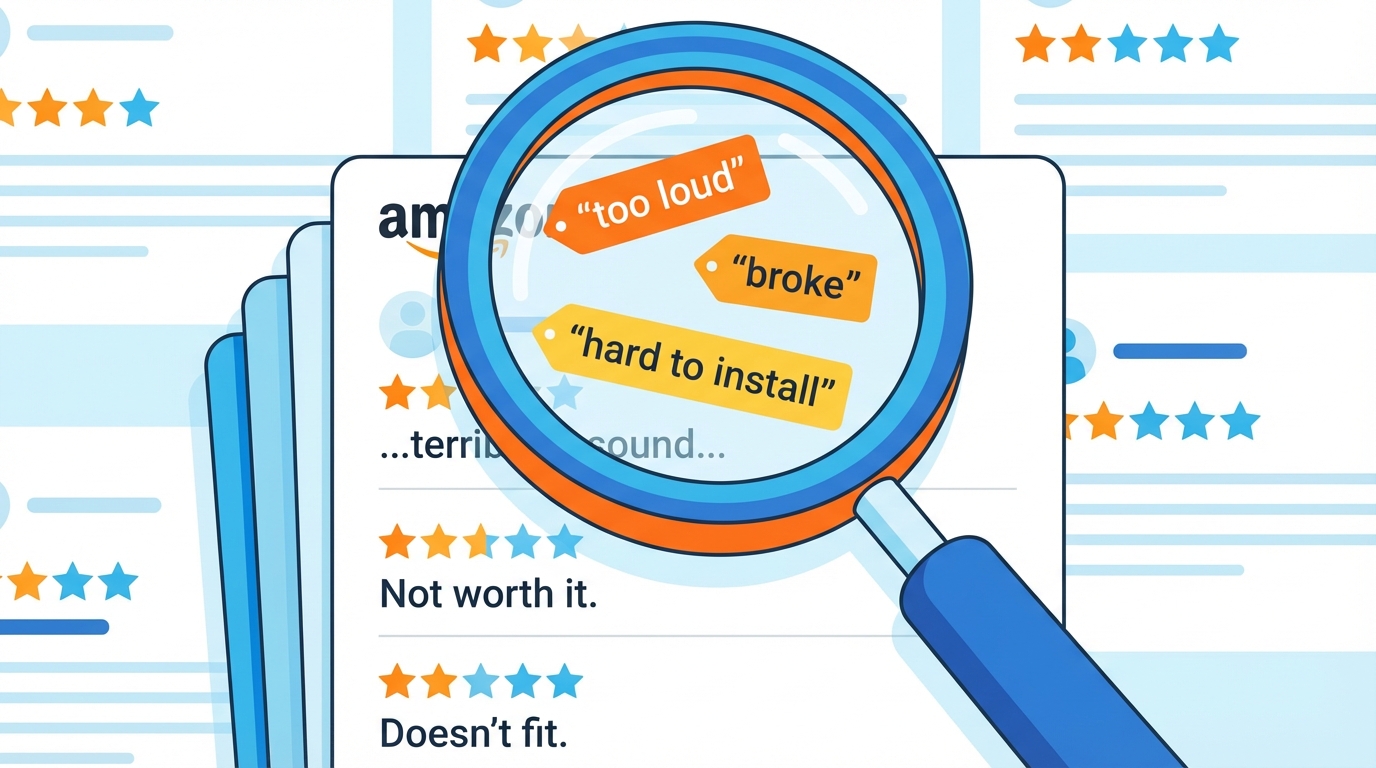
Amazon reviews aren't just ratings; they're raw, unfiltered customer feedback. When analyzed systematically, they reveal what buyers truly care about, what frustrates them, and what they wish existed. This makes them one of the most powerful tools for product differentiation on Amazon.
Definition: Review Analysis for Differentiation
Review analysis = extracting repeatable signals from customer feedback to identify unmet needs, prioritize product improvements, and craft compelling positioning that sets your brand apart.
Reviews reveal "jobs-to-be-done," not just features
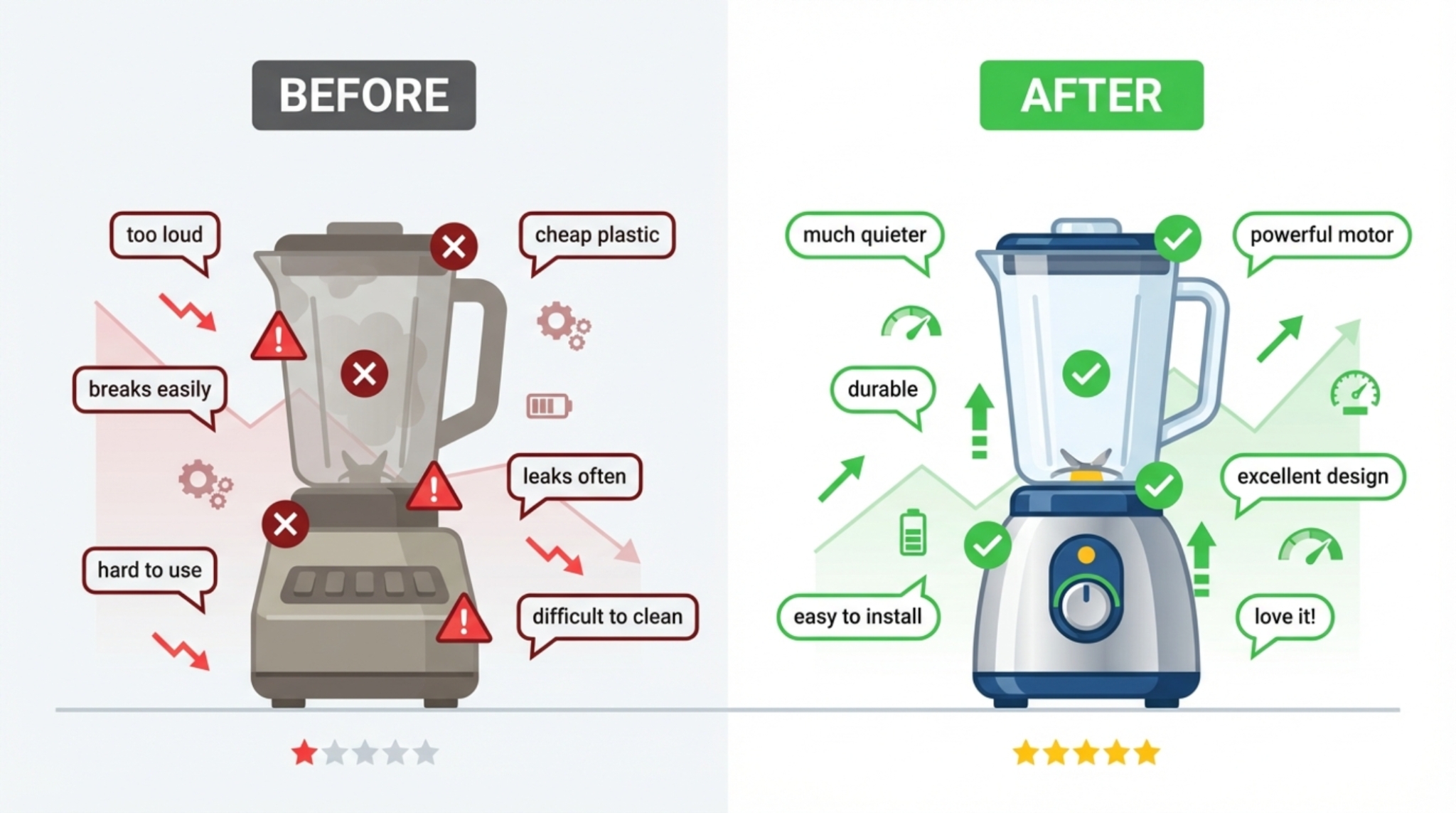
Customers don't buy products; they buy solutions. A review saying "This blender is too loud for my apartment" isn't just complaining about noise; it reveals a job-to-be-done: "I need a quiet blender for small living spaces." This insight opens the door to differentiation: design a quieter motor, highlight noise levels in your listing, and target "quiet blender for apartments" as a keyword.
What sellers miss: patterns beat anecdotes
Most sellers read reviews randomly and react to the loudest complaints. But real insights come from spotting patterns. If 15% of 1-star reviews mention "broke after 2 weeks," that's a signal. If one person says "I hate the color," that's an anecdote. Pattern recognition separates data-driven decisions from emotional reactions.
What reviews can (and can't) tell you about the market
Reviews tell you what's wrong with existing products and what customers value. But they won't tell you about unarticulated desires or future trends. For example, no one reviewed "I wish my phone had facial recognition" before it existed. Use reviews to fix and improve, but combine with trend data and innovation thinking to leapfrog competitors.
Set Your Differentiation Goal (So You Don't Drown in Comments)
Without a clear goal, Amazon review analysis becomes overwhelming. You'll collect hundreds of comments but won't know what to do with them. Start by defining your objective.
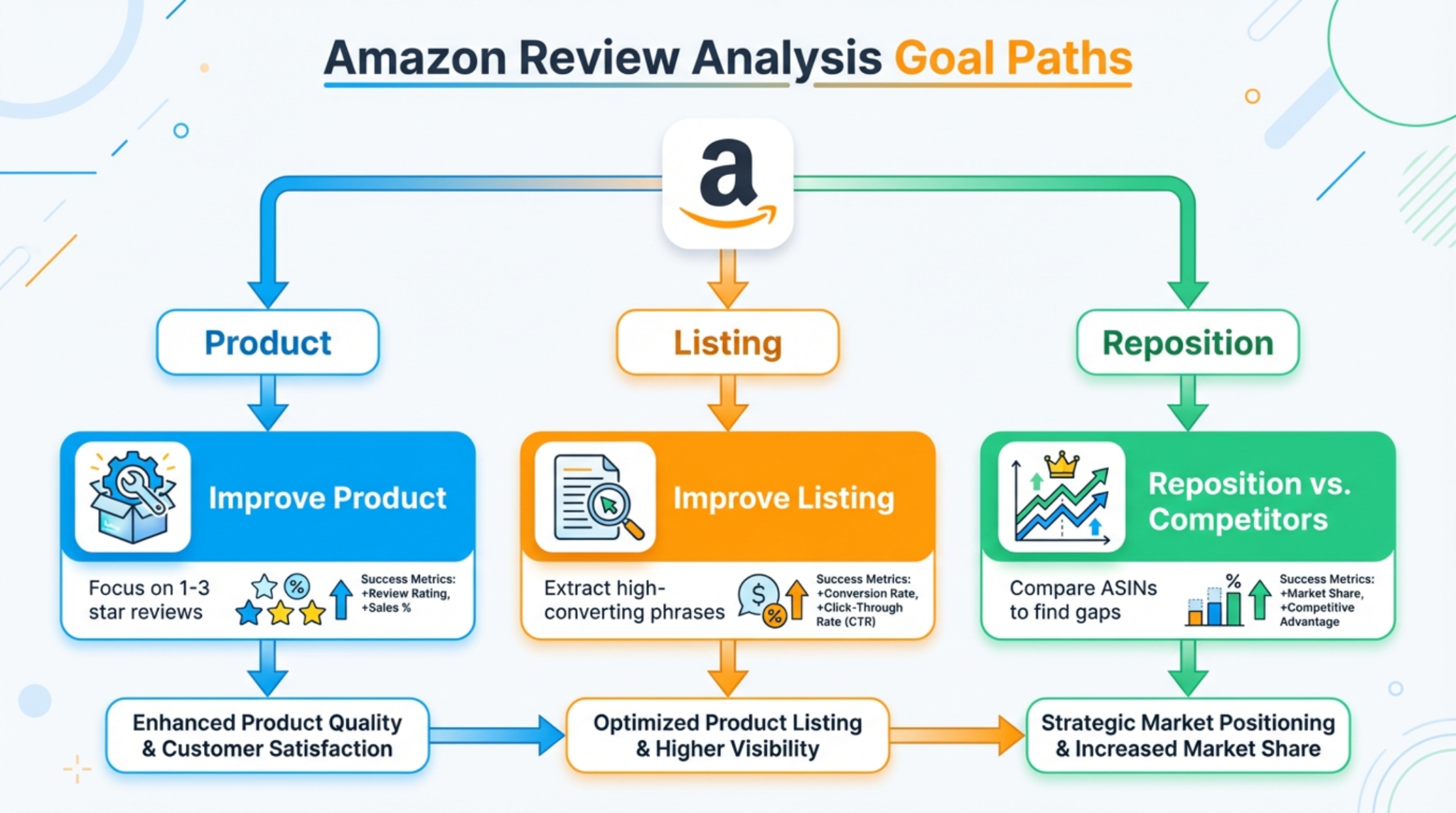
Choose one goal: improve product, improve listing, or reposition vs. competitors
Your goal shapes how you analyze reviews:
- Improve product: Focus on 1-3 star reviews to find defects and usability issues.
- Improve listing: Extract high-converting phrases and pain points to optimize copy.
- Reposition vs. competitors: Compare your ASIN to top sellers to find gaps you can own.
Define success metrics (CVR lift, return rate drop, fewer "1-star" themes)
Tie your goal to measurable outcomes:
- Product fix → 20% drop in return rate
- Listing update → 15% increase in conversion rate (CVR)
- Repositioning → 30% reduction in "not as described" 1-star themes
Pick your scope (your ASIN only vs. top 5 competitors vs. category leaders)
Start narrow. If you're improving your product, analyze your own ASIN and 2-3 direct competitors. If you're repositioning, expand to the top 5-10 in your category. Avoid analyzing irrelevant products (e.g., bundles vs. singles).
Step 1: Build a "Competitor Review Set" (High-Quality Inputs)
Your analysis is only as good as your data. Build a clean, relevant dataset of competitor reviews to ensure reliable insights.
How to pick competitors that match your buyer intent
Same use case + similar price band + similar format/specs
Choose competitors that serve the same customer need, price point, and product type. For example, if you sell a $35 ergonomic office chair, don't analyze $100 executive chairs or $20 folding chairs.
Avoid bundles vs. singles, off-position variants, and brand giants (unless intentional)
Bundles often get different feedback (e.g., "missing part" vs. "product broke"). Off-position variants (e.g., a "gaming" version of a general product) attract different buyers. Brand giants like Amazon Basics may have different return policies or customer expectations.
How many reviews to analyze (fast vs. deep modes)
Fast scan: 50-100 reviews per ASIN
Use this for quick insights or when launching a new product. Focus on recent 1- and 5-star reviews.
Deep scan: 200-500 reviews per ASIN
Use this for product redesign or entering a competitive category. Include 3-star reviews for "almost good" feedback.
Which review types matter most
1-2 star = pain points and failure modes
These reveal what's broken or missing. Look for recurring complaints.
3 star = "almost good" improvement list
Customers are satisfied but not delighted. These reviews suggest incremental improvements.
4-5 star = what to keep and amplify
Identify strengths to highlight in your own product and listing.
✅ Review Dataset Checklist
- ASINs: [List 3-5 competitor ASINs]
- Review count: [e.g., 200 per ASIN]
- Date range: [e.g., last 6 months]
- Review types: [1-2, 3, 4-5 stars]
- Tagging framework applied: [Yes/No]
Step 2: Extract Differentiation Signals (A Repeatable Tagging Framework)
Raw reviews are noise. Use a tagging framework to turn them into structured, actionable insights.
Tag every review into 5 buckets
| Bucket | What It Captures | Example |
|---|---|---|
| Product Quality | Breaks, defects, durability | "Stopped working after 3 weeks" |
| Fit/Compatibility | Size, match, "doesn't work with…" | "Too small for my XL dog" |
| Performance | "Works great for…", "doesn't solve…" | "Perfect for camping, but not for hiking" |
| Usability/UX | Instructions, setup, comfort, design | "Instructions were confusing" |
| Shipping/Packaging | Damage, missing parts, presentation | "Arrived with cracked lid" |
Separate "feature requests" vs. "failure complaints"
A failure complaint ("broke after one use") must be fixed. A feature request ("wish it had Bluetooth") is optional. Prioritize failures first because they damage trust and drive returns.
Identify the "frequency × severity" winners
Frequency = how often it appears
Severity = how much it drives 1-2 stars/returns
📊 Frequency × Severity Scoring Grid
| High Severity | Fix Immediately | Improve Soon |
| Low Severity | Nice-to-Have | Ignore |
| High Frequency | Low Frequency |
Step 3: Turn Reviews Into Product Upgrades (Differentiation You Can Actually Build)
Now convert insights into action. Build a roadmap that turns pain points into product advantages.
Make a "Fix / Improve / Add" roadmap
Fix: eliminates 1-star issues (highest ROI)
Example: Reinforce a weak hinge that breaks frequently.
Improve: increases satisfaction (raises rating)
Example: Add non-slip feet to reduce wobbling.
Add: creates a new angle (new keyword clusters)
Example: Include a travel case to target "portable" use cases.
Prioritize upgrades by impact and feasibility
Cost to implement vs. expected conversion lift
A $0.50 packaging upgrade that reduces damage claims by 30% is high ROI.
Risk: compliance, returns, manufacturing complexity
Avoid changes that increase liability or production delays.
Common high-ROI improvements across categories
- Packaging upgrades (reduce damage)
- Clearer instructions (reduce "hard to set up" complaints)
- Better sizing/compatibility clarity (reduce returns)
- Accessories or bundles (increase perceived value)
Step 4: Use Review Language to Improve Your Listing (And Rank for Buyer Terms)
Customers use specific language in reviews. Borrow it to make your listing more relatable and SEO-friendly.
Pull "buyer phrases" that repeat (natural language long-tails)
"for…" use cases
"for back pain", "for light sleepers", "for small kitchens"
"works with / compatible with…"
"works with iPhone 15", "fits under most desks"
pain-point phrases
"no more tangled cords", "finally a quiet fan"
Map review-derived keywords into your listing
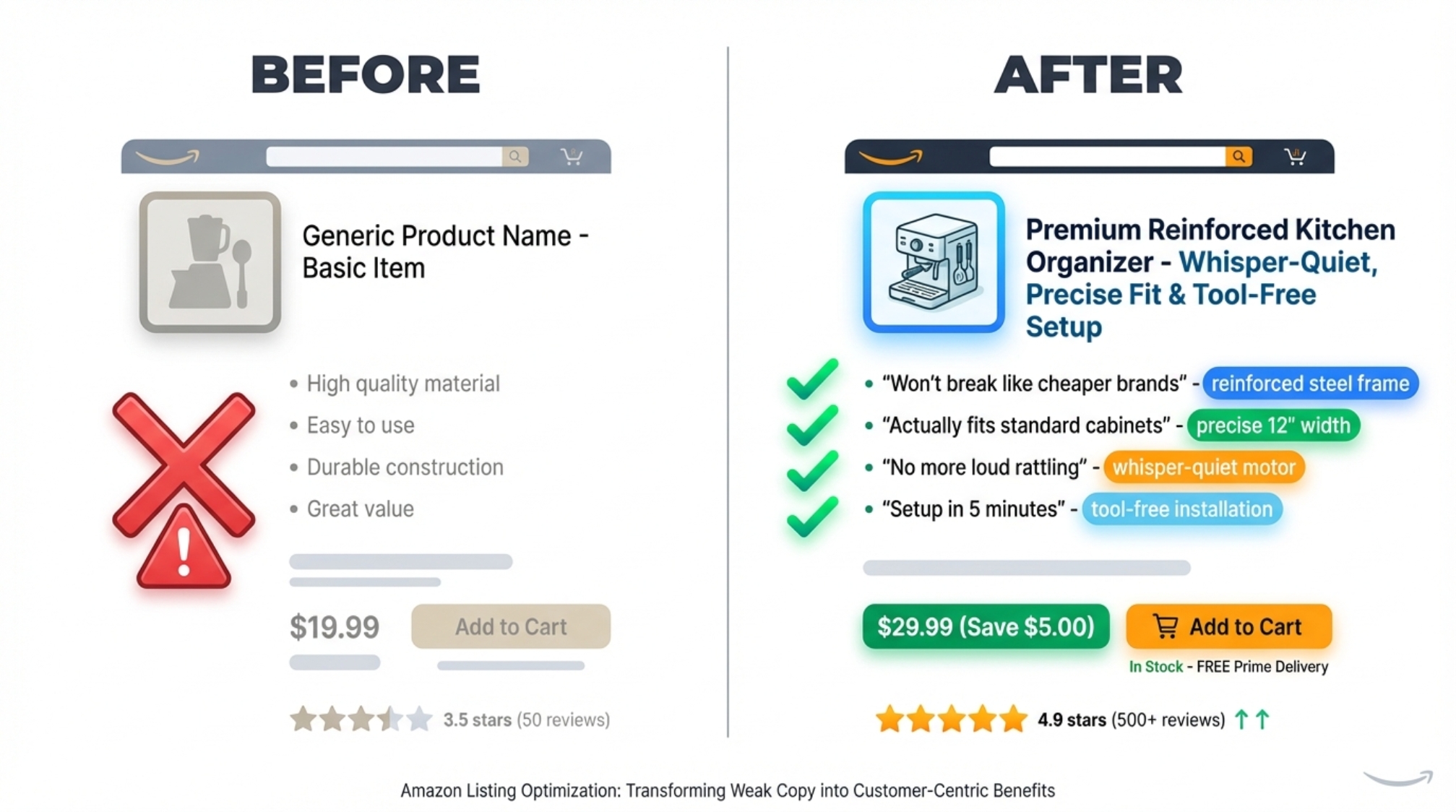
Title: core term + key differentiator (human first)
"Quiet Desk Fan for Light Sleepers, 3-Speed, USB-Powered"
Bullets: one intent theme per bullet + proof
"Whisper-Quiet Operation: 97% of reviewers said they couldn't hear it over their AC"
A+: objections + story + semantic coverage
Use A+ content to show comparisons, testimonials, and use-case visuals.
Backend: variants and leftovers (no repetition)
Include synonyms and long-tails that didn't fit in visible content.
Don't overpromise: keep claims compliant and defensible
Only make claims you can back up. Amazon may remove listings for false advertising.
📝 Review-to-Listing Keyword Map
| Review Phrase | Listing Use |
|---|---|
| "too loud for bedroom" | Title + Bullet: "Quiet for Bedrooms" |
| "doesn't fit under my desk" | Bullet: "Compact Design Fits Under Most Desks" |
Step 5: Competitor Comparison: Find the Gap You Can Own
Differentiation isn't just about being better; it's about being different in a way that matters.
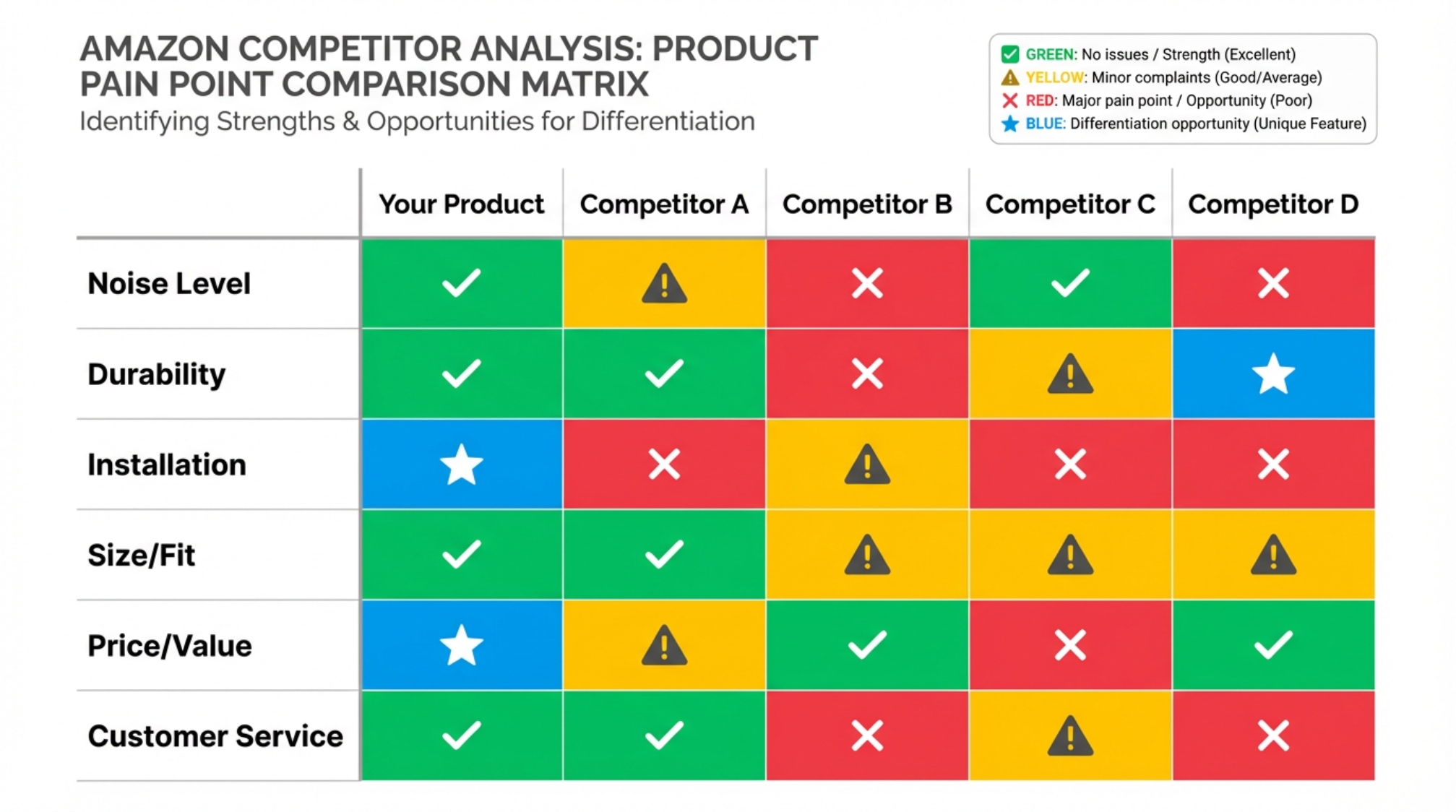
Build a "pain point matrix" (you vs. top competitors)
📋 Pain Point Matrix Template
| Issue | You | Comp A | Comp B |
|---|---|---|---|
| Durability | ✓ | ✗ | ✗ |
| Ease of Use | △ | ✓ | ✓ |
Identify "owned weaknesses" (competitors can't easily fix)
Look for flaws tied to core design, materials, or brand positioning. Example: A competitor's fan is powerful but loud because of its motor design. You can own "quietest".
Positioning angle: turn gaps into a clear promise
Examples:
- "The quietest desk fan on Amazon"
- "Easiest setup in under 2 minutes"
- "Fits perfectly under 95% of desks"
- "Built to last 3x longer"
Step 6: Validate Differentiation Before You Manufacture (Cheap Tests First)
Don't invest in tooling until you validate demand.
Validate with keyword demand (do buyers search for your improvement?)
Use SellerSprite's keyword tool to check search volume for phrases like "quiet desk fan".
Validate with PPC messaging tests (CTR/CVR on the promise)
Run Sponsored Brands ads with your new positioning. High CTR/CVR = market resonance.
Validate with small-batch or pre-launch feedback loops
Use Amazon Posts, social media, or email lists to test messaging before full production.
Common Mistakes When Using Reviews for Product Differentiation
Overreacting to outliers (one loud review ≠ market truth)
One 1-star review saying "worst product ever" doesn't mean your market is toxic. Look for patterns, not emotions.
Ignoring recency (old reviews may reflect old versions)
Focus on reviews from the last 6-12 months. Older reviews may refer to discontinued models.
Confusing preference with defect (e.g., "too firm" vs. "broken")
Not all negative feedback is a defect. "Too firm" is a preference; "fell apart" is a defect.
Copying competitor "fixes" that don't match your positioning
If you're the "budget" option, don't add expensive features. Stay true to your brand.
Mini Walkthrough: Review Analysis in 30 Minutes (Template)
Pick 3 competitors + pull 100 recent reviews each
Use SellerSprite's Review Analysis tool to extract reviews fast.
Tag into buckets + score frequency/severity
Apply the 5-bucket framework and use the scoring grid.
Produce 3 differentiation hypotheses
Example: "We can own 'quietest' by improving motor insulation."
Turn into actions: product spec + listing bullets + PPC angles
Close the loop: insights → execution.
⏱️ 30-Minute SOP: Review Analysis
- Collect: 3 competitors × 100 reviews
- Tag: Apply 5-bucket framework
- Score: Frequency × Severity
- Decide: Top 3 improvement ideas
- Implement: Update product or listing
FAQ
How can analyzing Amazon reviews help identify product differentiation opportunities?
By systematically analyzing reviews, you uncover recurring pain points, unmet needs, and competitor weaknesses. These insights reveal gaps in the market where you can improve durability, usability, or functionality, and as a result, turning customer frustrations into your product's unique selling points.
What tools are best for extracting customer sentiment from Amazon reviews?
SellerSprite's AI Review Analysis tool uses NLP to tag sentiment, extract keywords, and identify patterns across thousands of reviews. It's faster and more accurate than manual reading.
How do I use competitor review analysis to improve my product listing on Amazon?
Pull real phrases from 4-5 star reviews (e.g., "perfect for small spaces") and 1-2 star reviews (e.g., "too loud"). Use these in your title, bullets, and A+ content to address objections and highlight benefits in the customer's own words.
How many Amazon product reviews do I need to analyze for reliable insights?
For a fast scan, analyze 50-100 recent reviews per ASIN. For deep insights, go for 200-500 per competitor. More reviews increase pattern reliability, but focus on recency and relevance.
Can I use Amazon review phrases directly in my listing?
Yes, but ethically and legally. Use the language to inspire your copy, but don't quote verbatim without permission. Paraphrase customer sentiments (e.g., "customers love how quiet it is") and ensure all claims are truthful and defensible.
Next Steps
- Start your review analysis with SellerSprite's AI Review Analysis tool.
- Read our complete Amazon product research guide for more data-driven strategies.
References
- Amazon Product Research Guide View
- Unveiling SellerSprite's AI Review Analysis: Ultimate Helium10 & Jungle Scout Alternative View
- Review Analysis for Beginners View
By SellerSprite Success Team
The SellerSprite Success Team combines deep expertise in Amazon marketplace dynamics, AI-powered data analytics, and e-commerce growth strategy. With years of experience helping thousands of sellers, from beginners to enterprise brands, we deliver actionable, tested insights that drive product innovation, listing optimization, and sustainable sales growth. Our content is rooted in real-world data and designed to help you make smarter decisions faster.